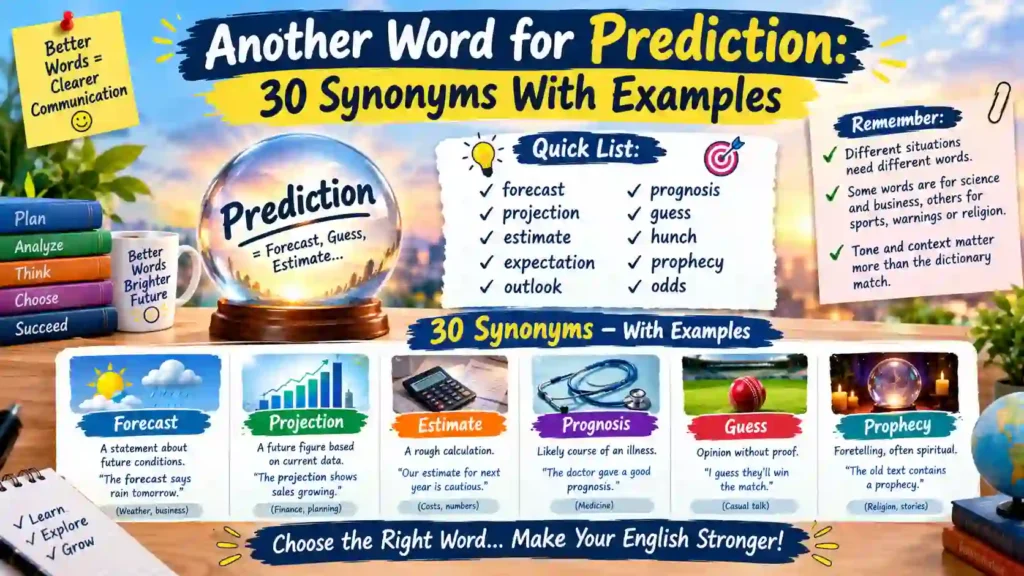
Another word for prediction is forecast. Other common choices are projection, estimate, expectation, prognosis, and prophecy. The best choice depends on the basis of the statement. Data points to a forecast, a medical outlook calls for a prognosis, and a feeling points to a guess.
Some alternatives suit science and business, while others suit sports, warnings, or religion. Therefore, tone and context matter more than the dictionary match.
Quick list: forecast, projection, estimate, expectation, outlook, prognosis, guess, hunch, prophecy, odds
Below, you will find 30 alternatives with meanings, IPA, usage notes, and examples.
At a Glance: Prediction Synonyms and Related Alternatives
| Alternative | Part of Speech | Meaning | Register / Tone | Ideal Context |
| Forecast | noun | Statement about future conditions | Neutral | Weather, business |
| Projection | noun | Future figure based on current data | Formal | Finance, planning |
| Estimate | noun | Rough calculation | Neutral | Costs, numbers |
| Prognosis | noun | Likely course of an illness | Formal | Medicine |
| Expectation | noun | Belief that something will happen | Neutral | General |
| Guess | noun | Opinion without proof | Informal | Casual talk |
| Hunch | noun | Feeling without evidence | Informal | Personal instinct |
| Prophecy | noun | Foretelling, often spiritual | Literary | Religion, stories |
| Outlook | noun | Expected future conditions | Neutral | Economy, careers |
| Extrapolation | noun | Prediction from known trends | Technical | Science, statistics |
Which Word Should You Use?
| If you want to… | Use | Why |
| Talk about weather or sales | Forecast | Based on data and patterns |
| Give numbers for the future | Projection | Suggests calculated figures |
| Describe a patient’s future | Prognosis | Standard medical term |
| Show you lack proof | Guess | Admits uncertainty |
| Describe a strange feeling | Hunch | Personal and instinctive |
| Write about destiny | Prophecy | Suggests insight beyond ordinary knowledge |
| Predict a winner | Pick | Sports and contests |
| Sound academic | Extrapolation | Points to a method |
Exploring the Multiple Meanings of Prediction
1. A Statement About the Future
- Meaning: A claim about what will happen.
- Explanation: This is the main sense. It can rest on evidence, experience, or opinion.
- Example: My prediction is that the team will win.
2. A Scientific Result
- Meaning: A result a theory says should occur.
- Explanation: Scientists test predictions through experiments. Here, a prediction is a testable claim rather than a guess.
- Example: The experiment confirmed the theory’s prediction.
3. A Forecast From Data
- Meaning: A future estimate produced by analysis or a model.
- Explanation: This sense is common in weather, economics, and computing.
- Example: The model’s prediction was close to the real number.
4. A Prophetic Statement
- Meaning: A foretelling thought to come from special insight.
- Explanation: In this sense, prophecy is usually the better word.
- Example: The old story contains a prediction about a flood.
Sources: Merriam-Webster; Collins Dictionary; Dictionary.com.
Analyzing 30 Prediction Alternatives in Detail
Some alternatives below are direct synonyms, while others are related words that fit only certain contexts.
Core Everyday and Professional Terms
1. Forecast
IPA: US /ˈfɔːrkæst/ · UK /ˈfɔːkɑːst/
Definition: A statement about expected future conditions.
- Usage: Closest everyday synonym; common in weather and business.
- Example: The forecast says rain tomorrow.
2. Projection
IPA: /prəˈdʒekʃn/ (US and UK)
Definition: An estimate of future amounts based on current data.
- Usage: Formal; related to prediction, but number-focused.
- Example: The projection shows sales growing ten percent.
3. Estimate
IPA: /ˈestɪmət/ (US and UK)
Definition: A rough judgment of size, cost, or amount.
- Usage: Related alternative; it often describes present values, not the future.
- Example: Our estimate for next year is cautious.
4. Expectation
IPA: /ˌekspekˈteɪʃn/ (US and UK)
Definition: A belief that something will happen.
- Usage: Close in meaning, but it stresses belief rather than a stated claim.
- Example: Her expectation was a quiet year.
5. Outlook
IPA: /ˈaʊtlʊk/ (US and UK)
Definition: The likely future condition of something.
- Usage: Neutral; common in economics and careers.
- Example: The job outlook looks strong.
6. Prognosis
IPA: US /prɑːɡˈnoʊsɪs/ · UK /prɒɡˈnəʊsɪs/
Definition: A forecast of the likely course of a disease.
- Usage: Medical term; figurative use is also possible.
- Example: The doctor gave a good prognosis.
Formal and Analytical Terms
7. Prognostication
IPA: US /prɑːɡˌnɑːstɪˈkeɪʃn/ · UK /prɒɡˌnɒstɪˈkeɪʃn/
Definition: The act of predicting the future.
- Usage: Very formal, sometimes humorous.
- Example: Endless prognostication did not help.
8. Extrapolation
IPA: /ɪkˌstræpəˈleɪʃn/ (US and UK)
Definition: A conclusion drawn by extending known trends.
- Usage: Technical; it names the method, so it is related rather than exact.
- Example: The extrapolation assumes steady growth.
9. Anticipation
IPA: /ænˌtɪsɪˈpeɪʃn/ (US and UK)
Definition: Looking ahead to something expected.
- Usage: Related word; it describes preparing or waiting, not stating.
- Example: She stocked food in anticipation of snow.
10. Foresight
IPA: US /ˈfɔːrsaɪt/ · UK /ˈfɔːsaɪt/
Definition: The ability to see what may happen.
- Usage: Related; it names a skill, not a statement.
- Example: His foresight saved the company.
Guess-Based Terms
11. Guess
IPA: /ɡes/ (US and UK)
Definition: An opinion formed without proof.
- Usage: Informal synonym for a weak prediction.
- Example: My guess is he’ll be late.
12. Conjecture
IPA: US /kənˈdʒektʃər/ · UK /kənˈdʒektʃə/
Definition: A conclusion based on incomplete evidence.
- Usage: Formal equivalent of guess.
- Example: Their theory is only conjecture.
13. Speculation
IPA: /ˌspekjuˈleɪʃn/ (US and UK)
Definition: Thinking about possibilities without firm knowledge.
- Usage: Related; often about rumors.
- Example: There is speculation about a merger.
14. Hunch
IPA: /hʌntʃ/ (US and UK)
Definition: A feeling that something is true or will happen.
- Usage: Informal; instinct-based.
- Example: I had a hunch she would call.
15. Bet
IPA: /bet/ (US and UK)
Definition: An informal opinion about what will happen.
- Usage: Casual; related, not a formal synonym.
- Example: My bet is on the home team.
Prophetic and Literary Terms
16. Prophecy
IPA: US /ˈprɑːfəsi/ · UK /ˈprɒfəsi/
Definition: A prediction of future events, often by divine insight.
- Usage: Literary or religious.
- Example: The prophecy came true.
17. Augury
IPA: /ˈɔːɡjəri/ (US and UK)
Definition: A sign of what will happen.
- Usage: Literary; related to omens.
- Example: Many saw the storm as a bad augury.
18. Omen
IPA: US /ˈoʊmən/ · UK /ˈəʊmən/
Definition: An event believed to show future good or evil.
- Usage: Related; it is a sign, not a statement.
- Example: The black cat felt like an omen.
19. Divination
IPA: /ˌdɪvɪˈneɪʃn/ (US and UK)
Definition: Seeking knowledge of the future by supernatural means.
- Usage: Related; it names the practice.
- Example: Ancient priests practiced divination.
20. Premonition
IPA: /ˌpriːməˈnɪʃn/ (US and UK)
Definition: A strong feeling about a coming event.
- Usage: Related; usually concerns something bad.
- Example: She had a premonition of trouble.
21. Foretelling
IPA: US /fɔːrˈtelɪŋ/ · UK /fɔːˈtelɪŋ/
Definition: The act of saying what will happen.
- Usage: Literary synonym.
- Example: The book is full of foretelling.
Sports, Betting, and Market Terms
22. Call
IPA: /kɔːl/ (US and UK)
Definition: A prediction about a result.
- Usage: Informal; common in sports and finance.
- Example: That was a bold call.
23. Pick
IPA: /pɪk/ (US and UK)
Definition: The choice of a likely winner.
- Usage: Contextual; used in contests.
- Example: Our pick is the red car.
24. Tip
IPA: /tɪp/ (US and UK)
Definition: A piece of advice about a likely result.
- Usage: Related; used in racing and betting.
- Example: He got a tip on the race.
25. Odds
IPA: US /ɑːdz/ · UK /ɒdz/
Definition: The chance that something will happen.
- Usage: Related; it measures chance rather than making a claim.
- Example: The odds favor the champion.
Warning and Likelihood Terms
26. Probability
IPA: US /ˌprɑːbəˈbɪləti/ · UK /ˌprɒbəˈbɪləti/
Definition: How likely something is to happen.
- Usage: Technical and related, not a synonym.
- Example: The probability of rain is low.
27. Forewarning
IPA: US /fɔːrˈwɔːrnɪŋ/ · UK /fɔːˈwɔːnɪŋ/
Definition: A warning given in advance.
- Usage: Related; it focuses on danger.
- Example: We had no forewarning of the flood.
28. Foreboding
IPA: US /fɔːrˈboʊdɪŋ/ · UK /fɔːˈbəʊdɪŋ/
Definition: A fear that something bad will happen.
- Usage: Literary; a feeling rather than a claim.
- Example: A sense of foreboding filled the room.
29. Presage
IPA: /ˈpresɪdʒ/ (US and UK)
Definition: A sign or warning of a future event.
- Usage: Formal and literary.
- Example: The cold wind was a presage of winter.
30. Prospect
IPA: US /ˈprɑːspekt/ · UK /ˈprɒspekt/
Definition: The possibility of a future event.
- Usage: Related; it describes something expected, not a statement.
- Example: The prospect of rain worried us.
Sources: Merriam-Webster; Collins Dictionary; Dictionary.com.
Prediction vs. Forecast vs. Prophecy
| Word | Basis | Typical Use |
| Prediction | Evidence, experience, or opinion | General |
| Forecast | Data and patterns | Weather, business |
| Prophecy | Special or spiritual insight | Religion, fiction |
In short, prediction is the widest term. Forecast adds method, while prophecy adds mystery.
Sources: Merriam-Webster; Collins Dictionary.
Prediction and Opposite/Paired Word Pairs
| Word | Paired Word | Note |
| Prediction | Outcome | The claim and what really happened |
| Prediction | Result | Often compared with a prediction |
| Prediction | Hindsight | Looking ahead vs. looking back |
| Prediction | Fact | Unproven claim vs. known truth |
Prediction has no true antonym. However, these words often appear beside it, because people compare a prediction with its outcome.
Sources: Collins Dictionary; Merriam-Webster.
Common Word Partners of Prediction
| Pattern | Common Partners | Example |
| Verb + prediction | make, confirm, test | Experts made a prediction. |
| Adjective + prediction | accurate, bold, gloomy | It was a bold prediction. |
| Prediction + noun | model, error | The prediction model improved. |
| Prediction + verb | come true, prove wrong | His prediction proved wrong. |
| Prediction + preposition | about, for | A prediction for next year |
Sources: Collins Dictionary; Oxford Collocations Dictionary.
Idiomatic Phrases Featuring Prediction
Prediction has few true idioms. Instead, these are established expressions.
1. Self-fulfilling prediction
- Meaning: A prediction that comes true because people believe it.
- Example: The bank panic became a self-fulfilling prediction.
2. Defy prediction
- Meaning: To turn out differently from what experts expected.
- Example: The young team defied every prediction.
3. Prediction market
- Meaning: A market where people trade on the outcomes of future events.
- Example: Traders watched the prediction market closely.
Sources: Merriam-Webster; Collins Dictionary.
Word Formation of Prediction
Etymology & Structure
Prediction comes from Latin, where prae means before. The related verb praedicere means foretell. The suffix -ion turns the action into a noun.
Date and History
Etymonline dates the verb predict to the 1620s. It says the verb may be a back formation from prediction, which suggests the noun is at least as old. An exact earlier date could not be verified here.
Word Class Variations
- Verb: predict, mispredict
- Noun: prediction, predictor, predictability
- Adjective: predictive, predictable, unpredictable
- Adverb: predictably
Sources: Etymonline; Dictionary.com; Merriam-Webster.
Common Word-Choice Mistakes
- Make a prediction, not do a prediction.
- A prediction about the weather, not of the weather in casual use; use forecast for formal weather reports.
- Medical prognosis, not medical forecast.
- A hunch is a feeling, not a scientific projection.
- Prophecy suggests spiritual insight, so avoid it for sales numbers.
- Use predict as the verb; prediction is a noun.
- Odds measure chance, so do not use them for a spoken claim.
Frequently Asked Questions
What is the closest synonym for prediction?
Forecast is the closest everyday synonym.
What is a formal alternative?
Prognostication or projection suits formal writing.
What is a literary alternative?
Prophecy, augury, or presage fit literary writing.
What is the difference between a prediction and a guess?
A guess has little evidence, while a prediction may rest on facts.
Is a prediction the same as a forecast?
Not always. A forecast is usually data-based.
What is the medical term?
Prognosis.
What is the opposite of prediction?
No true opposite exists; outcome or hindsight are common contrasts.
Conclusion
The closest alternatives to prediction are forecast, projection, estimate, expectation, and prophecy. Each fits a slightly different situation.
Context matters because words differ in basis and tone. For instance, a forecast uses data, a hunch uses instinct, and a prophecy suggests deeper insight.
To choose well, first ask how reliable the claim is. Next, consider your audience and setting. Finally, pick the word that matches your meaning.

Hi, I’m HAROON ,founder of LifeLoomer.com, I started LifeLoomer with one belief: the internet is full of answers, but not enough understanding. So I write guides that actually explain things the meanings behind everyday words, the small habits that make life better, and the how-tos nobody taught us.
Everything I publish is researched, written in plain words, and tested against one question: will this genuinely help someone today?
Thanks for being here. I hope you leave a little wiser than you came.