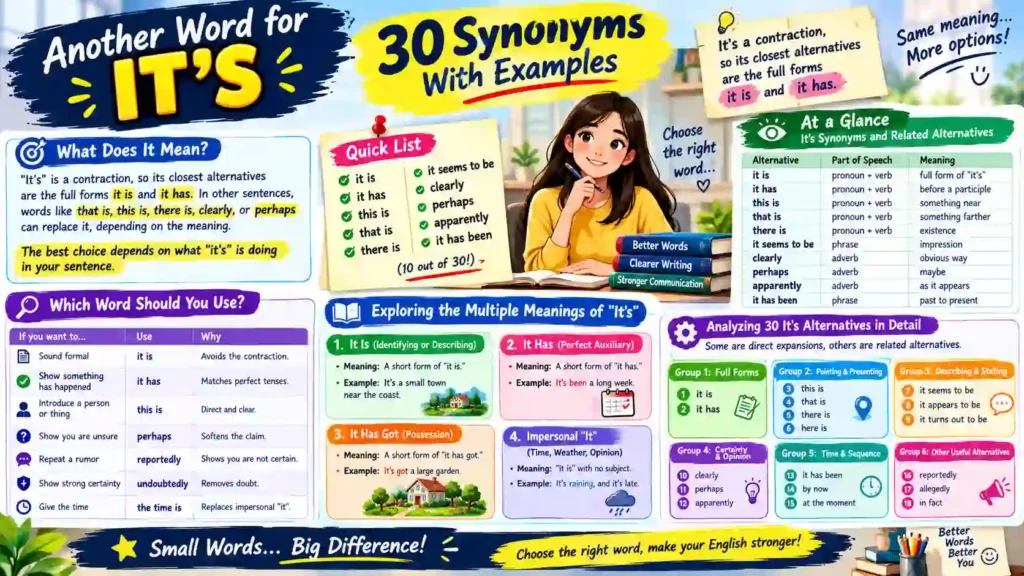
It’s is a contraction, so its closest alternatives are the full forms it is and it has. In other sentences, words like that is, this is, clearly, or perhaps can replace it, depending on the meaning.
The best choice depends on what it’s is doing in your sentence. It may name something, describe something, show certainty, or point to time and weather.
Quick list: it is, it has, this is, that is, there is, it seems to be, clearly, perhaps, apparently, it has been
This article covers 30 alternatives with meanings, IPA, usage notes, examples, and context.
At a Glance: It’s Synonyms and Related Alternatives
| Alternative | Part of Speech | Meaning | Register / Tone | Ideal Context |
| it is | pronoun + verb | full form of it’s | neutral, formal | writing, speeches |
| it has | pronoun + verb | full form of it’s before a participle | neutral, formal | perfect tenses |
| this is | pronoun + verb | points to something near | neutral | introductions |
| that is | pronoun + verb | points to something farther | neutral | explanations |
| there is | pronoun + verb | states existence | neutral | describing a scene |
| it seems to be | phrase | shows an impression | neutral | careful claims |
| clearly | adverb | in an obvious way | neutral | strong statements |
| perhaps | adverb | maybe | neutral | uncertainty |
| apparently | adverb | as it appears | neutral | reported facts |
| it has been | phrase | full form of it’s been | neutral | past-to-present |
Which Word Should You Use?
| If you want to… | Use | Why |
| Sound formal | it is | Avoids the contraction |
| Show something has happened | it has | Matches perfect tenses |
| Introduce a person or thing | this is | Direct and clear |
| Show you are unsure | perhaps | Softens the claim |
| Repeat a rumor | reportedly | Shows you are not certain |
| Show strong certainty | undoubtedly | Removes doubt |
| Give the time | the time is | Replaces impersonal it |
Exploring the Multiple Meanings of It’s
First, it’s is not a word with synonyms in the usual sense. It is a contraction, so each sense comes from the full form behind it.
1. It Is (Identifying or Describing)
- Meaning: A short form of it is.
- Explanation: This is the most common sense. It names or describes a thing.
- Example: It’s a small town near the coast.
2. It Has (Perfect Auxiliary)
- Meaning: A short form of it has before a past participle.
- Explanation: Context shows the difference. It’s finished can only mean it has finished when a participle follows an action.
- Example: It’s been a long week.
3. It Has Got (Possession)
- Meaning: A short form of it has got, mostly in everyday speech.
- Explanation: This is informal and common in British English.
- Example: It’s got a large garden.
4. Impersonal It (Time, Weather, Opinion)
- Meaning: It is with no real subject.
- Explanation: It does not refer to a thing here. It fills the subject slot.
- Example: It’s raining, and it’s late.
Sources: Merriam-Webster; Collins Dictionary; Cambridge Dictionary.
Analyzing 30 It’s Alternatives in Detail
Some alternatives below are direct expansions of it’s. Others are related alternatives that fit only certain meanings.
Group 1: Full Forms
1. it is
IPA: /ɪt ɪz/ (US and UK)
Definition: The uncontracted form of it’s.
- Usage: Exact expansion. Formal and neutral.
- Example: It is a clear morning.
2. it has
IPA: /ɪt hæz/ (US and UK)
Definition: The uncontracted form when it’s means it has.
- Usage: Exact expansion before a participle.
- Example: It has stopped snowing.
Group 2: Pointing and Presenting
3. this is
IPA: /ðɪs ɪz/ (US and UK)
Definition: Points to something near or just mentioned.
- Usage: Related, not identical. It adds nearness.
- Example: This is my sister.
4. that is
IPA: /ðæt ɪz/ (US and UK)
Definition: Points to something farther away or already mentioned.
- Usage: Related alternative. Often shortened to that’s.
- Example: That is the right answer.
5. there is
IPA: US /ðer ɪz/ · UK /ðeər ɪz/
Definition: States that something exists.
- Usage: Different meaning. Use it for existence, not identity.
- Example: There is a bakery nearby.
6. here is
IPA: US /hɪr ɪz/ · UK /hɪər ɪz/
Definition: Presents something to someone.
- Usage: Related alternative for offering or showing.
- Example: Here is your ticket.
Group 3: Describing and Stating
7. it seems to be
IPA: /ɪt siːmz tə biː/ (US and UK)
Definition: Gives an impression.
- Usage: Softer than it is. Not exact.
- Example: It seems to be broken.
8. it appears to be
IPA: US /ɪt əˈpɪrz tə biː/ · UK /ɪt əˈpɪəz tə biː/
Definition: Looks like something is true.
- Usage: More formal than it seems to be.
- Example: It appears to be a mistake.
9. it turns out to be
IPA: US /ɪt tɜːrnz aʊt tə biː/ · UK /ɪt tɜːnz aʊt tə biː/
Definition: Proves to be true after discovery.
- Usage: Related alternative for surprises.
- Example: It turns out to be easy.
10. it happens to be
IPA: /ɪt ˈhæpənz tə biː/ (US and UK)
Definition: Is so by chance.
- Usage: Related alternative that stresses coincidence.
- Example: It happens to be my birthday.
11. it remains
IPA: /ɪt rɪˈmeɪnz/ (US and UK)
Definition: Continues to be.
- Usage: Formal. Used with adjectives.
- Example: It remains unclear.
12. it proves to be
IPA: /ɪt pruːvz tə biː/ (US and UK)
Definition: Is shown to be.
- Usage: Formal. Common in reports.
- Example: It proves to be useful.
Group 4: Certainty and Opinion
13. clearly
IPA: US /ˈklɪrli/ · UK /ˈklɪəli/
Definition: In a way that is easy to see.
- Usage: Replaces it’s clear that.
- Example: Clearly, the plan worked.
14. obviously
IPA: US /ˈɑːbviəsli/ · UK /ˈɒbviəsli/
Definition: In a way that is easy to notice.
- Usage: Replaces it’s obvious that. Can sound blunt.
- Example: Obviously, we need more time.
15. evidently
IPA: /ˈevɪdəntli/ (US and UK)
Definition: As the evidence shows.
- Usage: Formal. Stronger than apparently.
- Example: Evidently, he left early.
16. apparently
IPA: /əˈpærəntli/ (US and UK)
Definition: According to what seems true or what people say.
- Usage: Replaces it’s said that. Not fully certain.
- Example: Apparently, the road is closed.
17. certainly
IPA: US /ˈsɜːrtnli/ · UK /ˈsɜːtnli/
Definition: Without doubt.
- Usage: Replaces it’s certain that.
- Example: It is certainly possible.
18. undoubtedly
IPA: /ʌnˈdaʊtɪdli/ (US and UK)
Definition: Without any doubt.
- Usage: Strong and formal.
- Example: Undoubtedly, she is the best choice.
19. indeed
IPA: /ɪnˈdiːd/ (US and UK)
Definition: In fact; truly.
- Usage: Related alternative that confirms a statement.
- Example: It is indeed true.
Group 5: Possibility and Reporting
20. perhaps
IPA: US /pərˈhæps/ · UK /pəˈhæps/
Definition: Maybe.
- Usage: Replaces it’s possible that.
- Example: Perhaps we should wait.
21. possibly
IPA: US /ˈpɑːsəbli/ · UK /ˈpɒsəbli/
Definition: In a way that could happen.
- Usage: Replaces it’s possible that. Fits formal writing.
- Example: She is possibly right.
22. probably
IPA: US /ˈprɑːbəbli/ · UK /ˈprɒbəbli/
Definition: Most likely.
- Usage: Replaces it’s likely that. Stronger than possibly.
- Example: It will probably rain.
23. reportedly
IPA: US /rɪˈpɔːrtɪdli/ · UK /rɪˈpɔːtɪdli/
Definition: According to reports.
- Usage: Replaces it’s reported that. Common in news.
- Example: The deal is reportedly complete.
24. allegedly
IPA: /əˈledʒɪdli/ (US and UK)
Definition: Claimed but not proven.
- Usage: Replaces it’s alleged that. Often legal.
- Example: He allegedly took the money.
25. supposedly
IPA: US /səˈpoʊzɪdli/ · UK /səˈpəʊzɪdli/
Definition: According to what people believe.
- Usage: Can show doubt. Informal.
- Example: Supposedly, it is safe.
Group 6: Time, Weather and Fixed Uses
26. it has been
IPA: /ɪt hæz bɪn/ (US and UK)
Definition: Full form of it’s been.
- Usage: Exact expansion. Links past to now.
- Example: It has been a busy year.
27. it has got
IPA: US /ɪt hæz ɡɑːt/ · UK /ɪt hæz ɡɒt/
Definition: Full form of it’s got.
- Usage: Exact expansion. More common in British English.
- Example: It has got two doors.
28. the time is
IPA: /ðə taɪm ɪz/ (US and UK)
Definition: States the hour.
- Usage: Replaces it’s in time statements.
- Example: The time is half past six.
29. the weather is
IPA: US /ðə ˈweðər ɪz/ · UK /ðə ˈweðə ɪz/
Definition: Describes outdoor conditions.
- Usage: Related alternative to it’s sunny.
- Example: The weather is cold today.
30. the time has come
IPA: /ðə taɪm hæz kʌm/ (US and UK)
Definition: The right moment has arrived.
- Usage: Replaces it’s time in formal speech.
- Example: The time has come to decide.
Sources: Merriam-Webster; Collins Dictionary; Collins Thesaurus; Dictionary.com.
It’s vs. Its
Many writers mix these two. However, they have different jobs.
| Form | Meaning | Example |
| it’s | it is / it has | It’s late. |
| its | belonging to it | The cat licked its paw. |
A simple test helps. If you can say it is or it has, use it’s.
Sources: Merriam-Webster; Cambridge Dictionary.
It’s and Opposite/Paired Word Pairs
| Word | Paired Word | Note |
| it’s | it isn’t | Positive and negative |
| it’s | its | Contraction vs. possessive |
| it’s | that’s | Near vs. far reference |
| it is | it is not | Formal pair |
| it has | it has not | Perfect tense pair |
It’s has no true antonym. Instead, the useful pairs are its negative forms and its look-alikes.
Sources: Collins Dictionary; Merriam-Webster.
Common Word Partners of It’s
| Pattern | Common Partners | Example |
| it’s + time word | time, late, early | It’s time to go. |
| it’s + adjective | okay, true, important | It’s important to rest. |
| it’s + a/an + noun | a shame, a deal | It’s a shame. |
| it’s + been | a while, a year | It’s been a while. |
| it’s + worth | trying, it | It’s worth trying. |
Sources: Collins Dictionary; Cambridge Dictionary.
Idiomatic Phrases Featuring It’s
1. It’s about time
- Meaning: Something should have happened sooner.
- Example: It’s about time you called me.
2. It’s a small world
- Meaning: People meet in surprising places.
- Example: We met in Rome. It’s a small world.
3. It’s not rocket science
- Meaning: Something is easy to understand.
- Example: Just follow the steps. It’s not rocket science.
4. It’s raining cats and dogs
- Meaning: It is raining very hard.
- Example: Bring an umbrella. It’s raining cats and dogs.
Sources: Merriam-Webster; Cambridge Dictionary.
Word Formation of It’s
Etymology & Structure
It’s joins it and is or has. An apostrophe marks the missing letters. According to Etymonline, it comes from Old English hit.
Date and History
An exact first date for the contraction it’s is not reliably documented in the sources checked, so none is given here.
Word Class Variations
- Pronoun + verb: it’s (it is / it has)
- Related form: its (possessive determiner)
- Negative forms: it isn’t, it hasn’t
Sources: Etymonline; Merriam-Webster.
Common Word-Choice Mistakes
- Its raining: use It’s raining.
- The dog wagged it’s tail: use its tail.
- Its been a long day: use It’s been a long day.
- It’s a formal letter, so I wrote it’s: write it is in formal writing.
- Thats right: use That’s right.
- It’s yesterday: use It was yesterday.
- It’s had for possession: use It has or It’s got.
Frequently Asked Questions
1. What is another word for it’s?
The closest forms are it is and it has.
2. Is it’s a word?
Yes. It is a standard contraction.
3. What does it’s stand for?
It stands for it is or it has.
4. What is the difference between it’s and its?
It’s means it is or it has. Its shows ownership.
5. Is it’s formal?
It is acceptable in most writing. In very formal writing, use it is.
6. Can it’s mean it has?
Yes, when a past participle follows, as in It’s been.
7. What is a formal alternative?
It is is the standard formal choice.
Conclusion
The closest alternatives to it’s are it is and it has. Other words, such as this is, clearly, and perhaps, work only in certain sentences.
Meaning and context decide the right choice. Impersonal it needs different treatment from it’s before a participle, and tone matters too.
To choose well, first expand it’s to its full form. Then check If another word fits the tone and meaning better.

Hi, I’m HAROON ,founder of LifeLoomer.com, I started LifeLoomer with one belief: the internet is full of answers, but not enough understanding. So I write guides that actually explain things the meanings behind everyday words, the small habits that make life better, and the how-tos nobody taught us.
Everything I publish is researched, written in plain words, and tested against one question: will this genuinely help someone today?
Thanks for being here. I hope you leave a little wiser than you came.