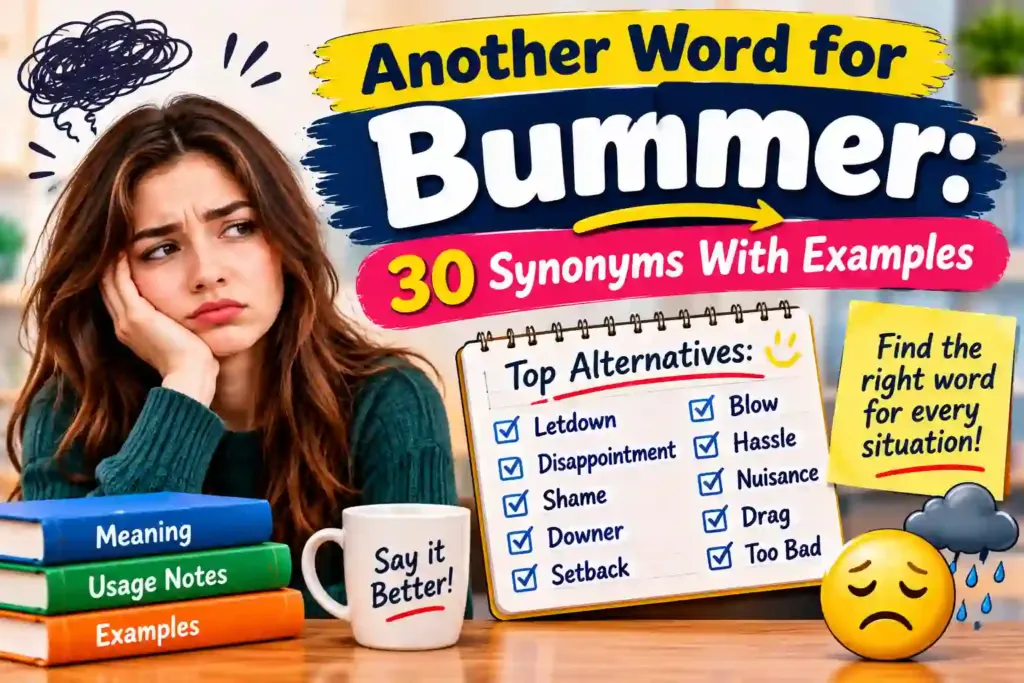
The closest everyday alternatives to bummer are letdown, disappointment, shame, and downer. If you only need a quick reaction, too bad or darn works. The best choice depends on If you mean a disappointing event, an annoying task, or a spoken reaction.
Bummer is informal. It can name a sad or frustrating situation, or work as an exclamation. For formal writing, words like setback or misfortune fit better.
Quick list: letdown, disappointment, shame, downer, setback, blow, hassle, nuisance, drag, too bad
Below, you will find 30 alternatives with meanings, IPA, usage notes, and examples, grouped by context.
At a Glance: Bummer Synonyms and Related Alternatives
| Alternative | Part of Speech | Meaning | Register / Tone | Ideal Context |
| Letdown | Noun | Disappointing event | Neutral | Everyday talk |
| Disappointment | Noun | Failed hope | Neutral | General writing |
| Shame | Noun | Regrettable thing | Neutral | Mild regret |
| Downer | Noun | Depressing thing | Informal | Casual chat |
| Drag | Noun | Boring or annoying thing | Informal | Casual chat |
| Setback | Noun | Delay or problem | Neutral | Work, plans |
| Blow | Noun | Sudden shock | Neutral | Serious news |
| Hassle | Noun | Irritating effort | Informal | Daily tasks |
| Misfortune | Noun | Bad luck | Formal | Writing |
| Too bad | Phrase | Expression of regret | Informal | Quick replies |
Which Word Should You Use?
| If you want to… | Use | Why |
| React quickly to bad news | Too bad | Short and natural |
| Describe a failed hope | Letdown | Focuses on expectation |
| Write a formal email | Setback | Neutral and professional |
| Describe a sad mood-killer | Downer | Matches the casual tone |
| Complain about a chore | Hassle | Suggests effort and annoyance |
| Show mild sympathy | Shame | Gentle and polite |
| Describe serious bad luck | Misfortune | Fits heavier situations |
| Avoid strong language | Darn | Soft, harmless exclamation |
Exploring the Multiple Meanings of Bummer
1. A Disappointing Experience
- Meaning: An unpleasant or disappointing situation.
- Explanation: This is the main modern sense. It is casual and usually mild.
- Example: Missing the last train was a real bummer.
2. An Exclamation of Disappointment
- Meaning: A word used to show annoyance or regret.
- Explanation: Here, bummer works like an interjection and often stands alone.
- Example: We have a test tomorrow. Bummer!
3. A Bad Drug Experience
- Meaning: A bad reaction to a hallucinogenic drug.
- Explanation: This sense is dated and rare today.
- Example: The festival story ended as a bummer for one guest.
4. A Loafer or Idler
- Meaning: A person who avoids work or lives off others.
- Explanation: This older sense is now rare and has little connection to the modern one.
- Example: The old novel called him a bummer.
Sources: Dictionary.com (including Collins English Dictionary); WordWeb; Etymonline; Merriam-Webster.
Analyzing 30 Bummer Alternatives in Detail
Some of these are close synonyms, while others are related alternatives that fit only certain contexts.
Core Everyday Alternatives
1. Letdown
IPA: /ˈlɛtˌdaʊn/ (US and UK)
Definition: Something disappointing after high hopes.
- Usage: A close synonym. It stresses unmet expectations.
- Example: The final episode was a letdown.
2. Disappointment
IPA: /ˌdɪsəˈpɔɪntmənt/ (US and UK)
Definition: The feeling or cause of failed hopes.
- Usage: A close, slightly more neutral synonym.
- Example: The cancelled trip was a big disappointment.
3. Shame
IPA: /ʃeɪm/ (US and UK)
Definition: A regrettable situation (in this sense).
- Usage: Related, not exact. It is gentler and often used in What a shame.
- Example: It’s a shame you can’t come.
4. Pity
IPA: US /ˈpɪɾi/ · UK /ˈpɪti/
Definition: A cause for regret.
- Usage: Related. It is slightly more formal than shame.
- Example: It’s a pity the shop closed.
5. Downer
IPA: US /ˈdaʊnər/ · UK /ˈdaʊnə/
Definition: A depressing person, event, or situation.
- Usage: A close informal synonym with a gloomy tone.
- Example: The news was a real downer.
6. Drag
IPA: /dræɡ/ (US and UK)
Definition: A boring or annoying thing.
- Usage: Informal and related. It suggests tiredness more than sadness.
- Example: Waiting in line is such a drag.
Setbacks and Bad Luck
7. Setback
IPA: /ˈsɛtˌbæk/ (US and UK)
Definition: A problem that slows progress.
- Usage: Related. It works well in neutral or professional writing.
- Example: The delay was a minor setback.
8. Blow
IPA: US /bloʊ/ · UK /bləʊ/
Definition: A sudden shock or disappointment.
- Usage: Stronger than bummer.
- Example: Losing the contract was a blow.
9. Misfortune
IPA: US /mɪsˈfɔːrtʃən/ · UK /mɪsˈfɔːtʃuːn/
Definition: Bad luck or an unlucky event.
- Usage: Formal and more serious than bummer.
- Example: He bore his misfortune calmly.
10. Mishap
IPA: /ˈmɪsˌhæp/ (US and UK)
Definition: A minor unlucky accident.
- Usage: Related. It suits small, harmless accidents.
- Example: A small mishap delayed lunch.
11. Snag
IPA: /snæɡ/ (US and UK)
Definition: A hidden or unexpected problem.
- Usage: Related. It describes obstacles, not feelings.
- Example: We hit a snag with the paperwork.
12. Reverse
IPA: US /rɪˈvɜːrs/ · UK /rɪˈvɜːs/
Definition: A change for the worse.
- Usage: Formal and related. It appears in business or sports writing.
- Example: The team suffered a reverse in the final.
Annoyance and Inconvenience
13. Nuisance
IPA: US /ˈnuːsəns/ · UK /ˈnjuːsəns/
Definition: Something that causes trouble or annoyance.
- Usage: Related. It fits annoying tasks, not sad news.
- Example: The noise is a nuisance.
14. Hassle
IPA: /ˈhæsəl/ (US and UK)
Definition: An irritating difficulty or effort.
- Usage: Informal and related. It focuses on effort.
- Example: Renewing the form is a hassle.
15. Pain
IPA: /peɪn/ (US and UK)
Definition: An annoying person or task (informal).
- Usage: Related, as in a pain in the neck.
- Example: The long forms are a pain.
16. Headache
IPA: /ˈhɛdˌeɪk/ (US and UK)
Definition: A source of ongoing trouble.
- Usage: Figurative and related.
- Example: Parking here is a headache.
17. Bore
IPA: US /bɔːr/ · UK /bɔː/
Definition: A dull, tiresome thing.
- Usage: Related. Use it only when the problem is boredom.
- Example: Filing reports is a bore.
18. Irritation
IPA: /ˌɪrɪˈteɪʃən/ (US and UK)
Definition: A source of annoyance.
- Usage: Related and neutral, but milder in emotion.
- Example: The delay was a minor irritation.
Spoken Reactions
19. Darn
IPA: US /dɑːrn/ · UK /dɑːn/
Definition: A mild exclamation of annoyance.
- Usage: Informal and polite. It works as an interjection.
- Example: Darn, I forgot my keys.
20. Drat
IPA: /dræt/ (US and UK)
Definition: A mild, old-fashioned exclamation.
- Usage: Dated and humorous.
- Example: Drat, the bus just left.
21. Shoot
IPA: /ʃuːt/ (US and UK)
Definition: A mild exclamation replacing stronger words.
- Usage: Informal, mainly American.
- Example: Shoot, I missed the call.
22. Rats
IPA: /ræts/ (US and UK)
Definition: An exclamation of mild annoyance.
- Usage: Old-fashioned and light.
- Example: Rats, it’s raining again.
23. Too bad
IPA: /tuː ˈbæd/ (US and UK)
Definition: A phrase expressing regret.
- Usage: The closest short reply. It can sound uncaring if said in the wrong tone.
- Example: Too bad you missed it.
Formal and Descriptive Alternatives
24. Adversity
IPA: US /ædˈvɜːrsəti/ · UK /ədˈvɜːsəti/
Definition: Serious difficulty or hardship.
- Usage: Formal and much stronger than bummer.
- Example: She faced adversity with courage.
25. Regrettable
IPA: US /rɪˈɡrɛɾəbəl/ · UK /rɪˈɡrɛtəbəl/
Definition: Deserving regret.
- Usage: A formal adjective. Use it instead of a bummer in emails.
- Example: The delay is regrettable.
26. Unfortunate
IPA: US /ʌnˈfɔːrtʃənət/ · UK /ʌnˈfɔːtʃənət/
Definition: Unlucky or regrettable.
- Usage: A neutral adjective that is polite and common.
- Example: It was an unfortunate mistake.
27. Disheartening
IPA: US /dɪsˈhɑːrtənɪŋ/ · UK /dɪsˈhɑːtənɪŋ/
Definition: Causing loss of hope or confidence.
- Usage: An adjective with stronger emotion.
- Example: The results were disheartening.
28. Discouraging
IPA: US /dɪsˈkɜːrɪdʒɪŋ/ · UK /dɪsˈkʌrɪdʒɪŋ/
Definition: Reducing confidence or motivation.
- Usage: An adjective that fits effort and progress.
- Example: The slow progress was discouraging.
29. Frustration
IPA: /frʌˈstreɪʃən/ (US and UK)
Definition: Annoyance caused by obstacles.
- Usage: Related. It names the feeling, not the event.
- Example: The delay caused frustration.
30. Calamity
IPA: US /kəˈlæməɾi/ · UK /kəˈlæməti/
Definition: A major disaster.
- Usage: Much stronger than bummer. Use it only for serious events.
- Example: The flood was a calamity.
Sources: Dictionary.com; Merriam-Webster; Collins (via Dictionary.com); WordWeb.
Bummer vs. Letdown vs. Downer vs. Drag
| Word | Main Focus | Best For |
| Bummer | Casual disappointment | Everyday chat |
| Letdown | Broken expectations | Events, products |
| Downer | Gloomy mood | Sad news, people |
| Drag | Boredom or effort | Tasks, plans |
Choose the word that matches the problem. If hopes failed, use letdown. If the mood turned sad, use downer.
Sources: Dictionary.com; Merriam-Webster.
Bummer and Opposite/Paired Word Pairs
| Word | Paired Word | Note |
| Bummer | Stroke of luck | Natural contrast |
| Bummer | Delight | Emotional opposite |
| Bummer | Win | Casual contrast |
| Bummer | Relief | Good outcome after worry |
Bummer has no strict antonym. Instead, speakers usually contrast it with good luck or happiness.
Sources: Merriam-Webster; Dictionary.com.
Common Word Partners of Bummer
| Pattern | Common Partners | Example |
| Intensifier + bummer | total, real, major | That’s a total bummer. |
| Such a + bummer | such a bummer | It was such a bummer to lose him. |
| What a + bummer | what a bummer | What a bummer! |
| Bummer + that | bummer that | It’s a bummer that it rained. |
| Kind of a + bummer | kind of a bummer | The ending was kind of a bummer. |
Sources: Dictionary.com usage examples.
Idiomatic Phrases Featuring Bummer
Bummer has few true idioms. These are established expressions.
1. What a bummer!
- Meaning: An exclamation of disappointment or sympathy.
- Example: What a bummer, the concert is sold out.
2. Not to be a bummer, but…
- Meaning: A polite warning before sharing bad news.
- Example: Not to be a bummer, but we’re out of time.
3. Bummed out
- Meaning: Feeling sad or disappointed. This form comes from the verb bum.
- Example: She was bummed out about the cancellation.
4. Bummer!
- Meaning: A one-word reaction to bad news.
- Example: I lost my phone. Bummer!
Sources: Dictionary.com; Merriam-Webster.
Word Formation of Bummer
Etymology & Structure
For the disappointment sense, Dictionary.com says bummer apparently comes from bum (adjective) plus -er. The older loafer sense likely comes from German Bummler, according to Merriam-Webster.
Date and History
Etymonline records the loafer sense from 1855. Dictionary.com dates the disappointment sense to around 1965–70.
Word Class Variations
- Noun: a bummer
- Interjection: Bummer!
- Related adjective: bummed (usually bummed out)
- Related verb: bum (to depress), as in bum someone out
Sources: Dictionary.com; Etymonline; Merriam-Webster; Oxford University Press blog.
Common Word-Choice Mistakes
- The test was bummer: say The test was a bummer.
- I am bummer: say I am bummed.
- I’m bum out: say I’m bummed out.
- We regret the bummer in a formal email: say We regret the inconvenience.
- What a bummer at a funeral: say I’m so sorry for your loss.
- The war was a bummer: say tragedy or calamity.
Frequently Asked Questions
What is the closest synonym for bummer?
Letdown is closest in meaning, followed by disappointment.
Is bummer formal?
No. It is informal and best for casual speech.
What is a formal alternative?
Setback, misfortune, or regrettable work better in formal writing.
What is the difference between bummer and shame?
Bummer is more casual, while shame sounds gentler and more polite.
Can bummer be an exclamation?
Yes. People often say Bummer! to react to bad news.
What is a mild exclamation instead?
Darn, shoot, and drat are soft options.
What is the opposite of bummer?
There is no exact opposite. Stroke of luck or delight are common contrasts.
Conclusion
The closest alternatives to bummer are letdown, disappointment, shame, and downer. Each carries a slightly different tone, so none replaces bummer in every sentence.
Context matters most. Hassle suits annoying tasks, setback suits plans, and calamity suits serious disasters. For quick reactions, too bad and darn fit best.
To choose well, ask what went wrong, how serious it is, and who will read your words. Then pick the word that matches the situation and tone.

Hi, I’m HAROON ,founder of LifeLoomer.com, I started LifeLoomer with one belief: the internet is full of answers, but not enough understanding. So I write guides that actually explain things the meanings behind everyday words, the small habits that make life better, and the how-tos nobody taught us.
Everything I publish is researched, written in plain words, and tested against one question: will this genuinely help someone today?
Thanks for being here. I hope you leave a little wiser than you came.