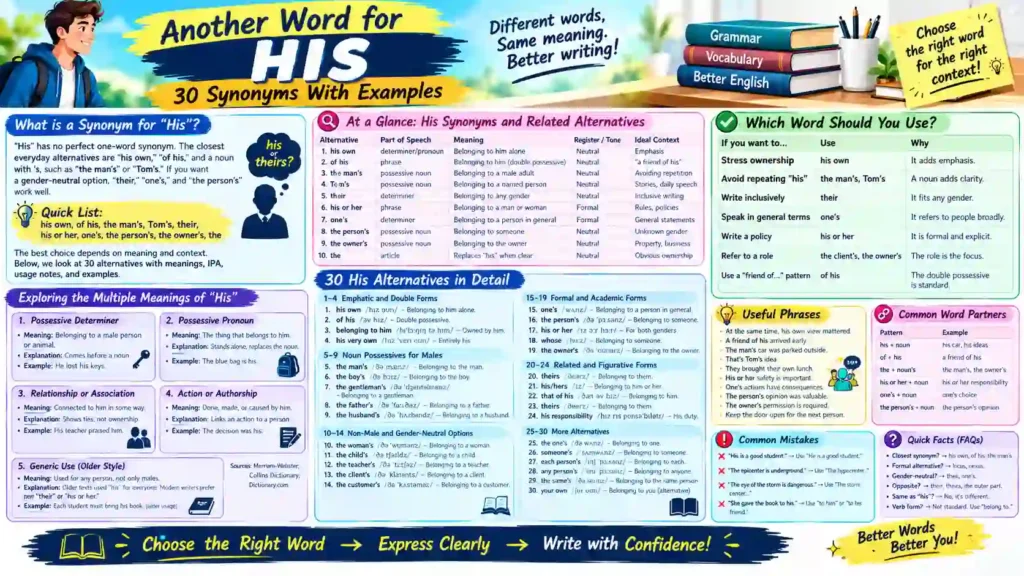
His has no perfect one-word synonym. The closest everyday alternatives are his own, of his, and a noun with ‘s, such as the man’s or Tom’s. If you want a gender-neutral option, their, one’s, and the person’s work well.
The best choice depends on meaning and context. His can show ownership, a relationship, or an action, so the right substitute changes with each use. Moreover, formal writing and inclusive writing often call for different forms.
Quick list: his own, of his, the man’s, Tom’s, their, his or her, one’s, the person’s, the owner’s, the
Below, we look at 30 alternatives with meanings, IPA, usage notes, and examples.
At a Glance: His Synonyms and Related Alternatives
| Alternative | Part of Speech | Meaning | Register / Tone | Ideal Context |
| his own | determiner/pronoun | Belonging to him alone | Neutral | Emphasis |
| of his | phrase | Belonging to him (double possessive) | Neutral | a friend of his |
| the man’s | possessive noun | Belonging to a male adult | Neutral | Avoiding repetition |
| Tom’s | possessive noun | Belonging to a named person | Neutral | Stories, daily speech |
| their | determiner | Belonging to a person of any gender | Neutral | Inclusive writing |
| his or her | phrase | Belonging to a man or woman | Formal | Rules, policies |
| one’s | determiner | Belonging to a person in general | Formal | General statements |
| the person’s | possessive noun | Belonging to someone | Neutral | Unknown gender |
| the owner’s | possessive noun | Belonging to the owner | Neutral | Property, business |
| the | article | Replaces his when ownership is clear | Neutral | Obvious ownership |
Which Word Should You Use?
| If you want to… | Use | Why |
| Stress ownership | his own | It adds emphasis. |
| Avoid repeating his | the man’s, Tom’s | A noun adds clarity. |
| Write inclusively | their | It fits any gender. |
| Speak in general terms | one’s | It refers to people broadly. |
| Write a policy | his or her | It is formal and explicit. |
| Refer to a role | the client’s, the owner’s | The role is the focus. |
| Use a friend of… pattern | of his | The double possessive is standard. |
Exploring the Multiple Meanings of His
1. Possessive Determiner
- Meaning: Belonging to a male person or animal.
- Explanation: His comes before a noun and shows ownership.
- Example: He lost his keys.
2. Possessive Pronoun
- Meaning: The thing that belongs to him.
- Explanation: Here, his stands alone and replaces the noun.
- Example: The blue bag is his.
3. Relationship or Association
- Meaning: Connected to him in some way.
- Explanation: It shows ties that are not ownership.
- Example: His teacher praised him.
4. Action or Authorship
- Meaning: Done, made, or caused by him.
- Explanation: It links an action or result to a person.
- Example: The decision was his.
5. Generic Use (Older Style)
- Meaning: Used for any person, not only males.
- Explanation: Older texts used his for everyone. Modern writers usually prefer their or his or her.
- Example: Each student must bring his book. (older usage)
Sources: Merriam-Webster, Collins Dictionary, Dictionary.com
Analyzing 30 His Alternatives in Detail
Some alternatives below are direct replacements, while others are related options that fit only certain contexts.
Emphatic and Double Forms
1. his own
IPA: US /hɪz oʊn/ · UK /hɪz əʊn/
Definition: Belonging to him and no one else.
- Usage: A direct, emphatic form of his. Neutral register.
- Example: He cooked his own dinner.
2. of his
IPA: (US and UK) /əv hɪz/
Definition: Belonging to or linked with him.
- Usage: A double possessive used after a noun, not before it.
- Example: A cousin of his called today.
3. belonging to him
IPA: US /bɪˈlɔːŋɪŋ tə hɪm/ · UK /bɪˈlɒŋɪŋ tə hɪm/
Definition: Owned by or part of him.
- Usage: A wordy, formal rewrite of his. Common in lists and notices.
- Example: The bag belonging to him was found.
4. his very own
IPA: US /hɪz ˈvɛri oʊn/ · UK /hɪz ˈveri əʊn/
Definition: Entirely and especially his.
- Usage: A stronger, informal version of his own.
- Example: At last, he had his very own room.
Noun Possessives for Males
5. the man’s
IPA: (US and UK) /ðə mænz/
Definition: Belonging to the man.
- Usage: Replaces his when the man has already been mentioned.
- Example: The man’s coat was wet.
6. the boy’s
IPA: (US and UK) /ðə bɔɪz/
Definition: Belonging to the boy.
- Usage: Limited to a young male.
- Example: The boy’s bike was new.
7. the gentleman’s
IPA: (US and UK) /ðə ˈdʒɛntəlmənz/
Definition: Belonging to the gentleman.
- Usage: Polite and formal. It sounds old-fashioned in casual speech.
- Example: The gentleman’s hat was on the chair.
8. the father’s
IPA: US /ðə ˈfɑðərz/ · UK /ðə ˈfɑːðəz/
Definition: Belonging to the father.
- Usage: A role-based option. It fits only when his means a father.
- Example: The father’s advice helped her.
9. the husband’s
IPA: (US and UK) /ðə ˈhʌzbəndz/
Definition: Belonging to the husband.
- Usage: Works only when the person is a husband.
- Example: The husband’s car was parked outside.
Names and Titles
10. Tom’s
IPA: US /tɑmz/ · UK /tɒmz/
Definition: Belonging to Tom (any name plus ‘s).
- Usage: The most common everyday alternative in stories.
- Example: Tom’s idea won.
11. Mr. Smith’s
IPA: US /ˈmɪstər smɪθs/ · UK /ˈmɪstə smɪθs/
Definition: Belonging to Mr. Smith.
- Usage: Polite and professional.
- Example: Mr. Smith’s office is upstairs.
12. the doctor’s
IPA: US /ðə ˈdɑktərz/ · UK /ðə ˈdɒktəz/
Definition: Belonging to the doctor.
- Usage: A role-based option. It does not show gender.
- Example: The doctor’s advice was clear.
13. the owner’s
IPA: US /ðə ˈoʊnərz/ · UK /ðə ˈəʊnəz/
Definition: Belonging to the owner.
- Usage: Common for property and business.
- Example: The owner’s name is on the sign.
14. the author’s
IPA: US /ðə ˈɔθərz/ · UK /ðə ˈɔːθəz/
Definition: Belonging to the writer.
- Usage: Fits books and articles.
- Example: The author’s style is simple.
Gender-Neutral Alternatives
15. their
IPA: US /ðɛr/ · UK /ðeə/
Definition: Belonging to them, or to one person of unknown gender.
- Usage: Singular their is widely accepted. It is not an exact synonym of his.
- Example: Each guest left their coat.
16. his or her
IPA: US /hɪz ɔr hɜr/ · UK /hɪz ɔː hɜː/
Definition: Belonging to a man or a woman.
- Usage: Formal and inclusive, though it can sound heavy.
- Example: Every driver must show his or her licence.
17. one’s
IPA: (US and UK) /wʌnz/
Definition: Belonging to a person in general.
- Usage: Formal. It sounds stiff in casual speech.
- Example: One should respect one’s elders.
18. the person’s
IPA: US /ðə ˈpɜrsənz/ · UK /ðə ˈpɜːsənz/
Definition: Belonging to the person.
- Usage: Neutral, and useful when gender is unknown.
- Example: The person’s bag was left behind.
19. the individual’s
IPA: (US and UK) /ðə ˌɪndɪˈvɪdʒuəlz/
Definition: Belonging to a single person.
- Usage: Formal, common in reports and law.
- Example: The individual’s rights are protected.
Formal and Reference Forms
20. the subject’s
IPA: (US and UK) /ðə ˈsʌbdʒɪkts/
Definition: Belonging to the person being studied.
- Usage: A technical term for research. It is not a general synonym.
- Example: The subject’s answers were recorded.
21. the latter’s
IPA: US /ðə ˈlætərz/ · UK /ðə ˈlætəz/
Definition: Belonging to the second person mentioned.
- Usage: Formal. It points back to one of two people.
- Example: The latter’s reply was short.
22. the former’s
IPA: US /ðə ˈfɔrmərz/ · UK /ðə ˈfɔːməz/
Definition: Belonging to the first person mentioned.
- Usage: Formal, and the pair of the latter’s.
- Example: The former’s plan was better.
23. the client’s
IPA: (US and UK) /ðə ˈklaɪənts/
Definition: Belonging to the client.
- Usage: Business and legal contexts.
- Example: The client’s file is ready.
24. the patient’s
IPA: (US and UK) /ðə ˈpeɪʃənts/
Definition: Belonging to the patient.
- Usage: Medical writing. It names the role, not the gender.
- Example: The patient’s records are private.
25. the defendant’s
IPA: (US and UK) /ðə dɪˈfɛndənts/
Definition: Belonging to the accused person.
- Usage: Legal register only.
- Example: The defendant’s lawyer spoke first.
26. the student’s
IPA: US /ðə ˈstudnts/ · UK /ðə ˈstjuːdnts/
Definition: Belonging to the student.
- Usage: School contexts. It avoids gender.
- Example: The student’s essay won a prize.
Related Pronouns and Articles
27. hers
IPA: US /hɜrz/ · UK /hɜːz/
Definition: Belonging to her.
- Usage: Not a synonym. It is the female counterpart of his as a pronoun.
- Example: The coat is hers.
28. theirs
IPA: US /ðɛrz/ · UK /ðeəz/
Definition: Belonging to them.
- Usage: A related pronoun for groups or one person of any gender.
- Example: The house is theirs.
29. its
IPA: (US and UK) /ɪts/
Definition: Belonging to a thing or animal.
- Usage: Related, but for non-human subjects.
- Example: The cat licked its paw.
30. the
IPA: (US and UK) /ðə/ (before a vowel: /ði/)
Definition: A word that points to a specific thing.
- Usage: Replaces his when ownership is already clear.
- Example: He opened the door to the car.
Sources: Merriam-Webster, Collins Dictionary, Dictionary.com
His vs. His Own vs. Of His
These three forms look similar, but they work differently.
| Form | Position | Example |
| his | before a noun (or alone as a pronoun) | his book |
| his own | adds emphasis | his own book |
| of his | after a noun | a book of his |
Therefore, use his own to stress ownership. Use of his when a noun comes first.
Sources: Merriam-Webster, Collins Dictionary
His and Opposite/Paired Word Pairs
| Word | Paired Word | Note |
| his | hers | Male and female pronouns |
| his | her | Her is also a determiner |
| his | their | For groups or unknown gender |
| his | mine | Speaker versus third person |
| his | its | For people versus things |
His has no true antonym. Instead, these pairs show contrast in person, gender, or number.
Sources: Merriam-Webster, Collins Dictionary
Common Word Partners of His
| Pattern | Common Partners | Example |
| his + body part | head, hands, eyes | He shook his head. |
| his + family | wife, father, sister | His sister lives abroad. |
| his + quality | skill, courage, fear | His courage inspired us. |
| his + own | his own way, his own time | He did it his own way. |
| his + turn/best | his turn, his best | It was his turn. |
Sources: Collins Dictionary, Merriam-Webster
Idiomatic Phrases Featuring His
1. Give the devil his due
- Meaning: Be fair to someone you dislike.
- Example: Give the devil his due; he works hard.
2. His bark is worse than his bite
- Meaning: He sounds angrier than he really is.
- Example: Don’t worry. His bark is worse than his bite.
Sources: Merriam-Webster, Collins Dictionary
Word Formation of His
Etymology & Structure
His comes from Old English his, the genitive form of he and hit (it). Today, it is a short, fixed word.
Date and History
It belongs to the Old English period, before about 1150.
Word Class Variations
- Determiner: his book
- Pronoun: The book is his.
- Related forms: he, him, himself
Sources: Etymonline, Merriam-Webster
Common Word-Choice Mistakes
- The book is his’s: the book is his.
- A friend of him: a friend of his.
- Him car: his car.
- The man his car: the man’s car.
- The dog wagged it’s tail: the dog wagged its tail.
- His own’s idea: his own idea.
Frequently Asked Questions
1. What is the closest synonym for his?
No single word matches it exactly. His own and a noun with ‘s, such as Tom’s, come closest.
2. What is a gender-neutral alternative?
Use their, one’s, or the person’s.
3. Can their refer to one person?
Yes. Singular their is widely accepted in modern English.
4. What is the difference between his and hers?
His refers to a male. Hers refers to a female.
5. What is the difference between his and his own?
His own adds emphasis to ownership.
6. Is his’s correct?
No. The correct form is his.
7. Is a friend of his correct?
Yes. It is a standard double possessive.
Conclusion
The closest alternatives to his are his own, of his, and a noun with ‘s. Gender-neutral choices include their, one’s, and the person’s.
Context matters, because his can show ownership, relationship, or action. Formal and legal writing also use role-based forms such as the client’s.
To choose well, first decide what you want to show. Then pick emphasis, clarity, or inclusiveness, and check your option against the examples above.

Hi, I’m ALI HAMZA writer at LifeLoomer.com, I write about the things we all wonder but rarely ask what everyday words really mean, how small habits shape our days, and the practical how-tos that make life a little easier.
My promise is simple: honest research, plain words, and articles that respect your time. If a piece doesn’t genuinely help someone, it doesn’t go live.
Glad you’re here let’s learn the little things that matter.