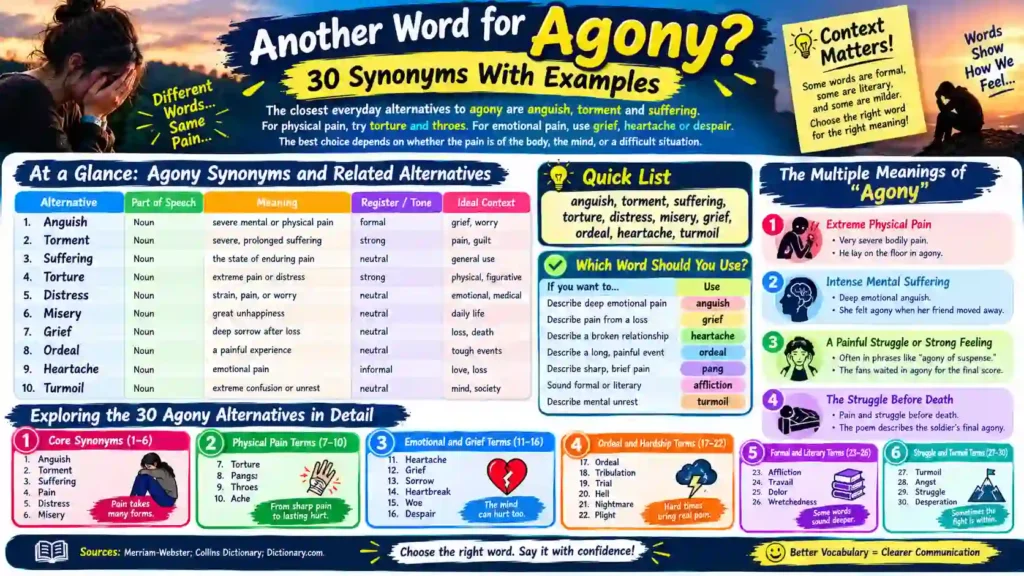
The closest everyday alternatives to agony are anguish, torment, and suffering. For physical pain, torture and throes also work. For emotional pain, try grief, heartache, or despair. The best choice depends on If the pain is of the body, the mind, or a difficult situation.
Agony is a strong word, so milder choices such as ache or distress can fit better in many sentences. Some alternatives are formal, and some are literary.
Quick list: anguish, torment, suffering, torture, distress, misery, grief, ordeal, heartache, turmoil
Below, you will find 30 alternatives with meanings, IPA, usage notes, examples, and context.
At a Glance: Agony Synonyms and Related Alternatives
| Alternative | Part of Speech | Meaning | Register / Tone | Ideal Context |
| Anguish | noun | severe mental or physical pain | formal | grief, worry |
| Torment | noun | severe, prolonged suffering | strong | pain, guilt |
| Suffering | noun | the state of enduring pain | neutral | general use |
| Torture | noun | extreme pain or distress | strong | physical, figurative |
| Distress | noun | strain, pain, or worry | neutral | emotional, medical |
| Misery | noun | great unhappiness | neutral | daily life |
| Grief | noun | deep sorrow after loss | neutral | loss, death |
| Ordeal | noun | a painful experience | neutral | tough events |
| Heartache | noun | emotional pain | informal | love, loss |
| Turmoil | noun | extreme confusion or unrest | neutral | mind, society |
Which Word Should You Use?
| If you want to… | Use | Why |
| Describe deep emotional pain | anguish | It suits serious emotional pain. |
| Describe pain from a loss | grief | It is specific to loss. |
| Describe pain from a broken relationship | heartache | It sounds natural and personal. |
| Describe a long, painful event | ordeal | It focuses on the experience. |
| Describe sharp, brief pain | pang | It means a sudden feeling. |
| Sound formal or literary | affliction | It suits serious writing. |
| Describe being nervous or restless | turmoil | It shows mental unrest. |
Exploring the Multiple Meanings of “Agony”
1. Extreme Physical Pain
- Meaning: Very severe bodily pain.
- Explanation: This is the most common sense. It is stronger than ordinary pain.
- Example: He lay on the floor in agony after the fall.
2. Intense Mental Suffering
- Meaning: Deep emotional anguish.
- Explanation: Here the pain is in the mind, not the body.
- Example: She felt agony when her friend moved away.
3. A Painful Struggle or Strong Feeling
- Meaning: A strong, painful feeling in a tense situation.
- Explanation: It often appears in phrases such as agony of suspense.
- Example: The fans waited in agony for the final score.
4. The Struggle Before Death
- Meaning: The pain and struggle that come before death.
- Explanation: This sense is older and formal. It now appears mostly in historical or religious writing.
- Example: The poem describes the soldier’s final agony.
Sources: Merriam-Webster; Collins Dictionary; Dictionary.com
Analyzing 30 Agony Alternatives in Detail
Some words below are direct synonyms, while others are related alternatives that fit only certain contexts.
Core Synonyms
1. Anguish
IPA: /ˈæŋɡwɪʃ/ (US and UK)
Definition: Severe mental or physical suffering.
- Usage: This is a close synonym. It is formal and mostly emotional.
- Example: She cried out in anguish at the news.
2. Torment
IPA: US /ˈtɔːrment/ · UK /ˈtɔːment/
Definition: Severe suffering of body or mind.
- Usage: This is a close synonym. It suggests pain that lasts and is hard to escape.
- Example: Guilt was a daily torment for him.
3. Suffering
IPA: /ˈsʌfərɪŋ/ (US and UK)
Definition: The state of enduring pain or hardship.
- Usage: It is a neutral synonym but weaker than agony.
- Example: The doctor tried to reduce her suffering.
4. Pain
IPA: /peɪn/ (US and UK)
Definition: The feeling of physical or emotional hurt.
- Usage: This is the most general word. It does not show the extreme level of agony.
- Example: The pain in his knee grew worse.
5. Distress
IPA: /dɪˈstres/ (US and UK)
Definition: Extreme worry, sorrow, or pain.
- Usage: It is a milder, formal alternative. It is common in medical and news writing.
- Example: The child showed signs of distress.
6. Misery
IPA: /ˈmɪzəri/ (US and UK)
Definition: Great unhappiness or suffering.
- Usage: It is a related alternative. It describes long unhappiness more than sharp pain.
- Example: The cold, wet journey was pure misery.
Physical Pain Terms
7. Torture
IPA: US /ˈtɔːrtʃər/ · UK /ˈtɔːtʃə/
Definition: Extreme pain or mental suffering.
- Usage: In daily speech it is often figurative and exaggerated.
- Example: Waiting in the heat was torture.
8. Pangs
IPA: /pæŋz/ (US and UK)
Definition: Sudden, sharp feelings of pain or emotion.
- Usage: It is related, not exact. It describes short bursts, such as hunger pangs.
- Example: She felt pangs of guilt.
9. Throes
IPA: US /θroʊz/ · UK /θrəʊz/
Definition: Violent pain or a struggle.
- Usage: It is related and fixed in phrases like in the throes of.
- Example: The country was in the throes of a crisis.
10. Ache
IPA: /eɪk/ (US and UK)
Definition: A steady, dull pain.
- Usage: It is much milder than agony, so it is a related alternative only.
- Example: A deep ache stayed in his back.
Emotional and Grief Terms
11. Heartache
IPA: US /ˈhɑːrteɪk/ · UK /ˈhɑːteɪk/
Definition: Deep emotional pain, often from loss or love.
- Usage: This is informal and personal. It is narrower than agony.
- Example: The song is about love and heartache.
12. Grief
IPA: /ɡriːf/ (US and UK)
Definition: Deep sorrow, especially after a death.
- Usage: It is related, not exact. It always points to loss.
- Example: Her grief lasted for months.
13. Sorrow
IPA: US /ˈsɑːroʊ/ · UK /ˈsɒrəʊ/
Definition: Sadness caused by loss or disappointment.
- Usage: This is a gentler, slightly literary alternative.
- Example: He spoke of his sorrow at leaving.
14. Heartbreak
IPA: US /ˈhɑːrtbreɪk/ · UK /ˈhɑːtbreɪk/
Definition: Overwhelming sadness.
- Usage: It is a related alternative. It is common for love and disappointment.
- Example: The loss caused great heartbreak.
15. Woe
IPA: US /woʊ/ · UK /wəʊ/
Definition: Deep sorrow or trouble.
- Usage: It is old-fashioned and literary.
- Example: She told a tale of woe.
16. Despair
IPA: US /dɪˈsper/ · UK /dɪˈspeə/
Definition: Complete loss of hope.
- Usage: It is related, not exact. It focuses on hopelessness, not pain.
- Example: He sank into despair.
Ordeal and Hardship Terms
17. Ordeal
IPA: US /ɔːrˈdiːl/ · UK /ɔːˈdiːl/
Definition: A very difficult or painful experience.
- Usage: It names the event, not the feeling.
- Example: The rescue was a long ordeal.
18. Tribulation
IPA: /ˌtrɪbjuˈleɪʃn/ (US and UK)
Definition: Great trouble or suffering.
- Usage: It is formal and often religious.
- Example: The family faced many tribulations.
19. Trial
IPA: /ˈtraɪəl/ (US and UK)
Definition: A source of hardship or suffering.
- Usage: This is a related alternative and much milder than agony.
- Example: The illness was a trial for everyone.
20. Hell
IPA: /hel/ (US and UK)
Definition: An extremely unpleasant experience.
- Usage: It is informal and figurative.
- Example: The exam week was hell.
21. Nightmare
IPA: US /ˈnaɪtmer/ · UK /ˈnaɪtmeə/
Definition: A terrible or frightening experience.
- Usage: It is informal and related, not exact.
- Example: Moving house was a nightmare.
22. Plight
IPA: /plaɪt/ (US and UK)
Definition: A bad or difficult situation.
- Usage: It describes the situation, not the pain itself.
- Example: The article explains the refugees’ plight.
Formal and Literary Terms
23. Affliction
IPA: /əˈflɪkʃn/ (US and UK)
Definition: Something that causes pain or suffering.
- Usage: It is formal. It can mean an illness or the suffering itself.
- Example: Poverty was a constant affliction.
24. Travail
IPA: US /trəˈveɪl/ · UK /ˈtræveɪl/
Definition: Painful or hard effort.
- Usage: It is literary and related. It stresses pain through hard work.
- Example: The poem describes a mother’s travail.
25. Dolor
IPA: US /ˈdoʊlər/ · UK /ˈdɒlə/
Definition: Deep sorrow or distress.
- Usage: It is rare and literary. Use it only in poetic writing.
- Example: The old song spoke of dolor.
26. Wretchedness
IPA: /ˈretʃɪdnəs/ (US and UK)
Definition: A state of deep misery.
- Usage: It is formal and describes a miserable condition.
- Example: The wretchedness of the camp shocked visitors.
Struggle and Turmoil Terms
27. Turmoil
IPA: US /ˈtɜːrmɔɪl/ · UK /ˈtɜːmɔɪl/
Definition: A state of great confusion or unrest.
- Usage: It is related. It suits mental agony over a choice.
- Example: She was in turmoil over her decision.
28. Angst
IPA: /ɑːŋst/ (US and UK)
Definition: Deep anxiety about life or the future.
- Usage: It is a related alternative and milder than agony.
- Example: The film shows teenage angst.
29. Struggle
IPA: /ˈstrʌɡl/ (US and UK)
Definition: A hard effort against difficulty.
- Usage: It is related. It links to the Greek root of agony.
- Example: Her struggle with illness was long.
30. Desperation
IPA: /ˌdespəˈreɪʃn/ (US and UK)
Definition: A state of hopelessness that leads to extreme action.
- Usage: It is related, not exact. It is about hopeless urgency.
- Example: He called out in desperation.
Sources: Merriam-Webster; Collins Dictionary and Thesaurus; Dictionary.com
Agony vs. Anguish vs. Torment
| Word | Main Focus | Typical Use |
| Agony | extreme pain, body or mind | physical and emotional |
| Anguish | mental suffering | grief, worry, guilt |
| Torment | long, ongoing suffering | guilt, cruelty, pain |
In short, choose agony for the strongest pain, anguish for the mind, and torment for pain that lasts.
Sources: Merriam-Webster; Collins Dictionary
Agony and Opposite Word Pairs
| Word | Paired Word | Note |
| Agony | Ecstasy | A common contrast in literature. |
| Pain | Relief | A natural everyday pair. |
| Misery | Joy | They are opposites in feeling. |
| Torment | Peace | They are opposites in state. |
Agony has no single exact antonym. The pairs above work by context.
Sources: Merriam-Webster; Collins Thesaurus
Common Word Partners of “Agony”
| Pattern | Common Partners | Example |
| in + agony | writhe, scream, cry out | He screamed in agony. |
| adjective + agony | sheer, sudden, unbearable | The pain was sheer agony. |
| agony of + noun | defeat, suspense, waiting | They felt the agony of waiting. |
Sources: Collins Dictionary; Merriam-Webster
Idiomatic Phrases Featuring “Agony”
1. Agony aunt
- Meaning: A person, usually a columnist, who gives advice on personal problems (mainly British).
- Example: She wrote to an agony aunt about her family.
2. Agony column
- Meaning: A newspaper section with advice on personal problems.
- Example: The magazine still has an agony column.
3. Pile on the agony
- Meaning: To make a bad situation seem worse, or to exaggerate it.
- Example: Please stop piling on the agony.
4. Prolong the agony
- Meaning: To make an unpleasant situation last longer.
- Example: Why prolong the agony? Just tell me.
Sources: Collins Dictionary; Merriam-Webster
Word Formation of “Agony”
Etymology & Structure
Agony comes from Old French agonie, from Late Latin and Greek agonia, meaning a struggle or contest. This goes back to Greek agōn, “contest.”
Date and History
Etymonline places the word in English in the late 14th century. Its first use referred to mental anguish.
Word Class Variations
- Noun: agony, agonies
- Verb: agonize
- Adjective: agonizing, agonized
- Adverb: agonizingly
Sources: Etymonline; Merriam-Webster.
Frequently Asked Questions
What is the closest synonym for agony? Anguish is the closest, followed by torment.
What is a formal alternative? Affliction and tribulation are formal.
What is a literary alternative? Woe and dolor are literary.
Is agony only physical? No. It can also mean strong emotional pain.
What is the opposite of agony? Ecstasy, relief, and comfort work, depending on context.
What is the difference between agony and anguish? Anguish is mostly mental, while agony can be physical too.
Can agony describe waiting? Yes, as in the agony of suspense.
Is torture the same as agony? Not always. Torture can also be a figure of speech.
What is an informal alternative? Hell and nightmare are informal.
What does “agony aunt” mean? It means an advice columnist.
Conclusion
The closest alternatives to agony are anguish, torment, and suffering. For emotional pain, grief and heartache often fit better.
However, context matters. Some words describe pain, while others describe a situation or a state of mind.
To choose well, first decide what kind of suffering you mean. Then match the word’s strength and tone to your sentence.

Hi, I’m ALI HAMZA writer at LifeLoomer.com, I write about the things we all wonder but rarely ask what everyday words really mean, how small habits shape our days, and the practical how-tos that make life a little easier.
My promise is simple: honest research, plain words, and articles that respect your time. If a piece doesn’t genuinely help someone, it doesn’t go live.
Glad you’re here let’s learn the little things that matter.