
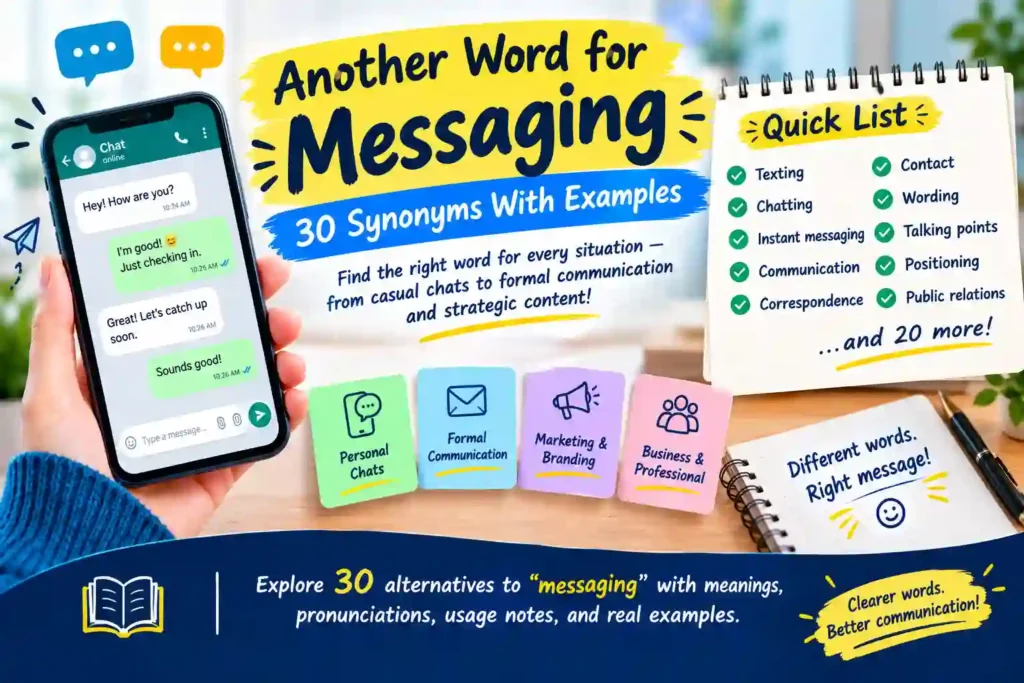
The closest everyday alternatives for messaging are texting, chatting, and communication. If you mean the content of a message in business or politics, wording, talking points, and branding work better. The right choice depends on whether you mean the act of sending messages, the system used, or the ideas a message carries.
Messaging has three main areas of meaning: personal digital communication, formal or general communication, and strategic content in marketing or politics. Each area needs different words.
Quick list: texting, chatting, instant messaging, communication, correspondence, contact, wording, talking points, positioning, public relations
Below you will find 30 alternatives with meanings, IPA, usage notes, and examples.
At a Glance: Messaging Synonyms and Related Alternatives
| Alternative | Part of Speech | Meaning | Register / Tone | Ideal Context |
| Texting | noun | Sending text messages by phone | Informal | Daily life |
| Chatting | noun | Casual online or phone conversation | Informal | Friends, apps |
| Instant messaging | noun | Real-time typed messages online | Neutral | Work, apps |
| Communication | noun | Sharing information | Neutral/formal | General, business |
| Correspondence | noun | Exchange of letters or emails | Formal | Official, business |
| Contact | noun | Act of reaching someone | Neutral | Customer service |
| Wording | noun | Choice of words in a message | Neutral | Writing, PR |
| Talking points | noun | Key ideas to communicate | Professional | Politics, meetings |
| Positioning | noun | How a brand is presented | Professional | Marketing |
| Public relations | noun | Managing public image | Professional | Business, media |
Which Word Should You Use?
| If you want to… | Use | Why |
| Describe phone-based chat | texting | It is the common everyday word. |
| Describe real-time work chat | instant messaging | It names the live, typed format. |
| Sound formal | correspondence | It suits letters and official emails. |
| Describe an official statement | communiqué | It sounds formal and public. |
| Talk about what a brand says | positioning | It focuses on strategy, not sending. |
| Talk about exact phrasing | wording | It stresses the words chosen. |
| Describe a politician’s key lines | talking points | It names the planned points. |
| Speak broadly | communication | It covers almost every sense. |
Exploring the Multiple Meanings of Messaging
1. Sending Messages
- Meaning: The act of sending messages to someone.
- Explanation: This is the most common sense, usually through phones or apps.
- Example: Messaging my sister is easier than calling.
2. A Messaging System
- Meaning: A system or service for sending messages.
- Explanation: Here the word names the technology, not the act.
- Example: The company switched to a new messaging platform.
3. Strategic Content
- Meaning: The ideas a person or organization wants to communicate.
- Explanation: This sense is common in marketing, politics, and public relations.
- Example: The campaign’s messaging focused on lower prices.
4. General Communication
- Meaning: The overall exchange of messages.
- Explanation: It is broader and appears in phrases like mixed messaging.
- Example: Unclear messaging confused the staff.
Sources: Merriam-Webster; Collins English Dictionary; Dictionary.com
Analyzing 30 Messaging Alternatives in Detail
Some alternatives below are direct synonyms, while others are related terms that fit only certain senses.
Everyday Alternatives
1. Texting
IPA: /ˈtɛkstɪŋ/ (US and UK)
Definition: Sending written messages by mobile phone.
- Usage: Direct synonym for the personal sense. Informal.
- Example: Texting is faster than writing letters.
2. Chatting
IPA: /ˈtʃætɪŋ/ (US and UK)
Definition: Talking or typing in a relaxed way.
- Usage: Close synonym for casual messaging. Informal.
- Example: They spent the evening chatting online.
3. SMS
IPA: /ˌɛs ɛm ˈɛs/ (US and UK)
Definition: Short message service, the standard phone text system.
- Usage: Technical term for text messaging only. Neutral.
- Example: The bank sent an SMS code.
4. Instant messaging
IPA: /ˈɪnstənt ˈmɛsɪdʒɪŋ/ (US and UK)
Definition: Real-time exchange of typed messages online.
- Usage: Direct synonym for live digital messaging. Neutral.
- Example: Our team uses instant messaging all day.
5. Direct messaging
IPA: /dɪˈrɛkt ˈmɛsɪdʒɪŋ/ (US and UK)
Definition: Sending private messages on a social platform.
- Usage: A specific kind of messaging. Common on social media.
- Example: Direct messaging lets fans contact creators.
6. Emailing
IPA: /ˈiːmeɪlɪŋ/ (US and UK)
Definition: Sending messages by electronic mail.
- Usage: Related alternative. It is slower and more formal than texting.
- Example: Emailing the client saved time.
General and Formal Terms
7. Communication
IPA: /kəˌmjuːnɪˈkeɪʃən/ (US and UK)
Definition: The sharing of information or ideas.
- Usage: Broad synonym covering most senses. Neutral to formal.
- Example: Good communication prevents mistakes.
8. Correspondence
IPA: US /ˌkɔːrəˈspɑːndəns/ · UK /ˌkɒrɪˈspɒndəns/
Definition: Letters or emails exchanged between people.
- Usage: Formal synonym for written exchanges only.
- Example: Please keep all correspondence on file.
9. Exchange
IPA: /ɪksˈtʃeɪndʒ/ (US and UK)
Definition: A back-and-forth of words or messages.
- Usage: Related alternative. It names a single conversation.
- Example: Their email exchange lasted weeks.
10. Contact
IPA: US /ˈkɑːntækt/ · UK /ˈkɒntækt/
Definition: The act of reaching or communicating with someone.
- Usage: Related alternative. It stresses reaching out, not content.
- Example: Contact us through the website.
11. Interaction
IPA: /ˌɪntərˈækʃən/ (US and UK)
Definition: Communication or action between people.
- Usage: Related alternative. It is broader than messaging.
- Example: Online interaction has grown.
Delivery and Notice
12. Transmission
IPA: /trænzˈmɪʃən/ (US and UK)
Definition: The sending of a message or signal.
- Usage: Technical or formal. It focuses on sending only.
- Example: The transmission was delayed.
13. Dispatch
IPA: /dɪˈspætʃ/ (US and UK)
Definition: An official message sent quickly.
- Usage: Formal, news or military. It is a related noun.
- Example: A dispatch reached the capital.
14. Communiqué
IPA: US /kəˌmjuːnɪˈkeɪ/ · UK /kəˈmjuːnɪkeɪ/
Definition: An official announcement.
- Usage: Formal and related. It names one statement, not the act.
- Example: The ministry issued a communiqué.
15. Notification
IPA: US /ˌnoʊtɪfɪˈkeɪʃən/ · UK /ˌnəʊtɪfɪˈkeɪʃən/
Definition: A message that gives notice of something.
- Usage: Related to apps and systems. It is one-way.
- Example: A notification appeared on my screen.
16. Announcement
IPA: /əˈnaʊnsmənt/ (US and UK)
Definition: A public statement of news.
- Usage: Related alternative for one-way messages.
- Example: The announcement came on Monday.
Content and Wording
17. Wording
IPA: US /ˈwɜːrdɪŋ/ · UK /ˈwɜːdɪŋ/
Definition: The words chosen to express something.
- Usage: Related to the strategic sense. It stresses phrasing.
- Example: The wording of the notice was unclear.
18. Talking points
IPA: /ˈtɔːkɪŋ pɔɪnts/ (US and UK)
Definition: Main ideas to be raised in a discussion.
- Usage: Close to the political sense. Professional.
- Example: She reviewed her talking points.
19. Narrative
IPA: US /ˈnɛrətɪv/ · UK /ˈnærətɪv/
Definition: A story or account used to explain something.
- Usage: Related to strategic messaging. It is broader.
- Example: The brand shaped a new narrative.
20. Framing
IPA: /ˈfreɪmɪŋ/ (US and UK)
Definition: Presenting information in a particular way.
- Usage: Related. It shows how an idea is presented.
- Example: The framing changed public opinion.
21. Copy
IPA: US /ˈkɑːpi/ · UK /ˈkɒpi/
Definition: Written text for advertising or publication.
- Usage: Related, used in marketing. Not a general synonym.
- Example: The copy was short and clear.
Brand and Strategy
22. Positioning
IPA: /pəˈzɪʃənɪŋ/ (US and UK)
Definition: How a brand is placed in people’s minds.
- Usage: Related to the strategic sense. Business term.
- Example: Their positioning targets young buyers.
23. Branding
IPA: /ˈbrændɪŋ/ (US and UK)
Definition: Creating a distinct identity for a product or company.
- Usage: Related. It covers more than words.
- Example: Strong branding builds trust.
24. Pitch
IPA: /pɪtʃ/ (US and UK)
Definition: A persuasive presentation of an idea.
- Usage: Related. It focuses on persuading.
- Example: Her pitch won the client.
25. Slogan
IPA: US /ˈsloʊɡən/ · UK /ˈsləʊɡən/
Definition: A short, memorable phrase for a brand or cause.
- Usage: Narrow related term. It is one part of messaging.
- Example: The slogan was easy to remember.
26. Outreach
IPA: /ˈaʊtriːtʃ/ (US and UK)
Definition: Efforts to connect with people or groups.
- Usage: Related. It stresses contacting an audience.
- Example: Their outreach reached schools.
Public-Facing Terms
27. Public relations
IPA: /ˌpʌblɪk rɪˈleɪʃənz/ (US and UK)
Definition: Managing how the public sees an organization.
- Usage: Related. It covers strategy beyond single messages.
- Example: She works in public relations.
28. Publicity
IPA: /pʌbˈlɪsəti/ (US and UK)
Definition: Attention given to someone by the media.
- Usage: Related. It stresses attention, not content.
- Example: The event gained great publicity.
29. Rhetoric
IPA: US /ˈrɛtərɪk/ · UK /ˈretərɪk/
Definition: Language used to persuade or influence.
- Usage: Related, often with a critical tone.
- Example: The campaign rhetoric grew heated.
30. Advertising
IPA: US /ˈædvərtaɪzɪŋ/ · UK /ˈædvətaɪzɪŋ/
Definition: Promoting products through public announcements.
- Usage: Narrow related term for paid promotion.
- Example: Advertising costs have risen.
Sources: Merriam-Webster; Collins English Dictionary; Dictionary.com
Messaging vs. Communication vs. Messaging Platform
| Term | Focus | Example |
| Messaging | Act or content of messages | Clear messaging helps customers. |
| Communication | Overall sharing of information | Communication improved. |
| Messaging platform | The tool or app | We use a messaging platform. |
Use messaging when you mean messages specifically. Use communication when you mean the broader process.
Sources: Merriam-Webster; Collins English Dictionary
Messaging and Opposite/Paired Word Pairs
| Word | Paired Word | Note |
| Messaging | Calling | Typed versus spoken contact |
| Messaging | Silence | Natural contrast |
| Messaging | Face-to-face talk | Digital versus in person |
| Messaging | Reply | Sending versus responding |
Messaging has no strict antonym. These pairs show useful contrasts instead.
Sources: Collins Thesaurus; Merriam-Webster
Common Word Partners of Messaging
| Pattern | Common Partners | Example |
| Adjective + messaging | instant, mobile, brand, clear | Clear messaging builds trust. |
| Messaging + noun | app, platform, service | The messaging app crashed. |
| Verb + messaging | improve, send, refine | They refined their messaging. |
Sources: Collins Dictionary; Merriam-Webster
Idiomatic Phrases Featuring Messaging
Messaging has no strong true idioms. These are established expressions.
1. Mixed messaging
- Meaning: Conflicting signals sent at the same time.
- Example: Mixed messaging confused the public.
2. Brand messaging
- Meaning: The ideas a company presents about itself.
- Example: Brand messaging should stay consistent.
3. Instant messaging
- Meaning: Real-time online chat.
- Example: Instant messaging replaced many emails.
Sources: Merriam-Webster; Collins Dictionary
Word Formation of Messaging
Etymology & Structure
Messaging is message plus the ending -ing. Message came from Old French and Medieval Latin, from Latin mittere, meaning to send.
Date and History
Etymonline dates message in English to around 1300.
Word Class Variations
- Noun: message, messaging, messenger
- Verb: message, messages, messaged
Sources: Etymonline; Merriam-Webster
Common Word-Choice Mistakes
- Messaging a letter: write sending a letter.
- Correspondence by app: messaging fits better.
- Communiqué to a friend: use text.
- Mixing up messaging and message: one is the act, the other is the item.
- Calling a slogan messaging: a slogan is only one part.
- Rhetoric as neutral: it often sounds critical.
- Using dispatch for casual texts: it sounds formal.
Frequently Asked Questions
What is the closest synonym for messaging?
Texting is closest for personal use. Communication works in general contexts.
What is a formal alternative?
Correspondence or communication suit formal writing.
What is the business meaning?
It means the ideas a company wants customers to hear.
Is messaging the same as texting?
Not always. Texting is one kind of messaging.
Is messaging the same as communication?
No. Communication is broader.
What is the opposite of messaging?
There is no strict opposite. Calling or silence are natural contrasts.
Can messaging mean marketing content?
Yes. It often refers to the ideas a brand presents.
Conclusion
The closest alternatives for messaging are texting, chatting, and communication. These cover everyday use. Formal terms like correspondence suit official writing.
Context decides the best word. Some alternatives describe sending messages, while others describe the ideas inside them. Strategic words like positioning and talking points apply only to the marketing and political senses.
To choose well, decide whether you mean the act, the tool, or the content. Then pick the word that matches that meaning and tone.

Hi, I’m HAROON ,founder of LifeLoomer.com, I started LifeLoomer with one belief: the internet is full of answers, but not enough understanding. So I write guides that actually explain things the meanings behind everyday words, the small habits that make life better, and the how-tos nobody taught us.
Everything I publish is researched, written in plain words, and tested against one question: will this genuinely help someone today?
Thanks for being here. I hope you leave a little wiser than you came.