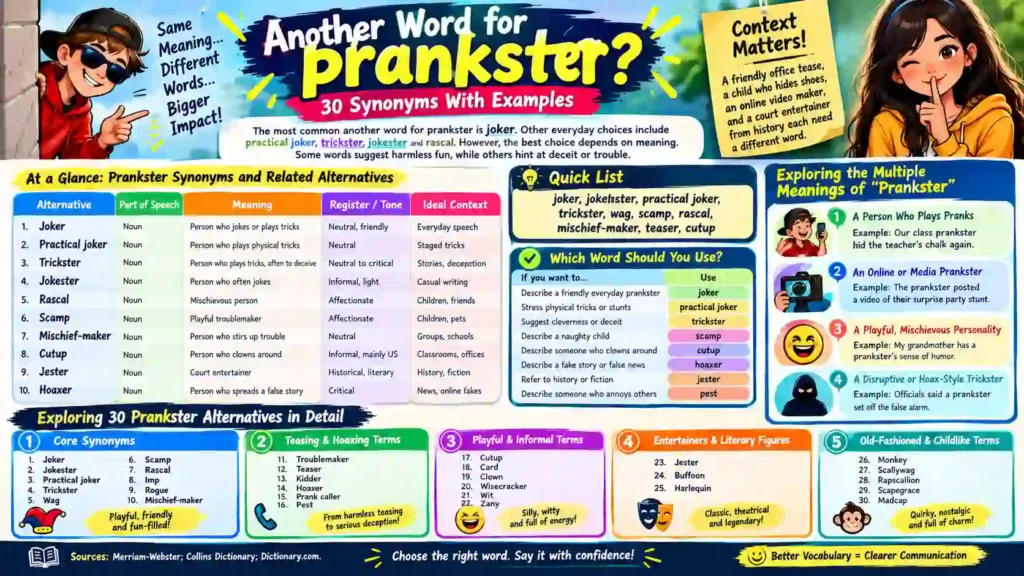
The most common another word for prankster is joker. Other everyday choices include practical joker, trickster, jokester, and rascal. However, the best choice depends on meaning. Some words suggest harmless fun, while others hint at deceit or trouble.
Context matters too. A friendly office tease, a child who hides shoes, an online video maker, and a court entertainer from history each need a different word. Below, you will find clear options for each situation.
Quick list: joker, jokester, practical joker, trickster, wag, scamp, rascal, mischief-maker, teaser, cutup
This article examines 30 alternatives with meanings, IPA, usage notes, examples, and context, so you can choose with confidence.
At a Glance: Prankster Synonyms and Related Alternatives
| Alternative | Part of Speech | Meaning | Register / Tone | Ideal Context |
| joker | noun | person who jokes or plays tricks | neutral, friendly | everyday speech |
| practical joker | noun | person who plays physical tricks | neutral | staged tricks |
| trickster | noun | person who plays tricks, often to deceive | neutral to critical | stories, deception |
| jokester | noun | person who often jokes | informal, light | casual writing |
| rascal | noun | mischievous person | affectionate | children, friends |
| scamp | noun | playful troublemaker | affectionate | children, pets |
| mischief-maker | noun | person who stirs up trouble | neutral | groups, schools |
| cutup | noun | person who clowns around | informal, mainly US | classrooms, offices |
| jester | noun | court entertainer | historical, literary | history, fiction |
| hoaxer | noun | person who spreads a false story | critical | news, online fakes |
Which Word Should You Use?
| If you want to… | Use | Why |
| Describe a friendly everyday prankster | joker | It is common and warm. |
| Stress physical tricks or stunts | practical joker | It points to staged tricks. |
| Suggest cleverness or deceit | trickster | It often means fooling people. |
| Describe a naughty child | scamp | It sounds affectionate. |
| Describe someone who clowns around | cutup | It is informal and lively. |
| Describe a fake story or false news | hoaxer | It focuses on deception. |
| Refer to history or fiction | jester | It names a court entertainer. |
| Describe someone who annoys others | pest | It shows the effect, not the joke. |
Exploring the Multiple Meanings of Prankster
1. A Person Who Plays Pranks
- Meaning: A person who plays pranks.
- Explanation: This is the core sense. A prank is usually a playful trick that does not cause serious harm.
- Example: Our class prankster hid the teacher’s chalk again.
2. An Online or Media Prankster
- Meaning: A person who films or posts pranks for an audience.
- Explanation: This modern sense often appears in YouTube prankster. Here, the audience matters as much as the trick.
- Example: The prankster posted a video of their surprise party stunt.
3. A Playful, Mischievous Personality
- Meaning: Someone with a joking spirit.
- Explanation: This sense can be a compliment. The person does not need to play tricks all the time.
- Example: My grandmother has a prankster’s sense of humor.
4. A Disruptive or Hoax-Style Trickster
- Meaning: Someone whose trick causes trouble.
- Explanation: In news reports, the word can describe false alarms. In that case, the tone becomes critical.
- Example: Officials said a prankster set off the false alarm.
Sources: Merriam-Webster; Collins Dictionary.
Analyzing 30 Prankster Alternatives in Detail
Some alternatives below are direct synonyms, while others are related words that fit only certain contexts.
Core Synonyms
1. Joker
IPA: US /ˈdʒoʊkər/ · UK /ˈdʒəʊkə/
Definition: A person who makes jokes or plays tricks.
- Usage: This is the closest everyday synonym. It is neutral and friendly.
- Example: Every team needs a joker to lift the mood.
2. Jokester
IPA: US /ˈdʒoʊkstər/ · UK /ˈdʒəʊkstə/
Definition: A person who often jokes.
- Usage: This is a direct synonym. It leans toward words more than physical tricks.
- Example: The jokester kept the whole table laughing.
3. Practical joker
IPA: US /ˌpræktɪkəl ˈdʒoʊkər/ · UK /ˌpræktɪkəl ˈdʒəʊkə/
Definition: A person who plays tricks through actions, not words.
- Usage: This is a direct synonym. It suits staged tricks like fake spiders.
- Example: The practical joker taped a fake bug to the lamp.
4. Trickster
IPA: US /ˈtrɪkstər/ · UK /ˈtrɪkstə/
Definition: A person who tricks others.
- Usage: This is a close synonym, but it can mean serious deceit. It also names a character in folklore.
- Example: In the story, a clever trickster fools the king.
5. Wag
IPA: /wæɡ/ (US and UK)
Definition: A witty, joking person.
- Usage: This is a related, somewhat old-fashioned word. It stresses humor over tricks.
- Example: The local wag nicknamed every teacher.
Mischievous Characters
6. Scamp
IPA: /skæmp/ (US and UK)
Definition: A playful person who causes small trouble.
- Usage: This is a related word, often for children. It is warm and light.
- Example: That little scamp swapped the salt and sugar.
7. Rascal
IPA: US /ˈræskəl/ · UK /ˈrɑːskəl/
Definition: A mischievous or dishonest person.
- Usage: This is a related word. In friendly use it is playful, but it can also mean dishonest.
- Example: The rascal hid my keys again.
8. Imp
IPA: /ɪmp/ (US and UK)
Definition: A small, mischievous being, or a naughty child.
- Usage: This is a related, figurative word. It suggests small, cheeky acts.
- Example: Their youngest is a real imp at bedtime.
9. Rogue
IPA: US /roʊɡ/ · UK /rəʊɡ/
Definition: A dishonest or unprincipled person.
- Usage: This is only loosely related. It can sound charming (lovable rogue), but it does not mean prankster.
- Example: The charming rogue talked his way into the party.
10. Mischief-maker
IPA: US /ˈmɪstʃɪf ˌmeɪkər/ · UK /ˈmɪstʃɪf ˌmeɪkə/
Definition: A person who causes trouble.
- Usage: This is a close alternative. It works for playful or harmful behavior, so tone depends on context.
- Example: The mischief-maker rearranged the street signs.
11. Troublemaker
IPA: US /ˈtrʌbəlˌmeɪkər/ · UK /ˈtrʌbəlˌmeɪkə/
Definition: A person who causes problems.
- Usage: This is a related, stronger word. It is usually negative and lacks the playfulness of prankster.
- Example: The teacher called them a troublemaker, not a prankster.
Teasing and Hoaxing Terms
12. Teaser
IPA: US /ˈtiːzər/ · UK /ˈtiːzə/
Definition: A person who teases others.
- Usage: This is a related word. It focuses on teasing, not staged tricks.
- Example: My cousin is a harmless teaser.
13. Kidder
IPA: US /ˈkɪdər/ · UK /ˈkɪdə/
Definition: A person who jokes or teases.
- Usage: This is a related, informal word. It suggests playful fibbing.
- Example: Don’t believe him; he’s a kidder.
14. Hoaxer
IPA: US /ˈhoʊksər/ · UK /ˈhəʊksə/
Definition: A person who deceives others with a false story.
- Usage: This is a related word. It is more serious than prankster and often critical.
- Example: A hoaxer posted a fake news alert.
15. Prank caller
IPA: US /ˈpræŋk ˌkɔːlər/ · UK /ˈpræŋk ˌkɔːlə/
Definition: A person who makes joke phone calls.
- Usage: This is a context-specific kind of prankster. It names only one type of prank.
- Example: A prank caller kept ringing the shop.
16. Pest
IPA: /pɛst/ (US and UK)
Definition: An annoying person.
- Usage: This is a related word. It describes the effect, not the joke.
- Example: My brother is a pest on April Fools’ Day.
Playful and Informal Terms
17. Cutup
IPA: US /ˈkʌtˌʌp/ (mainly US usage)
Definition: A person who clowns around.
- Usage: This is a near-synonym in casual speech. It suggests silly behavior.
- Example: The class cutup made everyone laugh.
18. Card
IPA: US /kɑːrd/ · UK /kɑːd/
Definition: An amusing or eccentric person (informal, mainly British).
- Usage: This is a related word. It describes character, not tricks.
- Example: Our neighbor is quite a card.
19. Clown
IPA: /klaʊn/ (US and UK)
Definition: A person who acts silly to amuse others.
- Usage: This is a related word. It can be friendly or mocking.
- Example: Stop being a clown and listen.
20. Wisecracker
IPA: US /ˈwaɪzˌkrækər/ · UK /ˈwaɪzˌkrækə/
Definition: A person who makes smart, joking remarks.
- Usage: This is a related word. It focuses on witty remarks, not actions.
- Example: The wisecracker had a joke for everything.
21. Wit
IPA: /wɪt/ (US and UK)
Definition: A person who speaks with clever humor.
- Usage: This is a related word. It praises intelligence, not trickery.
- Example: She is known as the office wit.
22. Zany
IPA: /ˈzeɪni/ (US and UK)
Definition: A person who acts in a silly, comic way.
- Usage: This is a related noun. It is less common than the adjective.
- Example: The zany of the group wore a cape to work.
Entertainers and Literary Figures
23. Jester
IPA: US /ˈdʒɛstər/ · UK /ˈdʒɛstə/
Definition: A person who entertained at a royal court.
- Usage: This is a historical word. Use it for stories or figurative praise.
- Example: The king laughed at the jester’s tricks.
24. Buffoon
IPA: /bəˈfuːn/ (US and UK)
Definition: A person who acts foolishly to amuse.
- Usage: This is a related word. It often sounds negative.
- Example: He played the buffoon to cheer us up.
25. Harlequin
IPA: US /ˈhɑːrləkwɪn/ · UK /ˈhɑːlɪkwɪn/
Definition: A comic character in traditional theater.
- Usage: This is a literary, related word. It fits theater, not daily speech.
- Example: The play featured a witty harlequin.
Old-Fashioned and Childlike Terms
26. Monkey
IPA: /ˈmʌŋki/ (US and UK)
Definition: A mischievous child (informal).
- Usage: This is a related, affectionate word for children.
- Example: That little monkey drew on the wall.
27. Scallywag
IPA: /ˈskæliˌwæɡ/ (US and UK)
Definition: A mischievous or disreputable person (informal).
- Usage: This is a related, playful word.
- Example: The scallywag stole a cookie.
28. Rapscallion
IPA: /ræpˈskæljən/ (US and UK)
Definition: A rascal.
- Usage: This is a humorous, old-fashioned word. It is close to rascal.
- Example: The rapscallion ran off laughing.
29. Scapegrace
IPA: /ˈskeɪpˌɡreɪs/ (US and UK)
Definition: A rascal or scamp.
- Usage: This is a rare, literary word. Use it only for a period tone.
- Example: The novel’s scapegrace caused endless trouble.
30. Madcap
IPA: /ˈmædˌkæp/ (US and UK)
Definition: A wild, impulsive person.
- Usage: This is a loosely related word. It suggests recklessness, not tricks.
- Example: The madcap jumped into the lake.
Sources: Merriam-Webster; Collins Dictionary; Dictionary.com.
Prankster vs. Trickster vs. Joker
| Word | Main Idea | Tone |
| prankster | plays playful tricks | light, mostly harmless |
| trickster | fools or deceives | can be serious |
| joker | makes people laugh | friendly, general |
In short, choose prankster for playful acts, trickster for cleverness or deceit, and joker for general humor.
Sources: Merriam-Webster; Collins Dictionary.
Prankster and Opposite/Paired Word Pairs
| Word | Paired Word | Note |
| prankster | killjoy | A killjoy spoils fun. |
| prankster | target | The target is the person pranked. |
| prankster | serious person | English has no single standard opposite. |
Prankster has no true antonym. Therefore, contrast words describe attitude, such as killjoy, or role, such as target.
Sources: Merriam-Webster; Collins Thesaurus.
Common Word Partners of Prankster
| Pattern | Common Partners | Example |
| place or platform + prankster | office, class, YouTube | The office prankster struck again. |
| adjective + prankster | notorious, mysterious, lifelong | A mysterious prankster left notes. |
| verb + prankster | blame, suspect | Teachers suspect a prankster. |
| prankster + noun | spirit | She has a prankster spirit. |
Sources: Merriam-Webster example sentences; Collins Dictionary.
Idiomatic Phrases Featuring Prankster
Prankster has no true idioms. Instead, the related word prank appears in these established expressions.
1. Play a prank on someone
- Meaning: To trick someone for fun.
- Example: They played a prank on their roommate.
2. Pull a prank
- Meaning: To carry out a prank.
- Example: Who pulled this prank?
3. Prank call
- Meaning: A joke phone call.
- Example: The prank call made us laugh.
4. April Fools’ prank
- Meaning: A trick played on April 1.
- Example: Their April Fools’ prank fooled everyone.
Sources: Merriam-Webster; Collins Dictionary.
Word Formation of Prankster
Etymology & Structure
Prankster combines prank and -ster, a suffix that names a person linked to an activity, as in trickster and youngster. Merriam-Webster traces the noun prank to an obsolete verb meaning to play tricks.
Date and History
Merriam-Webster dates the first known use of prankster to 1910. It dates the noun prank to about 1529.
Word Class Variations
- Noun: prankster, pranksters
- Related noun and verb: prank (pranked, pranking)
- Adjective: prankish
- Related noun: prankishness
Sources: Merriam-Webster.
Common Word-Choice Mistakes
- Wrong: make a prank. Correct: play or pull a prank.
- Wrong: prank with me. Correct: play a prank on me.
- Wrong: The prankster stole my savings. Correct: use thief or scammer, because pranksters do not intend serious harm.
- Wrong: calling a modern joker a jester. Correct: use joker, since jester is historical.
- Wrong: calling a professional performer a prankster. Correct: use comedian.
- Wrong: prankstar. Correct: prankster.
Frequently Asked Questions
What is the closest synonym for prankster?
Joker is the closest everyday word. Practical joker is closer when the tricks are physical.
What is a formal alternative?
Trickster works in formal writing, and person who plays pranks is the plainest option.
What is a literary alternative?
Scapegrace and harlequin fit literary or theatrical writing.
What is a word for a prankster child?
Scamp, imp, and monkey are warm choices for children.
Is prankster negative?
Usually not. However, context can make it critical, as with false alarms.
Is a hoaxer a prankster?
Only partly. A hoaxer spreads a false story, which is more serious.
Can prankster describe a personality?
Yes. People say someone has a prankster spirit, even if they rarely play tricks.
Conclusion
The closest alternatives to prankster are joker, practical joker, jokester, and trickster. Rascal and scamp work well for playful children.
Context matters because these words carry different tones. A hoaxer deceives, a jester belongs to history, and a pest simply annoys. Therefore, one small word change can shift the whole message.
To choose well, first decide whether the behavior is harmless, clever, or harmful. Next, consider your audience and setting. Then pick the word that fits both.

Hi, I’m HAROON ,founder of LifeLoomer.com, I started LifeLoomer with one belief: the internet is full of answers, but not enough understanding. So I write guides that actually explain things the meanings behind everyday words, the small habits that make life better, and the how-tos nobody taught us.
Everything I publish is researched, written in plain words, and tested against one question: will this genuinely help someone today?
Thanks for being here. I hope you leave a little wiser than you came.