The standard spelling is amidst, not admist. The closest everyday alternatives are amid, among, and in the middle of. The best choice depends on whether you mean physical surroundings, a time of trouble or change, or a group of people or things.
Most readers need one of three meanings: being surrounded by something, happening during a situation, or being part of a group. This guide covers all three.
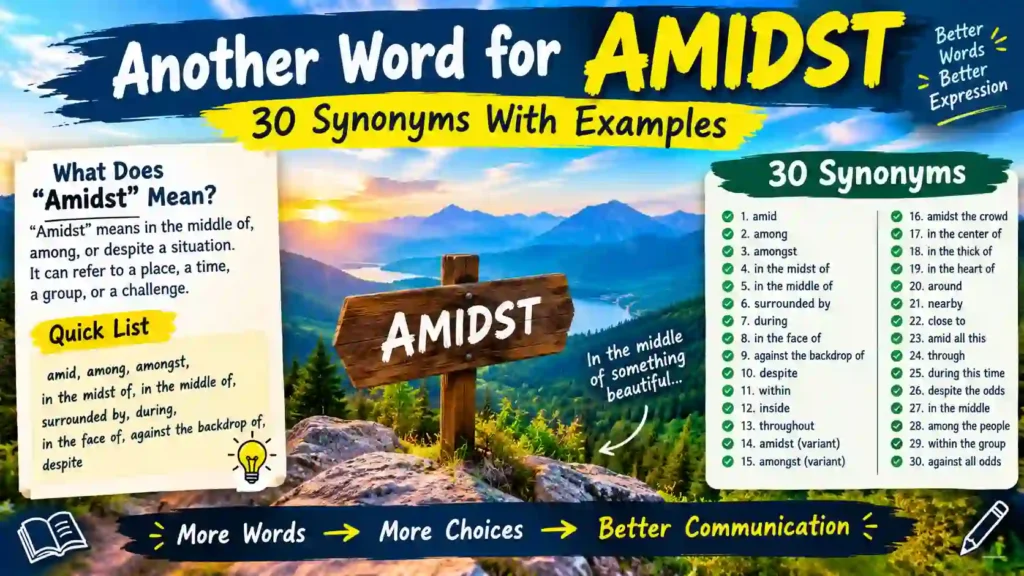
Quick list: amid, among, amongst, in the midst of, in the middle of, surrounded by, during, in the face of, against the backdrop of, despite
Below, you will find 30 alternatives with meanings, IPA, usage notes, and examples.
At a Glance: Admist (Amidst) Synonyms and Related Alternatives
| Alternative | Part of Speech | Meaning | Register / Tone | Ideal Context |
| amid | preposition | in the middle of | Formal | News, writing |
| among | preposition | surrounded by or part of a group | Neutral | Groups, people |
| amongst | preposition | among | Formal, British | Literary writing |
| in the midst of | phrase | during or surrounded by | Neutral | Busy or tense times |
| in the middle of | phrase | at the center of | Casual | Everyday speech |
| surrounded by | phrase | enclosed on all sides | Neutral | Places, people |
| during | preposition | throughout a period | Neutral | Time |
| in the face of | phrase | when dealing with | Formal | Difficulty |
| against the backdrop of | phrase | with a setting behind it | Formal | Background context |
| despite | preposition | without being stopped by | Neutral | Contrast |
Which Word Should You Use?
| If you want to… | Use | Why |
| Write a formal sentence about events | amid | It is short and common in news writing. |
| Talk about people in a group | among | It points to individuals within many. |
| Sound casual | in the middle of | It is plain and easy to follow. |
| Show a physical setting | surrounded by | It paints a clear picture. |
| Mention a time period | during | It marks when something happened. |
| Show a struggle | in the face of | It stresses the challenge. |
| Give background to a story | against the backdrop of | It sets the scene. |
| Show contrast | despite | It means although this was happening. |
Exploring the Multiple Meanings of Amidst
1. In the Middle of Something
- Meaning: In the center of or surrounded by.
- Explanation: This is the basic physical sense. It works for places and objects.
- Example: The house stood amidst tall pine trees.
2. During a Situation
- Meaning: While something is happening.
- Explanation: Here, amidst links an action to a larger event, often a tense or busy one.
- Example: She finished her exams amidst all the noise at home.
3. Among a Group
- Meaning: Within a group of people or things.
- Explanation: This sense is older and more literary. Today, among is more usual.
- Example: He found a friend amidst the crowd.
4. Despite a Difficulty
- Meaning: In spite of a problem.
- Explanation: The word often hints at struggle, even when it does not say so directly.
- Example: The team kept smiling amidst the chaos.
Sources: Merriam-Webster; Collins Dictionary; Dictionary.com.
Analyzing 30 Admist Alternatives in Detail
Some alternatives below are close synonyms, while others only fit certain contexts, and each usage note says which is which.
Core Synonyms
1. Amid
IPA: /əˈmɪd/ (US and UK)
Definition: In the middle of; surrounded by.
- Usage: This is the closest direct synonym. It is slightly shorter and more common in modern writing.
- Example: Prices rose amid growing demand.
2. Among
IPA: /əˈmʌŋ/ (US and UK)
Definition: In the company of or part of a group.
- Usage: This is a related alternative. It suits groups of three or more, not events or situations.
- Example: She sat among her classmates.
3. Amongst
IPA: /əˈmʌŋst/ (US and UK)
Definition: A variant of among.
- Usage: It is a direct variant, formal and more common in British English.
- Example: There was peace amongst the villagers.
4. In the midst of
IPA: /ɪn ðə ˈmɪdst əv/ (US and UK)
Definition: In the middle of an activity or place.
- Usage: It is a close match. It often suggests a busy or difficult moment.
- Example: We are in the midst of a big move.
5. In the middle of
IPA: /ɪn ðə ˈmɪdl əv/ (US and UK)
Definition: At the center of or during.
- Usage: This is the simplest everyday alternative. It sounds less formal than amidst.
- Example: He called me in the middle of dinner.
Surroundings and Position
6. Surrounded by
IPA: /səˈraʊndɪd baɪ/ (US and UK)
Definition: Enclosed on all sides by something.
- Usage: It fits the physical sense only.
- Example: The lake is surrounded by hills.
7. Within
IPA: /wɪˈðɪn/ (US and UK)
Definition: Inside the limits of something.
- Usage: This is a related word. It shows containment, not a scene.
- Example: She felt calm within the quiet room.
8. Inside
IPA: /ɪnˈsaɪd/ (US and UK)
Definition: In the inner part of something.
- Usage: This is a loose alternative for location only.
- Example: The cat slept inside the box.
9. Throughout
IPA: /θruːˈaʊt/ (US and UK)
Definition: In every part of, or for the whole of.
- Usage: It is related, not exact. It stresses coverage, not a central position.
- Example: Flowers grew throughout the garden.
10. Around
IPA: /əˈraʊnd/ (US and UK)
Definition: On all sides of.
- Usage: This is a casual, loose alternative.
- Example: Children played around the fountain.
Time and Circumstance
11. During
IPA: US /ˈdʊrɪŋ/ · UK /ˈdjʊərɪŋ/
Definition: Throughout the time of an event.
- Usage: It matches the while something happens sense.
- Example: He stayed calm during the storm.
12. While
IPA: /waɪl/ (US and UK)
Definition: At the same time as.
- Usage: It is a conjunction, so a full clause must follow it.
- Example: She smiled while the crowd shouted.
13. In the course of
IPA: US /ɪn ðə ˈkɔːrs əv/ · UK /ɪn ðə ˈkɔːs əv/
Definition: During a process or period.
- Usage: It is formal and fits reports and speeches.
- Example: Many ideas came up in the course of the meeting.
14. In the face of
IPA: /ɪn ðə ˈfeɪs əv/ (US and UK)
Definition: When dealing with a challenge.
- Usage: This is a close alternative for the difficulty sense.
- Example: They stayed brave in the face of danger.
15. Against the backdrop of
IPA: US /əˈɡenst ðə ˈbækdrɑːp əv/ · UK /əˈɡenst ðə ˈbækdrɒp əv/
Definition: With a certain setting or background behind it.
- Usage: It is a formal, related option often used in news and essays.
- Example: The talks began against the backdrop of rising tension.
Together and Alongside
16. Along with
IPA: US /əˈlɔːŋ wɪð/ · UK /əˈlɒŋ wɪð/
Definition: In addition to or together with.
- Usage: It shows addition, not surroundings, so it is only a loose match.
- Example: He left along with his friends.
17. Together with
IPA: US /təˈɡeðər wɪð/ · UK /təˈɡeðə wɪð/
Definition: In combination with.
- Usage: This is a related, slightly formal alternative.
- Example: The mayor, together with her team, opened the park.
18. Alongside
IPA: US /əˌlɔːŋˈsaɪd/ · UK /əˌlɒŋˈsaɪd/
Definition: Next to or at the same time as.
- Usage: It fits cases where things exist side by side.
- Example: New shops opened alongside old ones.
19. Mid
IPA: /mɪd/ (US and UK)
Definition: Short for amid or meaning middle.
- Usage: It is a poetic, shortened form, often written with an apostrophe as ‘mid. It is rare in modern writing.
- Example: Mid the noise, she found peace.
20. With
IPA: /wɪð/ (US and UK)
Definition: Accompanied by or having.
- Usage: This is a plain, general alternative.
- Example: She worked with music playing.
Strong or Formal Expressions
21. In the thick of
IPA: /ɪn ðə ˈθɪk əv/ (US and UK)
Definition: In the busiest or most active part.
- Usage: This is an informal, related phrase. It stresses heavy activity.
- Example: He was in the thick of the debate.
22. In the heart of
IPA: US /ɪn ðə ˈhɑːrt əv/ · UK /ɪn ðə ˈhɑːt əv/
Definition: At the very center of.
- Usage: It is a vivid, related option, mostly for places.
- Example: The cafe sits in the heart of the old city.
23. In the presence of
IPA: /ɪn ðə ˈprezns əv/ (US and UK)
Definition: In the same place as someone or something.
- Usage: This is a formal, related phrase for people or things.
- Example: He spoke in the presence of the judge.
24. In the company of
IPA: /ɪn ðə ˈkʌmpəni əv/ (US and UK)
Definition: With or beside someone.
- Usage: It is a related phrase, formal and gentle in tone.
- Example: She felt safe in the company of friends.
Contrast and Context
25. Despite
IPA: /dɪˈspaɪt/ (US and UK)
Definition: Without being stopped by.
- Usage: This is a related word for the in spite of trouble sense.
- Example: They won despite the rain.
26. In spite of
IPA: /ɪn ˈspaɪt əv/ (US and UK)
Definition: Without being affected by.
- Usage: It is a close match to despite.
- Example: She smiled in spite of her fear.
27. Notwithstanding
IPA: US /ˌnɑːtwɪθˈstændɪŋ/ · UK /ˌnɒtwɪθˈstændɪŋ/
Definition: In spite of.
- Usage: It is very formal, used mostly in legal and official writing.
- Example: The plan went ahead notwithstanding some doubts.
28. Under
IPA: US /ˈʌndər/ · UK /ˈʌndə/
Definition: In a certain condition.
- Usage: This is a related option for pressure or conditions.
- Example: He worked under great stress.
29. In light of
IPA: /ɪn ˈlaɪt əv/ (US and UK)
Definition: Considering a fact.
- Usage: It is a loose, formal alternative that points to reasoning, not setting.
- Example: In light of the news, we changed plans.
30. In the context of
IPA: US /ɪn ðə ˈkɑːntekst əv/ · UK /ɪn ðə ˈkɒntekst əv/
Definition: Within a certain situation.
- Usage: This is a related, formal phrase for explaining a background.
- Example: The rule makes sense in the context of safety.
Sources: Merriam-Webster; Collins Dictionary and Thesaurus; Dictionary.com; Oxford Learner’s Dictionaries.
Amidst vs. Amid vs. Among
These three words overlap, but they are not identical.
| Word | Best For | Example |
| amidst | Situations, settings | Amidst the chaos, she stayed calm. |
| amid | Situations (shorter form) | Amid the noise, he left. |
| among | Groups of people or things | She was among friends. |
Generally, amid and amidst go with uncountable or large settings, such as noise or trouble. Among goes with countable groups.
Sources: Merriam-Webster; Collins Dictionary.
Amidst and Opposite/Paired Word Pairs
| Word | Paired Word | Note |
| amidst | outside | Opposite in position |
| amidst | apart from | Shows separation |
| among | between | Groups versus two items |
| amidst | during | Related in time |
Amidst has no perfect antonym. Words like outside or apart from show the opposite idea of being in the middle. Among and between are a classic pair that learners often confuse.
Sources: Merriam-Webster; Collins Thesaurus.
Common Word Partners of Amidst
| Pattern | Common Partners | Example |
| amidst + noun (trouble) | chaos, uncertainty, controversy | Amidst uncertainty, they waited. |
| amidst + noun (setting) | the crowd, the trees, the noise | He stood amidst the crowd. |
| amidst + noun (change) | change, growth | Amidst change, we adapted. |
| amidst + noun (feeling) | excitement, laughter | She spoke amidst laughter. |
Sources: Collins Dictionary; Merriam-Webster.
Idiomatic Phrases Featuring Amidst
Amidst has no true idioms. The expressions below are set phrases built on its root word midst.
1. In the midst of
- Meaning: Busy with or in the middle of something.
- Example: I am in the midst of cooking.
2. In our midst
- Meaning: Among us, in our group or community.
- Example: A hero lives in our midst.
3. In the midst of it all
- Meaning: Right in the center of a busy or confusing scene.
- Example: In the midst of it all, he found time to smile.
Sources: Merriam-Webster; Collins Dictionary.
Word Formation of Amidst
Etymology & Structure
Amidst comes from Middle English amiddes. It was formed from amid with an added -s ending, and a -t was added later. Amid comes from Old English on middan, meaning in the middle.
Date and History
The word has been used in English since the Middle English period. Exact first dates differ by source, so check Etymonline for details.
Word Class Variations
- Preposition: amidst, amid
- Noun (related): midst
- Adjective (related): middle, mid
Sources: Etymonline; Merriam-Webster.
Common Word-Choice Mistakes
- Admist: amidst. Admist is a spelling error.
- Amidst the two cars: between the two cars. Between is for two items.
- Among the noise: amid the noise. Noise is not a group of individuals.
- Amidst of the crowd: amidst the crowd. No of is needed.
- Amongst each other: among each other. The shorter form is more natural.
- During the happy people: among the happy people. During is for time only.
- Amid friends: among friends. People in groups suit among best.
Frequently Asked Questions
1. What is the correct spelling: admist or amidst?
The correct spelling is amidst. Admist is a common typing mistake.
2. What is the closest synonym for amidst?
Amid is the closest synonym. In the midst of is also very close.
3. Is amidst formal?
It is fairly formal. In the middle of sounds more casual.
4. What is the difference between amid and amidst?
Their meanings are the same. Amidst is slightly more literary and more common in British English.
5. What is the difference between amidst and among?
Among is mainly for groups of people or things. Amidst is more often for settings and situations.
6. Can I use amidst for people?
Yes, but among usually sounds better for people.
7. What is a poetic alternative?
Mid is a poetic, shortened form, though it is rare today.
8. Which word means despite trouble?
Despite and in the face of both carry this sense.
9. What is the opposite of amidst?
There is no exact opposite. Outside and apart from show the opposite idea.
10. Is amongst the same as amidst?
No. Amongst means among, while amidst means amid.
Conclusion
The closest alternatives to amidst are amid, among, and in the midst of. Simple options such as in the middle of and during also work well in everyday writing.
Context matters because each word points to a different idea. Some show physical surroundings, some show time, and others show contrast or background.
To choose the right word, first ask what you mean: a place, a group, or a situation. Then match your tone, using formal words for reports and simple words for conversation.

Hi, I’m HAROON ,founder of LifeLoomer.com, I started LifeLoomer with one belief: the internet is full of answers, but not enough understanding. So I write guides that actually explain things the meanings behind everyday words, the small habits that make life better, and the how-tos nobody taught us.
Everything I publish is researched, written in plain words, and tested against one question: will this genuinely help someone today?
Thanks for being here. I hope you leave a little wiser than you came.