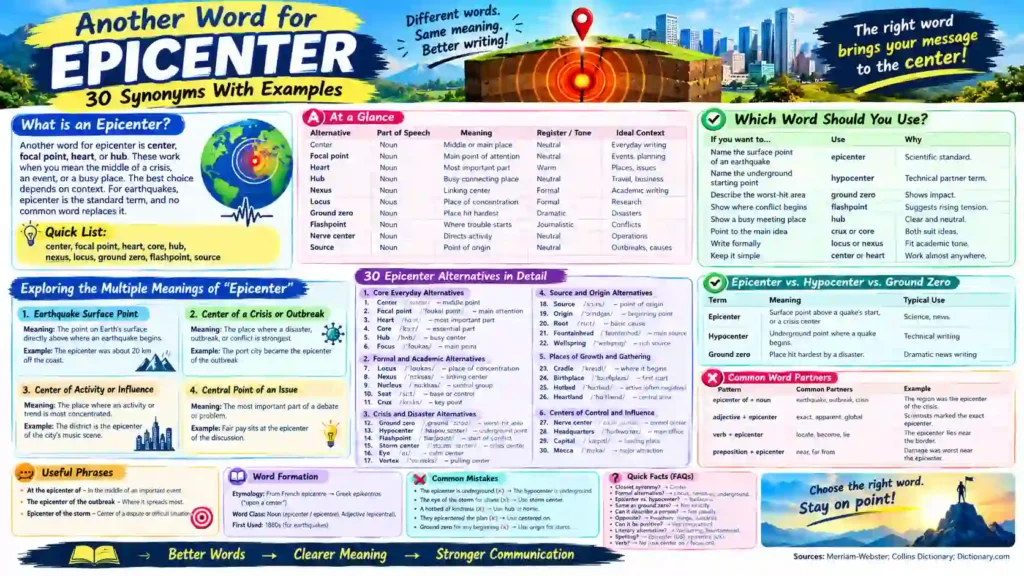
Another word for epicenter is center, focal point, heart, or hub. These work when you mean the middle of a crisis, an event, or a busy place. The best choice depends on context. For earthquakes, epicenter is the standard term, and no common word replaces it.
Some alternatives stress intensity, such as ground zero. Others stress activity, such as nerve center, or origin, such as source. Choosing by meaning keeps your writing clear.
Quick list: center, focal point, heart, core, hub, nexus, locus, ground zero, flashpoint, source
This article covers 30 alternatives, with meanings, IPA, usage notes, examples, and context.
At a Glance: Epicenter Synonyms and Related Alternatives
| Alternative | Part of Speech | Meaning | Register / Tone | Ideal Context |
| Center | noun | Middle or main place | Neutral | Everyday writing |
| Focal point | noun | Main point of attention | Neutral | Events, planning |
| Heart | noun | Most important part | Warm | Places, issues |
| Hub | noun | Busy connecting place | Neutral | Travel, business |
| Nexus | noun | Linking center | Formal | Academic writing |
| Locus | noun | Place of concentration | Formal | Research |
| Ground zero | noun | Place hit hardest | Dramatic | Disasters |
| Flashpoint | noun | Place where trouble starts | Journalistic | Conflicts |
| Nerve center | noun | Place that directs activity | Neutral | Operations |
| Source | noun | Point of origin | Neutral | Outbreaks, causes |
Which Word Should You Use?
| If you want to… | Use | Why |
| Name the surface point of an earthquake | epicenter | It is the scientific standard. |
| Name the underground starting point | hypocenter | It is the technical partner term. |
| Describe the worst-hit area | ground zero | It shows impact. |
| Show where conflict begins | flashpoint | It suggests rising tension. |
| Show a busy meeting place | hub | It is clear and neutral. |
| Point to the main idea | crux or core | Both suit ideas. |
| Write formally | locus or nexus | Both fit academic tone. |
| Keep it simple | center or heart | They work almost anywhere. |
Exploring the Multiple Meanings of Epicenter
1. Earthquake Surface Point
- Meaning: The point on Earth’s surface directly above where an earthquake begins.
- Explanation: This is the scientific sense. The quake itself starts deeper underground.
- Example: The epicenter was about 20 kilometers off the coast.
2. Center of a Crisis or Outbreak
- Meaning: The place where a disaster, outbreak, or conflict is strongest.
- Explanation: This figurative sense is common in news. It stresses intensity, not only position.
- Example: The port city became the epicenter of the outbreak.
3. Center of Activity or Influence
- Meaning: The place where an activity or trend is most concentrated.
- Explanation: The tone can be positive here, as in culture, trade, or technology.
- Example: The district is the epicenter of the city’s music scene.
4. Central Point of an Issue
- Meaning: The most important part of a debate or problem.
- Explanation: This sense is abstract. In it, crux often sounds more natural.
- Example: Fair pay sits at the epicenter of the discussion.
Sources: Merriam-Webster; Collins Dictionary; Dictionary.com
Analyzing 30 Epicenter Alternatives in Detail
Some alternatives below are close synonyms, while others are related words that fit only certain contexts.
Core Everyday Alternatives
1. Center
IPA: US /ˈsɛntɚ/ · UK /ˈsentə/
Definition: The middle point or main place of something.
- Usage: The closest everyday synonym. It is neutral and fits most figurative uses.
- Example: The town became the center of the crisis.
2. Focal point
IPA: US /ˈfoʊkəl ˌpɔɪnt/ · UK /ˈfəʊkl ˌpɔɪnt/
Definition: A central point of attention or interest.
- Usage: A close synonym for figurative uses. It does not suit earthquakes.
- Example: The harbor is the focal point of the festival.
3. Heart
IPA: US /hɑːrt/ · UK /hɑːt/
Definition: The central or most important part of something.
- Usage: Warm and common. It suggests importance more than intensity.
- Example: The old market sits at the heart of the city.
4. Core
IPA: US /kɔːr/ · UK /kɔː/
Definition: The central, most essential part of something.
- Usage: Related. It stresses the essential inner part, often of an issue.
- Example: Trust is at the core of the problem.
5. Hub
IPA: (US and UK) /hʌb/
Definition: A center of activity where things meet or connect.
- Usage: Related. It shows busyness, not intensity.
- Example: The airport is a hub for travelers across Asia.
6. Focus
IPA: US /ˈfoʊkəs/ · UK /ˈfəʊkəs/
Definition: The main point of attention or activity.
- Usage: Related. In seismology, focus means the hypocenter, so avoid it for the surface point.
- Example: Housing is now the focus of the debate.
Formal and Academic Alternatives
7. Locus
IPA: US /ˈloʊkəs/ · UK /ˈləʊkəs/
Definition: The place where something happens or is concentrated.
- Usage: Formal and rare. It is a close alternative in academic writing.
- Example: The university was the locus of the movement.
8. Nexus
IPA: (US and UK) /ˈnɛksəs/
Definition: A connection, or a center that links several things.
- Usage: Formal and related. It stresses links, not intensity.
- Example: The city is a nexus of trade and culture.
9. Nucleus
IPA: US /ˈnuːkliəs/ · UK /ˈnjuːkliəs/
Definition: The central part around which other things gather.
- Usage: Related. It suggests a small starting group.
- Example: A few volunteers formed the nucleus of the project.
10. Seat
IPA: (US and UK) /siːt/
Definition: The place where something is based or controlled.
- Usage: Formal and related, as in seat of government.
- Example: The city is the seat of regional power.
11. Crux
IPA: (US and UK) /krʌks/
Definition: The most important or central point of an issue.
- Usage: Related. Use it for ideas and problems, never places.
- Example: The crux of the debate is funding.
Crisis and Disaster Alternatives
12. Ground zero
IPA: US /ˌɡraʊnd ˈziroʊ/ · UK /ˌɡraʊnd ˈzɪərəʊ/
Definition: The place where a disaster or major event hits hardest.
- Usage: Strong and dramatic. Use it with care, because it recalls tragic events.
- Example: The coast was ground zero for the storm damage.
13. Hypocenter
IPA: US /ˈhaɪpoʊˌsɛntɚ/ · UK /ˈhaɪpəʊˌsentə/
Definition: The point inside Earth where an earthquake begins.
- Usage: Technical and related, not a synonym. It lies directly below the epicenter.
- Example: The hypocenter lay ten kilometers below the surface.
14. Flashpoint
IPA: (US and UK) /ˈflæʃˌpɔɪnt/
Definition: A place or moment where trouble or violence may begin.
- Usage: Related. It stresses the start of conflict.
- Example: The border became a flashpoint for tension.
15. Storm center
IPA: US /ˈstɔːrm ˌsɛntɚ/ · UK /ˈstɔːm ˌsentə/
Definition: The center of a storm, or of a dispute.
- Usage: A close figurative synonym, common in journalism.
- Example: The new rule put the school at the storm center.
16. Eye
IPA: (US and UK) /aɪ/
Definition: The calm center of a storm.
- Usage: Related only. The eye is calm, while an epicenter is intense.
- Example: The ship sailed into the eye of the hurricane.
17. Vortex
IPA: US /ˈvɔːrtɛks/ · UK /ˈvɔːteks/
Definition: Something that pulls in everything around it, like a whirlpool.
- Usage: Dramatic and related. It stresses pull, not position.
- Example: The city became a vortex of rumors.
Source and Origin Alternatives
18. Source
IPA: US /sɔːrs/ · UK /sɔːs/
Definition: The place or thing something comes from.
- Usage: Related. An outbreak’s epicenter may be its source, but not always.
- Example: Officials traced the outbreak to its source.
19. Origin
IPA: US /ˈɔːrɪdʒɪn/ · UK /ˈɒrɪdʒɪn/
Definition: The point where something begins.
- Usage: Related. It looks back in time, not at current intensity.
- Example: The origin of the fire is still unknown.
20. Root
IPA: (US and UK) /ruːt/
Definition: The basic cause of something.
- Usage: Related. It suits causes, not places.
- Example: Poor planning was the root of the delay.
21. Fountainhead
IPA: US /ˈfaʊntənˌhɛd/ · UK /ˈfaʊntɪnhed/
Definition: The main source or origin of something.
- Usage: Formal and related. It suits ideas and movements.
- Example: The institute was the fountainhead of the reform.
22. Wellspring
IPA: (US and UK) /ˈwɛlsprɪŋ/
Definition: A rich, continuing source of something.
- Usage: Literary and related.
- Example: Curiosity is a wellspring of new ideas.
Places of Growth and Gathering
23. Cradle
IPA: (US and UK) /ˈkreɪdl/
Definition: A place where something begins and grows.
- Usage: Literary and related, as in cradle of civilization.
- Example: Greece is often called the cradle of democracy.
24. Birthplace
IPA: US /ˈbɜːrθpleɪs/ · UK /ˈbɜːθpleɪs/
Definition: The place where something first began.
- Usage: Related. It stresses history.
- Example: The town is the birthplace of the movement.
25. Hotbed
IPA: US /ˈhɑːtˌbɛd/ · UK /ˈhɒtbed/
Definition: A place with lots of activity, often unwanted.
- Usage: Related and usually negative. Avoid it for neutral topics.
- Example: The region was a hotbed of unrest.
26. Heartland
IPA: US /ˈhɑːrtlænd/ · UK /ˈhɑːtlænd/
Definition: The central or most important area of a region or activity.
- Usage: Related. It suits large regions, not single points.
- Example: The valley is the heartland of the wine industry.
Centers of Control and Influence
27. Nerve center
IPA: US /ˈnɜːrv ˌsɛntɚ/ · UK /ˈnɜːv ˌsentə/
Definition: The place that controls or directs an operation.
- Usage: Related. It stresses control, not impact.
- Example: The control room is the nerve center of the station.
28. Headquarters
IPA: US /ˈhɛdˌkwɔːrtɚz/ · UK /ˌhedˈkwɔːtəz/
Definition: The main office or base of an organization.
- Usage: Related and literal. It fits organizations only.
- Example: The group’s headquarters is in Nairobi.
29. Capital
IPA: (US and UK) /ˈkæpɪtl/
Definition: A place that leads in a certain activity.
- Usage: Related. It needs a qualifier, as in fashion capital.
- Example: Milan is a fashion capital.
30. Mecca
IPA: (US and UK) /ˈmɛkə/
Definition: A place many people are drawn to for a shared interest.
- Usage: Related. The lowercase figurative sense differs from the city’s name, so some writers prefer hub.
- Example: The island is a mecca for divers.
Sources: Merriam-Webster; Collins Dictionary and Thesaurus; Dictionary.com
Epicenter vs. Hypocenter vs. Ground Zero
These three terms are often confused.
| Term | Meaning | Typical Use |
| Epicenter | Surface point above a quake’s start, or a crisis center | Science, news |
| Hypocenter | Underground point where a quake begins | Technical writing |
| Ground zero | Place hit hardest by a disaster | Dramatic news writing |
Sources: Merriam-Webster; Collins Dictionary
Epicenter and Opposite/Paired Word Pairs
| Word | Paired Word | Note |
| Epicenter | Hypocenter | A technical pair: surface and underground |
| Epicenter | Periphery | The outer edge of an area or event |
| Epicenter | Fringe | The outer, less affected part |
| Epicenter | Outskirts | The edges of a place |
Epicenter has no perfect antonym. However, words for edges and outer areas show the contrast well.
Sources: Merriam-Webster; Collins Thesaurus
Common Word Partners of Epicenter
| Pattern | Common Partners | Example |
| epicenter of + noun | the earthquake, the outbreak, the crisis | The region was the epicenter of the crisis. |
| adjective + epicenter | exact, apparent, global | Scientists marked the exact epicenter. |
| verb + epicenter | locate, become, lie | The epicenter lies near the border. |
| preposition + epicenter | near, far from | Damage was worst near the epicenter. |
Sources: Collins Dictionary; Merriam-Webster
Idiomatic Phrases Featuring Epicenter
Epicenter has no true idioms. The following are established expressions instead.
1. At the epicenter of
- Meaning: In the middle of an important event or change.
- Example: Teachers found themselves at the epicenter of the reform.
2. The epicenter of the outbreak
- Meaning: The place where a disease is spreading most strongly.
- Example: Doctors rushed supplies to the epicenter of the outbreak.
3. Epicenter of the storm
- Meaning: The center of a dispute or difficult situation.
- Example: The mayor stood at the epicenter of the storm.
Sources: Merriam-Webster; Collins Dictionary
Word Formation of Epicenter
Etymology & Structure
Epicenter came into English from French épicentre. That word came from Greek epikentros, meaning situated on a center. It combines epi (upon) and kentron (center).
Date and History
Etymonline places the English word in the 1880s, first for earthquakes. The figurative sense developed later.
Word Class Variations
- Noun: epicenter (US), epicentre (UK)
- Adjective: epicentral
No standard verb or adverb exists.
Sources: Etymonline; Merriam-Webster
Frequently Asked Questions
What is the closest synonym for epicenter?
Center is the closest everyday synonym. Focal point and storm center also fit crisis contexts.
What is a formal alternative?
Locus and nexus suit formal writing.
What is the difference between epicenter and hypocenter?
The hypocenter is where a quake starts underground. The epicenter is directly above it, on the surface.
Is epicenter the same as ground zero?
Not exactly. Ground zero suggests where damage was worst, while epicenter names the central point.
Can epicenter describe a person?
Not usually. It names places, events, or issues. For people, say at the center of the debate.
What is the opposite of epicenter?
Periphery, fringe, and outskirts show the contrast best.
Can epicenter be positive?
Yes. The epicenter of innovation is a common phrase.
Conclusion
The closest everyday alternatives to epicenter are center, focal point, heart, and hub. They work in most news and general writing.
Still, each word carries its own meaning. Hypocenter is technical, ground zero is dramatic, and source looks back to origins. For this reason, context matters.
To choose well, ask what you want to stress: location, intensity, origin, or activity. Then pick the word that matches. When in doubt, center is a safe choice.

Hi, I’m HAROON ,founder of LifeLoomer.com, I started LifeLoomer with one belief: the internet is full of answers, but not enough understanding. So I write guides that actually explain things the meanings behind everyday words, the small habits that make life better, and the how-tos nobody taught us.
Everything I publish is researched, written in plain words, and tested against one question: will this genuinely help someone today?
Thanks for being here. I hope you leave a little wiser than you came.