
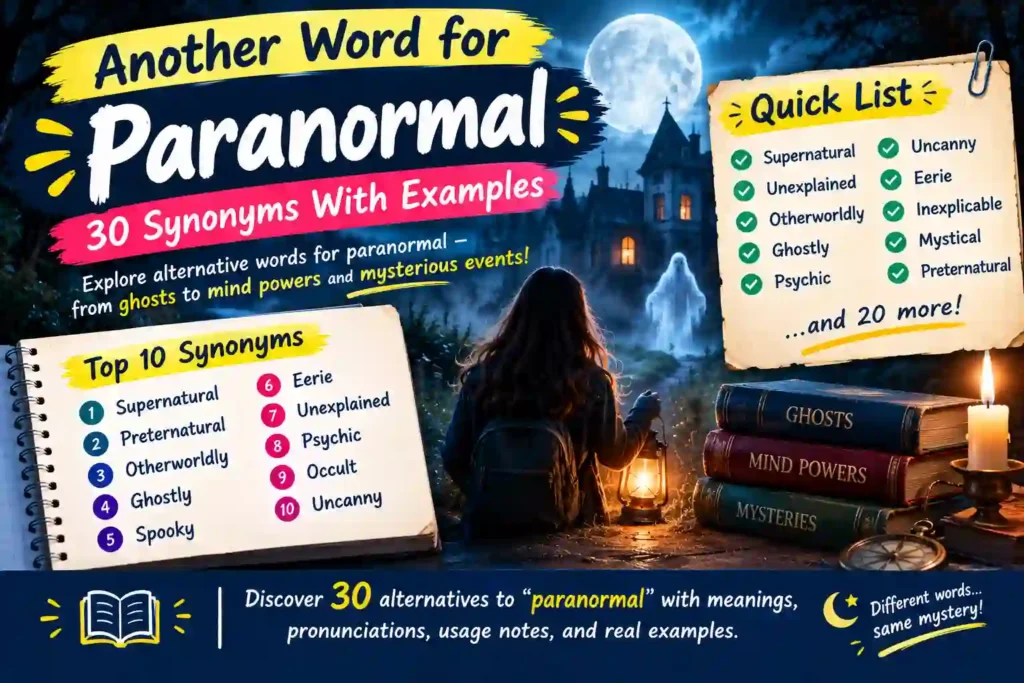
The closest everyday words for paranormal are supernatural, unexplained, and otherworldly. Paranormal describes events that science cannot explain, so the best alternative depends on the meaning you want.
Some words suggest ghosts, while others point to mind powers or simple mystery. Because paranormal covers all three areas, this guide groups its alternatives by meaning.
Quick list: supernatural, unexplained, otherworldly, ghostly, psychic, uncanny, eerie, inexplicable, mystical, preternatural
Below, 30 alternatives are explained with meanings, IPA, usage notes, and examples.
At a Glance: Paranormal Synonyms and Related Alternatives
| Alternative | Part of Speech | Meaning | Register / Tone | Ideal Context |
| Supernatural | adjective | beyond nature | neutral | general use |
| Preternatural | adjective | beyond the natural | formal | fiction |
| Otherworldly | adjective | not of this world | neutral | descriptions |
| Ghostly | adjective | like a ghost | neutral | spirits |
| Spooky | adjective | mildly scary | informal | light stories |
| Eerie | adjective | strange and creepy | neutral | mood |
| Unexplained | adjective | without a known cause | neutral | mysteries |
| Psychic | adjective | about mind powers | neutral | mind abilities |
| Occult | adjective | about hidden magic | formal | secret rituals |
| Uncanny | adjective | strangely unsettling | neutral | odd coincidences |
Which Word Should You Use?
| If you want to… | Use | Why |
| Match paranormal closely | supernatural | Widely understood |
| Describe ghosts | ghostly | Fits spirits directly |
| Describe a creepy mood | eerie | Stresses atmosphere |
| Describe mind powers | psychic | Names the ability |
| Describe a mystery | unexplained | Avoids claiming ghosts |
| Write formally | preternatural | Literary and precise |
| Keep it light | spooky | Playful, not serious |
Exploring the Multiple Meanings of “Paranormal”
1. Beyond Science
- Meaning: Not explainable by known scientific laws.
- Explanation: This is the main sense, so it covers most uses of the word.
- Example: Visitors report paranormal activity in the old mansion.
2. Ghosts and Spirits
- Meaning: Linked to ghosts or other unseen beings.
- Explanation: Films and shows use this sense most often.
- Example: The show follows a team of paranormal investigators.
3. Mind Powers
- Meaning: Mental abilities beyond the normal senses.
- Explanation: Telepathy and clairvoyance belong here, and parapsychology investigates claims about them.
- Example: Researchers tested paranormal mind abilities in the lab.
4. The Paranormal as a Subject
- Meaning: Events and ideas of this kind, taken together.
- Explanation: Here the word works as a noun, usually after “the.”
- Example: He is curious about the paranormal.
Sources: Merriam-Webster; Etymonline.
Analyzing 30 Paranormal Alternatives in Detail
Some alternatives are direct synonyms, while others are related words that fit only certain contexts.
Core Synonyms
1. Supernatural
IPA: US /ˌsuːpərˈnætʃərəl/ · UK /ˌsuːpəˈnætʃərəl/
Definition: Beyond the natural world or its laws.
- Usage: Closest synonym; however, it often suggests gods or spirits.
- Example: Many stories feature supernatural beings.
2. Preternatural
IPA: US /ˌpriːtərˈnætʃərəl/ · UK /ˌpriːtəˈnætʃərəl/
Definition: Beyond what is normal in nature.
- Usage: Close synonym; formal and literary, so it suits fiction.
- Example: A preternatural calm settled over the town when the storm passed.
3. Otherworldly
IPA: US /ˌʌðərˈwɜːrldli/ · UK /ˌʌðəˈwɜːldli/
Definition: Seeming to belong to another world.
- Usage: Related word; instead of a cause, it describes a feeling.
- Example: The singer’s voice sounded otherworldly when the lights dimmed.
4. Unearthly
IPA: US /ʌnˈɜːrθli/ · UK /ʌnˈɜːθli/
Definition: Strange or ghostly, as if not from earth.
- Usage: Related word; also, it can mean absurdly early.
- Example: An unearthly glow filled the cave when we entered.
5. Uncanny
IPA: /ʌnˈkæni/ (US and UK)
Definition: Strange in an unsettling way.
- Usage: Related word, but it fits coincidences better than ghosts.
- Example: The twins share an uncanny likeness.
Ghostly and Spooky Alternatives
6. Ghostly
IPA: US /ˈɡoʊstli/ · UK /ˈɡəʊstli/
Definition: Like or relating to a ghost.
- Usage: Close synonym, but only for the spirit sense.
- Example: A ghostly figure appeared at the window when the clock struck twelve.
7. Haunted
IPA: /ˈhɔːntɪd/ (US and UK)
Definition: Said to be visited by ghosts.
- Usage: Related word; it describes places, so it rarely fits events.
- Example: Locals call the hotel haunted because guests hear footsteps.
8. Spectral
IPA: /ˈspɛktrəl/ (US and UK)
Definition: Relating to a ghost or spirit.
- Usage: Related word; also formal and literary.
- Example: A spectral light drifted across the field.
9. Spooky
IPA: /ˈspuːki/ (US and UK)
Definition: Mildly frightening, especially in a ghostly way.
- Usage: Informal related word; therefore it suits playful stories.
- Example: The kids loved the spooky story, but they slept with the lights on.
10. Eerie
IPA: US /ˈɪri/ · UK /ˈɪəri/
Definition: Strange and a little frightening.
- Usage: Related word; it stresses mood instead of cause.
- Example: The empty hallway felt eerie when the lights flickered.
Unexplained and Mysterious Alternatives
11. Unexplained
IPA: /ˌʌnɪkˈspleɪnd/ (US and UK)
Definition: Having no known cause.
- Usage: Neutral synonym, but unlike paranormal, it claims nothing supernatural.
- Example: Scientists studied the unexplained lights because many people reported them.
12. Inexplicable
IPA: /ˌɪnɪkˈsplɪkəbəl/ (US and UK)
Definition: Impossible to explain.
- Usage: Formal synonym; also, it fits everyday puzzles.
- Example: His sudden disappearance remains inexplicable.
13. Mysterious
IPA: US /mɪˈstɪriəs/ · UK /mɪˈstɪəriəs/
Definition: Hard to understand or explain.
- Usage: Broad related word; however, it can sound vague.
- Example: A mysterious sound woke us after midnight.
14. Anomalous
IPA: US /əˈnɑːmələs/ · UK /əˈnɒmələs/
Definition: Different from what is expected.
- Usage: Related technical word; for example, scientists use it for odd data.
- Example: The team recorded anomalous readings while the equipment warmed up.
15. Mystifying
IPA: /ˈmɪstɪfaɪɪŋ/ (US and UK)
Definition: Confusing and hard to understand.
- Usage: Related word, but it stresses puzzlement more than fear.
- Example: The mystifying event baffled the town.
Mind-Power Alternatives
16. Psychic
IPA: /ˈsaɪkɪk/ (US and UK)
Definition: Relating to mind abilities beyond normal senses.
- Usage: Related word, but it fits only the mind-power sense.
- Example: She claims to have psychic gifts, but nobody has proved it.
17. Extrasensory
IPA: /ˌɛkstrəˈsɛnsəri/ (US and UK)
Definition: Beyond the normal senses.
- Usage: Related word; especially common in “extrasensory perception.”
- Example: The study tested extrasensory perception.
18. Telepathic
IPA: /ˌtɛləˈpæθɪk/ (US and UK)
Definition: Able to share thoughts without speaking.
- Usage: Narrow related word, because it covers one mind power.
- Example: The characters in the film are telepathic.
19. Clairvoyant
IPA: US /klɛrˈvɔɪənt/ · UK /kleəˈvɔɪənt/
Definition: Able to see hidden things or the future.
- Usage: Related word; similarly, it fits fortune-telling claims.
- Example: The clairvoyant predicted a long journey.
20. Telekinetic
IPA: /ˌtɛləkɪˈnɛtɪk/ (US and UK)
Definition: Able to move objects with the mind.
- Usage: Narrow related word; in fact, it is common in fantasy.
- Example: The telekinetic hero lifted the car when she was cornered.
Mystical and Hidden Alternatives
21. Occult
IPA: US /əˈkʌlt/ · UK /ˈɒkʌlt/
Definition: Relating to secret, magical practices.
- Usage: Related word; besides mystery, it suggests ritual.
- Example: The library holds books on occult history.
22. Mystical
IPA: /ˈmɪstɪkəl/ (US and UK)
Definition: Relating to spiritual mystery or deep faith.
- Usage: Related word; in contrast, it is often positive and religious.
- Example: The monks described a mystical experience after long meditation.
23. Esoteric
IPA: /ˌɛsəˈtɛrɪk/ (US and UK)
Definition: Known or understood by only a few.
- Usage: Related word; however, it means obscure, not supernatural.
- Example: The lecture covered esoteric theories.
24. Metaphysical
IPA: /ˌmɛtəˈfɪzɪkəl/ (US and UK)
Definition: Relating to ideas beyond the physical world.
- Usage: Related word; it is philosophical, so it may sound abstract.
- Example: They debated metaphysical questions while they walked home.
25. Spiritual
IPA: /ˈspɪrɪtʃuəl/ (US and UK)
Definition: Relating to the soul rather than the body.
- Usage: Related word, although it is rarely frightening.
- Example: She found peace in spiritual practice.
Strange and Extraordinary Alternatives
26. Abnormal
IPA: US /æbˈnɔːrməl/ · UK /æbˈnɔːməl/
Definition: Different from what is normal.
- Usage: Related word; it sounds medical, so it lacks supernatural meaning.
- Example: The lab noted abnormal results because the machine overheated.
27. Extraordinary
IPA: US /ɪkˈstrɔːrdneri/ · UK /ɪkˈstrɔːdnri/
Definition: Far beyond what is usual.
- Usage: Related word; while it is positive or neutral, it implies no spirits.
- Example: Her recovery was extraordinary.
28. Miraculous
IPA: /mɪˈrækjələs/ (US and UK)
Definition: Seeming to break natural laws, often happily.
- Usage: Related word; it suggests wonder, so it is often positive.
- Example: The family called the rescue miraculous when everyone survived.
29. Magical
IPA: /ˈmædʒɪkəl/ (US and UK)
Definition: Having or seeming to have magic.
- Usage: Related word; it is playful, especially in stories.
- Example: The magical forest glowed at dusk.
30. Weird
IPA: US /wɪrd/ · UK /wɪəd/
Definition: Strange or unusual.
- Usage: Informal related word; because it is vague, avoid it in formal writing.
- Example: Weird noises came from the attic, so we checked.
Sources: Merriam-Webster.
Paranormal vs. Supernatural vs. Unexplained
| Word | Main Idea | Tone |
| Paranormal | events science cannot explain | neutral |
| Supernatural | beyond nature, often spirits or gods | neutral |
| Unexplained | no known cause yet | neutral, careful |
Paranormal and supernatural overlap closely. However, supernatural is broader and can involve gods or spirits. Meanwhile, unexplained makes no claim about the cause.
Sources: Merriam-Webster; Etymonline.
Paranormal and Opposite/Paired Word Pairs
| Word | Paired Word | Note |
| Paranormal | Normal | Within usual limits |
| Paranormal | Natural | Explained by nature |
| Paranormal | Scientific | Supported by evidence |
| Paranormal | Ordinary | Everyday and expected |
Paranormal has no strict antonym. Instead, these words show natural contrasts.
Sources: Merriam-Webster.
Common Word Partners of “Paranormal”
| Pattern | Common Partners | Example |
| paranormal + event | occurrence, phenomenon, anomaly | Locals describe paranormal occurrences. |
| paranormal + person | researcher, podcaster | A paranormal researcher visited the house. |
| paranormal + media | podcast, genre | She hosts a paranormal podcast. |
| the + paranormal | the paranormal | Many writers explore the paranormal. |
Sources: Merriam-Webster.
Idiomatic Phrases Featuring “Paranormal”
Paranormal has no true idioms. These are established expressions.
1. Paranormal activity
- Meaning: Events blamed on ghosts or unexplained forces.
- Example: Staff reported paranormal activity at night.
2. Paranormal investigator
- Meaning: A person who studies reported ghosts or strange events.
- Example: A paranormal investigator checked the old school.
3. Paranormal romance
- Meaning: A fiction genre mixing love stories with supernatural beings.
- Example: She reads paranormal romance on weekends.
Sources: Merriam-Webster.
Word Formation of “Paranormal”
Etymology & Structure
Paranormal joins the prefix para- with the word normal. Para- comes from Greek and means “beside” or “beyond,” so the word suggests “beyond the normal.”
Date and History
Both Merriam-Webster and Etymonline date the word to 1905.
Word Class Variations
- Adjective: paranormal
- Adverb: paranormally
- Noun: the paranormal
- Related: parapsychology
Sources: Merriam-Webster; Etymonline.
Frequently Asked Questions
What is the closest synonym for paranormal?
Supernatural is the closest, though unexplained is more neutral.
What is a neutral alternative?
Unexplained, because it claims no cause.
What is the opposite of paranormal?
Normal or natural, though no strict antonym exists.
Can paranormal describe a person?
Rarely. Instead, say psychic or clairvoyant.
Can paranormal mean scary?
Not alone, but spooky and eerie add fear.
Is paranormal ever a noun?
Yes, as in “the paranormal.”
What is parapsychology?
It is the field that studies claims of mind powers like telepathy.
Conclusion
The closest alternatives to paranormal are supernatural, unexplained, and otherworldly. Ghostly, psychic, and eerie fit narrower meanings.
Context matters because each word carries a different idea. For example, ghostly points to spirits, while psychic points to the mind.
To choose well, first decide which meaning you need. Then match the word to the mood and level of formality.

Hi, I’m HAROON ,founder of LifeLoomer.com, I started LifeLoomer with one belief: the internet is full of answers, but not enough understanding. So I write guides that actually explain things the meanings behind everyday words, the small habits that make life better, and the how-tos nobody taught us.
Everything I publish is researched, written in plain words, and tested against one question: will this genuinely help someone today?
Thanks for being here. I hope you leave a little wiser than you came.