
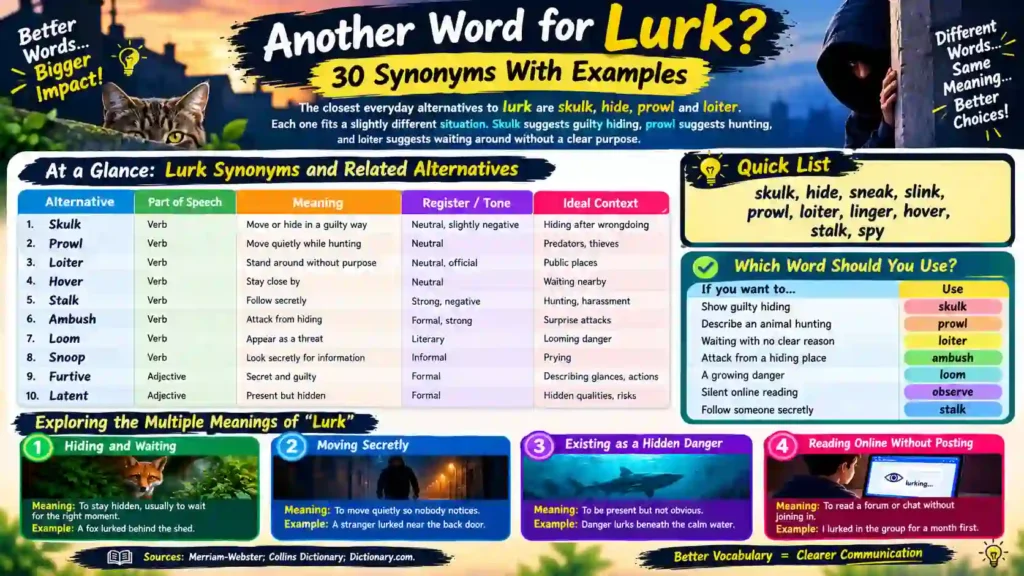
The closest everyday alternatives to lurk are skulk, hide, prowl, and loiter. Each one fits a slightly different situation. Skulk suggests guilty hiding, prowl suggests hunting, and loiter suggests waiting around without a clear purpose.
The best choice depends on meaning and context. Lurk can describe someone hiding with bad intent, a danger that is felt but not seen, or a person who reads an online forum without posting. Therefore, the right substitute changes with each sense.
Quick list: skulk, hide, sneak, slink, prowl, loiter, linger, hover, stalk, spy
Below, we examine 30 alternatives with meanings, IPA, usage notes, examples, and context.
At a Glance: Lurk Synonyms and Related Alternatives
| Alternative | Part of Speech | Meaning | Register / Tone | Ideal Context |
| Skulk | Verb | Move or hide in a guilty way | Neutral, slightly negative | Hiding after wrongdoing |
| Prowl | Verb | Move quietly while hunting | Neutral | Predators, thieves |
| Loiter | Verb | Stand around without purpose | Neutral, official | Public places |
| Hover | Verb | Stay close by | Neutral | Waiting nearby |
| Stalk | Verb | Follow secretly | Strong, negative | Hunting, harassment |
| Ambush | Verb | Attack from hiding | Formal, strong | Surprise attacks |
| Loom | Verb | Appear as a threat | Literary | Looming danger |
| Snoop | Verb | Look secretly for information | Informal | Prying |
| Furtive | Adjective | Secret and guilty | Formal | Describing glances, actions |
| Latent | Adjective | Present but hidden | Formal | Hidden qualities, risks |
Which Word Should You Use?
| If you want to… | Use | Why |
| Show guilty hiding | skulk | It suggests shame or bad intent. |
| Describe an animal hunting | prowl | It suggests quiet, active movement. |
| Describe waiting with no clear reason | loiter | It sounds official and neutral. |
| Describe attack from a hiding place | ambush | It names the surprise attack itself. |
| Describe a danger that is growing | loom | It fits threats that feel close. |
| Describe silent online reading | observe | It carries no negative tone. |
| Describe following someone secretly | stalk | It is serious and often criminal. |
Exploring the Multiple Meanings of “Lurk”
1. Hiding and Waiting
- Meaning: To stay hidden, usually to wait for the right moment.
- Explanation: This is the classic sense. It often suggests bad intent, but it can describe animals too.
- Example: A fox lurked behind the shed.
2. Moving Secretly
- Meaning: To move quietly so nobody notices.
- Explanation: Here, lurk describes movement as well as stillness. However, words like sneak and slink show this more clearly.
- Example: A stranger lurked near the back door.
3. Existing as a Hidden Danger
- Meaning: To be present but not obvious.
- Explanation: This figurative sense applies to things, not people. The danger exists, but nobody can see it yet.
- Example: Danger lurks beneath the calm water.
4. Reading Online Without Posting
- Meaning: To read a forum or chat without joining in.
- Explanation: This modern sense is often neutral. Many people lurk for weeks before they post.
- Example: I lurked in the group for a month first.
Sources: Merriam-Webster; Collins Dictionary; Dictionary.com.
Analyzing 30 Lurk Alternatives in Detail
Some alternatives below are direct synonyms. Others are related words that fit only certain senses, and each note says which is which.
Core Synonyms: Hiding and Moving Secretly
1. Skulk
IPA: /skʌlk/ (US and UK)
Definition: To hide or move in a secretive, guilty way.
- Usage: A close synonym. It adds a sense of guilt or cowardice.
- Example: He skulked behind the wall until the guard left.
2. Hide
IPA: /haɪd/ (US and UK)
Definition: To put yourself where you cannot be seen.
- Usage: The plainest alternative. It lacks the sense of waiting with bad intent.
- Example: The children hid behind the curtain.
3. Sneak
IPA: /sniːk/ (US and UK)
Definition: To move quietly so as not to be noticed.
- Usage: Related. It stresses movement, whereas lurk stresses staying put.
- Example: She sneaked past the sleeping dog.
4. Slink
IPA: /slɪŋk/ (US and UK)
Definition: To move quietly, often from shame or fear.
- Usage: Related. It suggests a smooth, guilty exit.
- Example: He slunk out of the room.
5. Prowl
IPA: /praʊl/ (US and UK)
Definition: To move around quietly, looking for prey or a chance.
- Usage: Close synonym for movement. It is more active than lurk.
- Example: A cat prowled the garden at night.
6. Creep
IPA: /kriːp/ (US and UK)
Definition: To move slowly and quietly, often close to the ground.
- Usage: Related. It describes movement, not hiding.
- Example: The thief crept along the hallway.
Waiting and Watching
7. Ambush
IPA: /ˈæmbʊʃ/ (US and UK)
Definition: To attack by surprise from a hidden place.
- Usage: Related. It names the attack that often follows lurking.
- Example: Soldiers ambushed the convoy.
8. Stalk
IPA: /stɔːk/ (US and UK)
Definition: To follow a person or animal in secret.
- Usage: Related and stronger. It often implies harassment or hunting.
- Example: The lion stalked the herd.
9. Watch
IPA: US /wɑːtʃ/ · UK /wɒtʃ/
Definition: To look at something carefully.
- Usage: Weak, general alternative. It lacks the hiding element.
- Example: She watched the street from the window.
10. Spy
IPA: /spaɪ/ (US and UK)
Definition: To watch someone secretly.
- Usage: Related. It focuses on collecting information.
- Example: He spied on his neighbors.
11. Wait
IPA: /weɪt/ (US and UK)
Definition: To stay in place until something happens.
- Usage: Very general. It covers only the waiting part of lurk.
- Example: They waited by the gate.
12. Eavesdrop
IPA: US /ˈiːvzdrɑːp/ · UK /ˈiːvzdrɒp/
Definition: To listen secretly to a private talk.
- Usage: Related. It applies to listening, not hiding.
- Example: She eavesdropped from the stairs.
Hanging Around
13. Loiter
IPA: US /ˈlɔɪtər/ · UK /ˈlɔɪtə/
Definition: To stand around without an obvious reason.
- Usage: Close synonym in public settings. It sounds official.
- Example: Teenagers loitered outside the shop.
14. Linger
IPA: US /ˈlɪŋɡər/ · UK /ˈlɪŋɡə/
Definition: To stay longer than expected.
- Usage: Related. It is gentler and has no hidden intent.
- Example: He lingered near the door.
15. Hover
IPA: US /ˈhʌvər/ · UK /ˈhɒvə/
Definition: To stay close, often while waiting.
- Usage: Related. It is less secretive than lurk.
- Example: A waiter hovered by our table.
16. Tarry
IPA: /ˈtæri/ (US and UK)
Definition: To stay somewhere longer than you should.
- Usage: Old-fashioned and formal. It is related, not exact.
- Example: Do not tarry on the bridge.
Figurative Threats
17. Loom
IPA: /luːm/ (US and UK)
Definition: To appear as a large, threatening shape or event.
- Usage: Fits danger that is near. It is not used for people hiding.
- Example: A storm loomed over the town.
18. Brew
IPA: /bruː/ (US and UK)
Definition: To develop slowly, as trouble does.
- Usage: Related. It fits trouble that is building.
- Example: Trouble was brewing in the office.
19. Smolder
IPA: US /ˈsmoʊldər/ · UK /ˈsməʊldə/ (spelled smoulder in UK)
Definition: To burn slowly, or to keep a strong feeling hidden.
- Usage: Related. It suits anger or tension kept below the surface.
- Example: Anger smoldered between the two brothers.
20. Haunt
IPA: /hɔːnt/ (US and UK)
Definition: To stay in the mind or in a place, causing unease.
- Usage: Related. It describes lasting worry, not hiding.
- Example: The memory haunted her for years.
Online and Observing
21. Observe
IPA: US /əbˈzɜːrv/ · UK /əbˈzɜːv/
Definition: To watch carefully.
- Usage: A neutral, formal choice for the online sense.
- Example: Many users simply observe the forum.
22. Monitor
IPA: US /ˈmɑːnətər/ · UK /ˈmɒnɪtə/
Definition: To watch something over time.
- Usage: Related. It suggests a task or duty.
- Example: He monitored the chat for updates.
23. Browse
IPA: /braʊz/ (US and UK)
Definition: To look through content casually.
- Usage: Related. It carries no secret intent.
- Example: She browsed the thread without replying.
24. Snoop
IPA: /snuːp/ (US and UK)
Definition: To look into private matters.
- Usage: Informal and negative. It fits prying more than lurking.
- Example: Stop snooping in my messages.
Descriptive Words Related to Lurking
25. Furtive
IPA: US /ˈfɜːrtɪv/ · UK /ˈfɜːtɪv/
Definition: Done secretly because of guilt.
- Usage: An adjective, so it is related, not a synonym. It describes how someone acts.
- Example: He gave the door a furtive glance.
26. Stealthy
IPA: /ˈstelθi/ (US and UK)
Definition: Quiet and careful, so as not to be noticed.
- Usage: Related adjective. It is less negative than furtive.
- Example: The cat made a stealthy approach.
27. Covert
IPA: US /ˈkoʊvɜːrt/ · UK /ˈkʌvət/
Definition: Hidden or secret.
- Usage: Formal adjective. It suits operations and plans.
- Example: The agency ran a covert mission.
28. Surreptitious
IPA: US /ˌsɜːrəpˈtɪʃəs/ · UK /ˌsʌrəpˈtɪʃəs/
Definition: Done secretly to avoid attention.
- Usage: Formal adjective. It is related, not a synonym.
- Example: She took a surreptitious look at her phone.
29. Clandestine
IPA: /klænˈdestɪn/ (US and UK)
Definition: Kept secret, often because it is illegal or not allowed.
- Usage: Formal adjective. It describes meetings or plans.
- Example: They held clandestine meetings.
30. Latent
IPA: /ˈleɪtənt/ (US and UK)
Definition: Present but not yet active or visible.
- Usage: Related adjective for the “hidden danger” sense only.
- Example: The disease can stay latent for years.
Sources: Merriam-Webster; Collins Dictionary; Collins Thesaurus; Dictionary.com.
Lurk vs. Skulk vs. Loiter
These three words are often confused, so this table separates them.
| Word | Main Idea | Intent | Typical Setting |
| Lurk | Hide and wait | Often bad, sometimes neutral | Shadows, forums |
| Skulk | Hide from guilt | Guilty | After wrongdoing |
| Loiter | Stand around | Unclear | Streets, shops |
In short, lurk stresses hiding, skulk stresses guilt, and loiter stresses having no purpose.
Sources: Merriam-Webster; Collins Dictionary.
Lurk and Opposite/Paired Word Pairs
| Word | Paired Word | Note |
| Lurk | Emerge | Moving from hiding into view |
| Lurk | Appear | Becoming visible |
| Lurk | Reveal oneself | A more formal contrast |
| Lurk (online) | Post / Participate | Reading versus joining in |
Lurk has no single fixed antonym. Instead, its opposite depends on the sense. For hiding, the contrast is coming into view. For online use, the contrast is taking part.
Sources: Collins Thesaurus; Merriam-Webster.
Common Word Partners of “Lurk”
| Pattern | Common Partners | Example |
| lurk + preposition | in, behind, beneath, around | Something lurked behind the tree. |
| lurk + place | shadows, forums, corners | He lurked in the shadows. |
| lurking + noun | danger, fear, doubt, threat | A lurking doubt remained. |
| lurker | forum lurker, silent lurker | Most lurkers never post. |
Sources: Collins Dictionary; Merriam-Webster.
Idiomatic Phrases Featuring “Lurk”
Lurk has few true idioms. The expressions below are well established, but they are fixed phrases rather than idioms in the strict sense.
1. Lurk in the shadows
- Meaning: To stay hidden, often with bad intent.
- Example: Reporters lurked in the shadows outside the hotel.
2. Lurk beneath the surface
- Meaning: To exist as a hidden problem.
- Example: Tension lurked beneath the surface of the meeting.
3. A lurking suspicion
- Meaning: A doubt that stays in the mind.
- Example: She had a lurking suspicion that he was lying.
Sources: Merriam-Webster; Collins Dictionary.
Word Formation of “Lurk”
Etymology & Structure
Lurk is a short, one-syllable verb. Etymonline suggests it may come from Scandinavian sources, or from an older English word related to lour, but the exact origin is uncertain.
Date and History
Etymonline dates the verb to the early 14th century, in the sense of lying hidden. The online sense is much newer and arose with internet forums.
Word Class Variations
- Verb: lurk, lurks, lurked, lurking
- Noun: lurker (a person who lurks)
- Adjective: lurking (as in “a lurking fear”)
Sources: Etymonline; Merriam-Webster; Collins Dictionary.
Frequently Asked Questions
What is the closest synonym for lurk?
Skulk is the closest. It also means to hide, but it adds a sense of guilt.
What does lurk mean online?
It means reading a forum or chat without posting. Many people use it neutrally.
What is the difference between lurk and loiter?
Lurk involves hiding, while loiter means standing around openly.
What is the opposite of lurk?
It depends on the sense. Emerge fits hiding, and post fits online use.
Is lurk always negative?
No. It is negative for hiding with bad intent, but neutral online.
What is a literary alternative?
Loom, smolder, and haunt work well in descriptive writing.
Is a lurker a bad person?
Not necessarily. Online, a lurker is just a silent reader.
Conclusion
The closest alternatives to lurk are skulk, hide, prowl, and loiter. Others, like loom, brew, and observe, fit narrower senses.
Context matters because lurk covers several meanings. It can describe a person hiding, a danger felt but unseen, or a quiet online reader. As a result, one substitute rarely works everywhere.
To choose well, first decide which sense you mean. Next, check the tone: guilty, neutral, or formal. Finally, use the tables above to confirm the word fits.

Hi, I’m HAROON ,founder of LifeLoomer.com, I started LifeLoomer with one belief: the internet is full of answers, but not enough understanding. So I write guides that actually explain things the meanings behind everyday words, the small habits that make life better, and the how-tos nobody taught us.
Everything I publish is researched, written in plain words, and tested against one question: will this genuinely help someone today?
Thanks for being here. I hope you leave a little wiser than you came.