
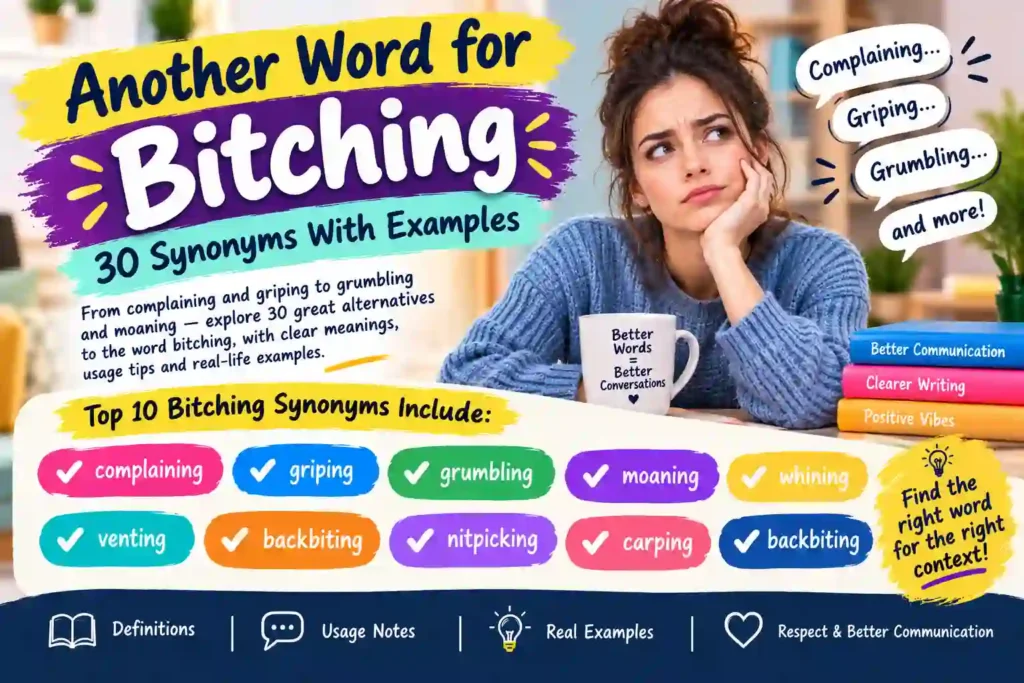
The closest everyday alternatives to bitching are complaining, griping, grumbling, and moaning. They keep the main meaning, which is expressing annoyance, but sound much milder.
The best choice depends on context. Bitching can mean complaining, spiteful talk about people, or, in older slang, something excellent. Many listeners find the word vulgar, so safer alternatives matter at work and in writing.
Quick list: complaining, griping, grumbling, moaning, whining, venting, bellyaching, carping, backbiting, nitpicking
This article covers 30 alternatives with meanings, IPA, usage notes, and examples.
At a Glance: Bitching Synonyms and Related Alternatives
| Alternative | Part of Speech | Meaning | Register / Tone | Ideal Context |
| Complaining | verb/noun | Expressing dissatisfaction | Neutral | Any setting |
| Griping | verb/noun | Complaining in an irritated way | Informal | Work, friends |
| Grumbling | verb/noun | Complaining in a low, unhappy tone | Neutral | Daily life |
| Moaning | verb/noun | Complaining at length | Informal, mostly UK | Casual talk |
| Whining | verb/noun | Complaining in a childish way | Critical | Judging behavior |
| Venting | verb/noun | Releasing frustration | Sympathetic | Emotional talk |
| Bellyaching | verb/noun | Complaining loudly | Informal | Casual talk |
| Carping | verb/noun | Complaining about small faults | Formal, critical | Writing |
| Backbiting | noun | Spiteful talk behind someone’s back | Negative | Social conflict |
| Nitpicking | verb/noun | Criticizing tiny details | Informal | Work, editing |
Which Word Should You Use?
| If you want to… | Use | Why |
| Stay neutral | Complaining | Works everywhere |
| Sound casual | Griping | Natural in speech |
| Show mild annoyance | Grumbling | Sounds quiet, not angry |
| Criticize childish behavior | Whining | Suggests weakness |
| Be kind to the speaker | Venting | Implies a need to talk |
| Describe unkind gossip | Backbiting | Focuses on harm to others |
| Describe petty criticism | Nitpicking | Points to small details |
| Write formally | Objecting | Sounds professional |
Exploring the Multiple Meanings of Bitching
1. Complaining
- Meaning: Expressing annoyance or dissatisfaction.
- Explanation: This is the most common sense. It is informal and often vulgar, so it can sound rude in polite settings.
- Example: I’m tired of his constant bitching about work.
2. Spiteful Talk
- Meaning: Malicious criticism or gossip about someone.
- Explanation: Here the target is a person, not a situation. The talk is meant to hurt.
- Example: The office was full of bitching after the meeting.
3. Excellent (Dated Slang)
- Meaning: Very good or impressive.
- Explanation: This adjective sense, often spelled bitchin’, is old American slang. It is rare now, and none of the 30 alternatives below carry this meaning.
- Example: He played a bitching guitar solo.
Sources: Merriam-Webster; Collins Dictionary; Dictionary.com.
Analyzing 30 Bitching Alternatives in Detail
Some alternatives below are direct synonyms, while others are related words that fit only certain contexts.
Everyday Complaining
1. Complaining
IPA: /kəmˈpleɪnɪŋ/ (US and UK)
Definition: Expressing dissatisfaction.
- Usage: The closest neutral synonym.
- Example: She kept complaining about the cold.
2. Griping
IPA: /ˈɡraɪpɪŋ/ (US and UK)
Definition: Complaining in an irritated way.
- Usage: Informal; very close in tone.
- Example: Stop griping and start packing.
3. Grumbling
IPA: /ˈɡrʌmblɪŋ/ (US and UK)
Definition: Complaining in a low, unhappy voice.
- Usage: Milder and quieter than bitching.
- Example: He left the room grumbling.
4. Moaning
IPA: US /ˈmoʊnɪŋ/ · UK /ˈməʊnɪŋ/
Definition: Complaining at length.
- Usage: Informal, especially British.
- Example: Stop moaning about the traffic.
5. Whining
IPA: /ˈwaɪnɪŋ/ (US and UK)
Definition: Complaining in a childish way.
- Usage: Critical; judges the speaker.
- Example: Her whining annoyed everyone.
6. Venting
IPA: /ˈventɪŋ/ (US and UK)
Definition: Releasing frustration by talking.
- Usage: Related, not exact; sounds sympathetic.
- Example: I just needed to vent about my day.
Informal and Slang Alternatives
7. Bellyaching
IPA: /ˈbeliˌeɪkɪŋ/ (US and UK)
Definition: Complaining loudly and often.
- Usage: Informal and a little humorous.
- Example: Quit bellyaching about the homework.
8. Kvetching
IPA: /ˈkvetʃɪŋ/ (US and UK)
Definition: Complaining habitually.
- Usage: Yiddish-origin, playful.
- Example: They spent lunch kvetching about taxes.
9. Beefing
IPA: /ˈbiːfɪŋ/ (US and UK)
Definition: Complaining or protesting.
- Usage: Slang; fits beefing about a problem.
- Example: He’s beefing about his schedule.
10. Grousing
IPA: /ˈɡraʊzɪŋ/ (US and UK)
Definition: Complaining in a grumpy way.
- Usage: Informal; common in news writing.
- Example: Fans were grousing about ticket prices.
11. Carping
IPA: US /ˈkɑːrpɪŋ/ · UK /ˈkɑːpɪŋ/
Definition: Complaining about small faults.
- Usage: More formal and sharply critical.
- Example: She is tired of his carping.
12. Ranting
IPA: /ˈræntɪŋ/ (US and UK)
Definition: Speaking angrily at length.
- Usage: Related; stronger and louder.
- Example: He was ranting about the bill.
Nasty Talk About People
13. Backbiting
IPA: /ˈbækbaɪtɪŋ/ (US and UK)
Definition: Spiteful talk behind someone’s back.
- Usage: Matches the spiteful talk sense only.
- Example: Backbiting ruined the team.
14. Badmouthing
IPA: /ˈbædmaʊðɪŋ/ (US and UK)
Definition: Speaking negatively about someone.
- Usage: Informal; the target is a person.
- Example: Don’t badmouth your old boss.
15. Gossiping
IPA: US /ˈɡɑːsɪpɪŋ/ · UK /ˈɡɒsɪpɪŋ/
Definition: Sharing rumors about people.
- Usage: Related; not always negative.
- Example: They were gossiping by the door.
16. Sniping
IPA: /ˈsnaɪpɪŋ/ (US and UK)
Definition: Making sly, unkind remarks.
- Usage: Related; sounds sharp and indirect.
- Example: Stop sniping at each other.
17. Slagging off
IPA: US /ˈslæɡɪŋ ɔːf/ · UK /ˈslæɡɪŋ ɒf/
Definition: Criticizing someone harshly.
- Usage: British slang; the target is a person.
- Example: He’s always slagging off his rivals.
18. Trash-talking
IPA: /ˈtræʃ ˌtɔːkɪŋ/ (US and UK)
Definition: Insulting others boastfully.
- Usage: Related; common in sports.
- Example: The players kept trash-talking.
Criticism and Fault-Finding
19. Nitpicking
IPA: /ˈnɪtpɪkɪŋ/ (US and UK)
Definition: Criticizing tiny details.
- Usage: Related; focuses on trivial faults.
- Example: Stop nitpicking my report.
20. Faultfinding
IPA: /ˈfɔːltfaɪndɪŋ/ (US and UK)
Definition: Habitually looking for flaws.
- Usage: Related; sounds more formal.
- Example: His faultfinding wore us out.
21. Criticizing
IPA: /ˈkrɪtɪsaɪzɪŋ/ (US and UK)
Definition: Pointing out faults.
- Usage: Neutral but broader than bitching.
- Example: She’s criticizing the plan again.
22. Censuring
IPA: /ˈsenʃərɪŋ/ (US and UK)
Definition: Expressing strong disapproval.
- Usage: Formal; not a casual synonym.
- Example: The board is censuring him.
23. Nagging
IPA: /ˈnæɡɪŋ/ (US and UK)
Definition: Repeatedly urging or scolding.
- Usage: Related; implies persistence.
- Example: Quit nagging me about chores.
Formal Alternatives
24. Protesting
IPA: /prəˈtestɪŋ/ (US and UK)
Definition: Objecting strongly.
- Usage: Formal; suggests open objection.
- Example: Residents are protesting the closure.
25. Objecting
IPA: /əbˈdʒektɪŋ/ (US and UK)
Definition: Expressing disagreement.
- Usage: Polite, professional option.
- Example: Several staff are objecting to the rule.
26. Remonstrating
IPA: US /rɪˈmɑːnstreɪtɪŋ/ · UK /rɪˈmɒnstreɪtɪŋ/
Definition: Arguing in protest.
- Usage: Very formal and rare.
- Example: He was remonstrating with the manager.
27. Lamenting
IPA: /ləˈmentɪŋ/ (US and UK)
Definition: Expressing sorrow or regret.
- Usage: Related; sad, not angry.
- Example: They were lamenting the lost chance.
Related Words With a Different Tone
28. Railing
IPA: /ˈreɪlɪŋ/ (US and UK)
Definition: Complaining angrily.
- Usage: Literary; stronger than bitching.
- Example: She was railing against the system.
29. Fussing
IPA: /ˈfʌsɪŋ/ (US and UK)
Definition: Making a fuss over small things.
- Usage: Related; mild and light.
- Example: Stop fussing about the seats.
30. Harping
IPA: US /ˈhɑːrpɪŋ/ · UK /ˈhɑːpɪŋ/
Definition: Talking tediously about one subject.
- Usage: Related; works in harping on.
- Example: He keeps harping on the mistake.
Sources: Merriam-Webster; Collins Dictionary; Dictionary.com; Oxford Learner’s Dictionaries.
Bitching vs. Complaining vs. Venting
These three overlap, but the intent differs.
| Word | Main Purpose | Tone |
| Bitching | Show annoyance, often repeatedly | Informal, vulgar |
| Complaining | State a problem | Neutral |
| Venting | Release feelings | Sympathetic |
Sources: Merriam-Webster; Collins Dictionary.
Bitching and Opposite/Paired Word Pairs
| Word | Paired Word | Note |
| Bitching | Praising | Closest opposite |
| Complaining | Complimenting | Positive contrast |
| Griping | Appreciating | Gratitude replaces irritation |
| Bitching | Moaning | Common pair: bitching and moaning |
Bitching has no single dictionary antonym. Praising and complimenting give the clearest contrast.
Sources: Collins Thesaurus; Merriam-Webster.
Common Word Partners of Bitching
| Pattern | Common Partners | Example |
| Verb + bitching | stop, hear, start | Stop the bitching. |
| Bitching + about | work, weather, boss | Bitching about work is easy. |
| Adjective + bitching | constant, endless | The endless bitching tired us. |
| Bitching + noun | session | They held a bitching session. |
Sources: Collins Dictionary; Merriam-Webster.
Idiomatic Phrases Featuring Bitching
These are established expressions, not true idioms.
1. Bitching and moaning
- Meaning: Complaining continuously.
- Example: Less bitching and moaning, more working.
2. Bitch session
- Meaning: A gathering for complaining.
- Example: Lunch turned into a bitch session.
3. Bitchin’
- Meaning: Excellent (dated slang).
- Example: That’s a bitchin’ bike.
Sources: Merriam-Webster; Dictionary.com.
Word Formation of Bitching
Etymology & Structure
Bitching is the verb bitch plus -ing. Bitch comes from Old English bicce, meaning a female dog. Its deeper origin is uncertain.
Date and History
The verb sense to complain appears in the early 20th century. Merriam-Webster gives about 1930.
Word Class Variations
- Verb: bitch, bitched
- Noun: bitching
- Adjective: bitching, bitchin’ (slang); bitchy
- Adverb: bitchily
Sources: Etymonline; Merriam-Webster.
Common Word-Choice Mistakes
- Bitching to my manager in an email: use raising a concern.
- Gossiping about a broken printer: use complaining, since gossip concerns people.
- Whining as a neutral word: it is critical, so use complaining.
- Venting as an insult: it is sympathetic, so use whining for criticism.
- Remonstrating with friends: use griping in casual talk.
- Nitpicking about a big failure: use criticizing.
Frequently Asked Questions
What is the closest synonym for bitching?
Complaining is the closest neutral match. Griping is the closest informal one.
What is the difference between griping and whining?
Griping shows irritation. Whining sounds childish.
Can bitching mean gossip?
Yes. In that sense, use backbiting or badmouthing.
What is a British alternative?
Moaning and slagging off are common in the UK.
What is the opposite of bitching?
Praising is the closest opposite.
Is venting the same as bitching?
No. Venting releases feelings and sounds sympathetic.
What is a literary alternative?
Railing or lamenting suits literary writing.
Which word suits small faults?
Nitpicking or carping fits petty criticism.
Conclusion
The closest alternatives to bitching are complaining, griping, grumbling, and moaning. Each keeps the core idea of expressing annoyance in a gentler tone.
Context matters because bitching also covers spiteful gossip and criticism. Words like backbiting and nitpicking fit those senses, while objecting and protesting fit formal writing.
To choose well, first decide what you mean: a problem, an attack on a person, or released frustration. Then match the tone to your audience.

Hi, I’m HAROON ,founder of LifeLoomer.com, I started LifeLoomer with one belief: the internet is full of answers, but not enough understanding. So I write guides that actually explain things the meanings behind everyday words, the small habits that make life better, and the how-tos nobody taught us.
Everything I publish is researched, written in plain words, and tested against one question: will this genuinely help someone today?
Thanks for being here. I hope you leave a little wiser than you came.