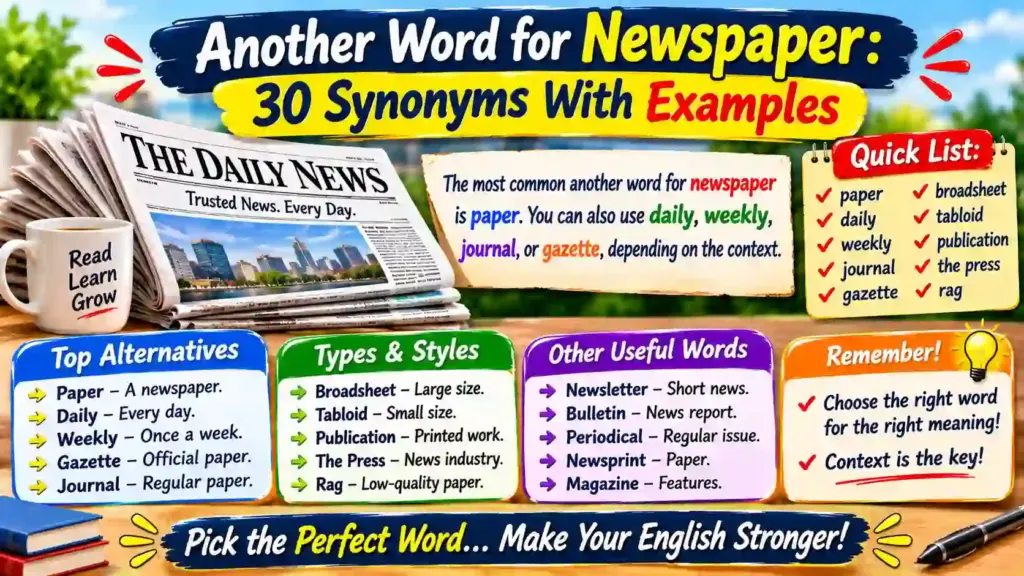
The most common another word for newspaper is paper. You can also use daily, weekly, journal, or gazette, depending on how often the publication comes out and how formal you want to sound.
The best choice depends on meaning. Newspaper can refer to a printed publication, the company behind it, or the paper it is printed on. Some alternatives describe size (broadsheet, tabloid), tone (rag), or the wider news industry (the press).
Quick list: paper, daily, weekly, journal, gazette, broadsheet, tabloid, publication, the press
This article explains 30 alternatives. Each entry includes a meaning, IPA, usage note, example, and context.
At a Glance: Newspaper Synonyms and Related Alternatives
| Alternative | Part of Speech | Meaning | Register / Tone | Ideal Context |
| Paper | noun | A newspaper | Neutral, informal | Everyday speech |
| Daily | noun | A newspaper published every day | Neutral | News and business writing |
| Weekly | noun | A newspaper published once a week | Neutral | Local news |
| Gazette | noun | A newspaper, often in a title | Formal | Titles, official notices |
| Journal | noun | A daily paper or regular publication | Formal, dated | Names, academic writing |
| Broadsheet | noun | A large-format serious newspaper | Neutral | Describing newspaper style |
| Tabloid | noun | A small-format paper with short stories and photos | Neutral to critical | Describing style |
| Publication | noun | Any printed or published work | Formal | General writing |
| The press | noun | Newspapers and journalists as a group | Neutral | Media, law, politics |
| Rag | noun | A low-quality newspaper | Informal, negative | Criticism |
Which Word Should You Use?
| If you want to… | Use | Why |
| Say it simply | paper | It is short and natural. |
| Stress that it comes out every day | daily | It describes how often it is published. |
| Describe a small-town paper | weekly | Many local papers appear once a week. |
| Describe a serious, large-format paper | broadsheet | It names the page size and style. |
| Describe a paper with short stories and many photos | tabloid | It names the compact style. |
| Talk about all news organizations | the press | It covers papers and journalists together. |
| Criticize a paper’s quality | rag | It is informal and negative. |
| Write formally | publication | It is neutral and broad. |
Exploring the Multiple Meanings of Newspaper
1. A Printed News Publication
- Meaning: A paper printed and shared daily or weekly that contains news, opinion, features, and advertising.
- Explanation: This is the main sense. It usually means the printed product, although many newspapers now also publish online.
- Example: She reads the newspaper every morning.
2. A News Organization
- Meaning: The organization that publishes a newspaper.
- Explanation: Here the word refers to the business or staff. It often appears in phrases such as work for a newspaper.
- Example: He worked for the newspaper for twenty years.
3. The Paper Material
- Meaning: The paper a newspaper is printed on, also called newsprint.
- Explanation: In this sense, the word means the material itself, not the news inside it.
- Example: We wrapped the glasses in old newspaper.
4. To Do Newspaper Work
- Meaning: To work in the newspaper business.
- Explanation: This verb sense is rare and mostly formal or older.
- Example: She newspapered in Chicago before moving into radio.
Sources: Merriam-Webster (newspaper); Online Etymology Dictionary.
Analyzing 30 Newspaper Alternatives in Detail
Some alternatives below are direct synonyms, while others are related terms that fit only specific contexts.
Everyday Core Alternatives
1. Paper
IPA: US /ˈpeɪpər/ · UK /ˈpeɪpə/
Definition: A newspaper, often used as a short form.
- Usage: This is the closest everyday synonym. It is informal to neutral. Note that paper also has other meanings.
- Example: Did you see the story in today’s paper?
2. Daily
IPA: /ˈdeɪli/ (US and UK)
Definition: A newspaper published every day.
- Usage: This is a direct synonym only for papers printed daily. It is common in news writing.
- Example: The city’s daily reported on the new bridge.
3. Weekly
IPA: /ˈwiːkli/ (US and UK)
Definition: A newspaper published once a week.
- Usage: This is a direct synonym only for weekly papers. It often suggests local news.
- Example: The local weekly covers school sports.
4. Journal
IPA: US /ˈdʒɜːrnəl/ · UK /ˈdʒɜːnəl/
Definition: A daily newspaper, or a regular publication for a special group.
- Usage: This is a related alternative. The newspaper sense is now mostly formal or found in titles. Today the word more often means an academic publication or a diary.
- Example: She read the evening journal on the train.
5. Gazette
IPA: /ɡəˈzɛt/ (US and UK)
Definition: A newspaper, especially one with Gazette in its title, or an official public journal.
- Usage: This is formal and slightly old-fashioned. It is a direct synonym in many newspaper names.
- Example: The town gazette printed the council’s notice.
6. Publication
IPA: /ˌpʌblɪˈkeɪʃən/ (US and UK)
Definition: Something printed or issued to the public.
- Usage: This is a related, broader term. It also covers magazines and books.
- Example: The publication runs local news and a weekly crossword.
Formats and Styles
7. Broadsheet
IPA: /ˈbrɔːdʃiːt/ (US and UK)
Definition: A newspaper printed on large pages, usually with serious news.
- Usage: This is a type of newspaper, not a general synonym. It is neutral.
- Example: The broadsheet ran a long report on the economy.
8. Tabloid
IPA: /ˈtæblɔɪd/ (US and UK)
Definition: A newspaper about half the usual page size, with short news items and many photographs.
- Usage: This is a type of newspaper. It can sound critical when it implies sensational stories.
- Example: The tabloid put the actor’s photo on its front page.
9. Newssheet
IPA: US /ˈnuːzʃiːt/ · UK /ˈnjuːzʃiːt/
Definition: A small printed sheet of news.
- Usage: This is a related alternative. It suggests something smaller and simpler than a full newspaper.
- Example: Volunteers hand out a weekly newssheet at the market.
10. Newsletter
IPA: US /ˈnuːzˌlɛtər/ · UK /ˈnjuːzˌlɛtə/
Definition: A short report sent regularly to a group.
- Usage: This is related, not a true synonym. It serves a club, company, or community rather than the general public.
- Example: The club emails a monthly newsletter.
11. Bulletin
IPA: /ˈbʊlɪtɪn/ (US and UK)
Definition: A short news report or a regular publication from an organization.
- Usage: This is related and formal. It is not a full newspaper.
- Example: The school bulletin lists this week’s events.
Informal and Critical Alternatives
12. Rag
IPA: /ræɡ/ (US and UK)
Definition: A newspaper, especially a low-quality one.
- Usage: This is informal and negative. Use it only when you mean to criticize.
- Example: He refused to read that rag.
13. Scandal sheet
IPA: /ˈskændl ʃiːt/ (US and UK)
Definition: A newspaper that focuses on scandal and gossip.
- Usage: This is informal and critical. It describes content, not a neutral type.
- Example: The scandal sheet printed rumors about the mayor.
14. Red top
IPA: US /ˈrɛd tɑːp/ · UK /ˈrɛd tɒp/
Definition: A British tabloid newspaper with a red masthead.
- Usage: This is a British, informal, related alternative. It is not used for all newspapers.
- Example: The red tops all led with the football story.
15. Yellow press
IPA: US /ˌjɛloʊ ˈprɛs/ · UK /ˌjɛləʊ ˈprɛs/
Definition: Newspapers that use sensational stories to attract readers.
- Usage: This is a critical, somewhat dated collective term. It refers to a group, not one paper.
- Example: Critics blamed the yellow press for the panic.
Collective and Industry Terms
16. The press
IPA: /ðə ˈprɛs/ (US and UK)
Definition: Newspapers and journalists considered as a group.
- Usage: This is a related collective term. Use it for the news industry, not one newspaper.
- Example: The press waited outside the court.
17. Fourth estate
IPA: US /ˌfɔːrθ ɪˈsteɪt/ · UK /ˌfɔːθ ɪˈsteɪt/
Definition: The press seen as a powerful part of society.
- Usage: This is formal and figurative. It is related, not a synonym for a single paper.
- Example: The fourth estate holds public officials to account.
18. Print media
IPA: US /ˈprɪnt ˌmiːdiə/ · UK /ˈprɪnt ˌmiːdiə/
Definition: News and information published in printed form.
- Usage: This is a neutral, professional term. It includes newspapers and magazines.
- Example: Print media faces strong competition from the internet.
19. News media
IPA: US /ˈnuːz ˌmiːdiə/ · UK /ˈnjuːz ˌmiːdiə/
Definition: All the outlets that report news, including papers, television, radio, and websites.
- Usage: This is broader than newspaper. It is neutral.
- Example: The news media covered the election all night.
20. News outlet
IPA: US /ˈnuːz ˌaʊtlɛt/ · UK /ˈnjuːz ˌaʊtlɛt/
Definition: A company or channel that publishes or broadcasts news.
- Usage: This is related and neutral. It can mean a newspaper but is not limited to one.
- Example: Several news outlets reported the result.
21. Organ
IPA: US /ˈɔːrɡən/ · UK /ˈɔːɡən/
Definition: A newspaper or magazine that speaks for a group.
- Usage: This is formal and related. It suggests a paper tied to a party or organization.
- Example: The union’s organ praised the new contract.
Physical and Related Forms
22. Sheet
IPA: /ʃiːt/ (US and UK)
Definition: An informal word for a newspaper, often a cheap one.
- Usage: This is a related, informal term. It usually appears with another word, such as local sheet.
- Example: He wrote for the local sheet.
23. Periodical
IPA: US /ˌpɪriˈɑːdɪkəl/ · UK /ˌpɪəriˈɒdɪkəl/
Definition: A publication issued at regular intervals.
- Usage: This is a formal, broader term. It includes magazines and journals.
- Example: The library keeps every periodical on one shelf.
24. Newsprint
IPA: US /ˈnuːzprɪnt/ · UK /ˈnjuːzprɪnt/
Definition: Cheap paper used mainly for newspapers.
- Usage: This is related and refers to the material, not the publication.
- Example: The ink left black marks on his hands from the newsprint.
25. Magazine
IPA: US /ˈmæɡəziːn/ · UK /ˌmæɡəˈziːn/
Definition: A periodical with articles, stories, and pictures.
- Usage: This is related, not a synonym. Magazines are usually less focused on daily news.
- Example: She buys a fashion magazine every month.
26. News website
IPA: US /ˈnuːz ˈwɛbsaɪt/ · UK /ˈnjuːz ˈwɛbsaɪt/
Definition: A website that publishes news.
- Usage: This is a modern related term. It is not a printed newspaper, although many newspapers run one.
- Example: I read the news website on my phone.
Historical and Literary Alternatives
27. Newsbook
IPA: US /ˈnuːzbʊk/ · UK /ˈnjuːzbʊk/
Definition: An early printed news pamphlet from 17th-century England.
- Usage: This is a historical term. Use it only when discussing early printing.
- Example: Historians study each newsbook from the 1640s.
28. Coranto
IPA: US /kəˈræntoʊ/ · UK /kəˈræntəʊ/
Definition: An early 17th-century printed sheet of news.
- Usage: This is a rare historical term, not for modern use.
- Example: A coranto from 1620 is on display.
29. Courant
IPA: /kəˈrænt/ (US and UK)
Definition: An old word for a newspaper, now mostly found in titles.
- Usage: This is archaic. It is a direct synonym in meaning, but readers will see it mainly in newspaper names.
- Example: The old courant is kept in the archive.
30. Chronicle
IPA: US /ˈkrɑːnɪkəl/ · UK /ˈkrɒnɪkəl/
Definition: A record of events, often used in newspaper titles.
- Usage: This is related. It means a record of events, and some newspapers use it as part of their name.
- Example: The regional Chronicle covers county news.
Sources: Merriam-Webster; Collins Dictionary; Online Etymology Dictionary.
Newspaper vs. Magazine vs. Journal
These three words are often confused. However, each has a different main purpose.
| Word | Main Purpose | Typical Schedule |
| Newspaper | Current news, opinion, and advertising | Daily or weekly |
| Magazine | Articles, stories, and photos | Weekly or monthly |
| Journal | Special-interest or academic articles | Usually less often |
In short, choose newspaper for current news. Choose magazine for general feature reading. Choose journal for specialist or academic writing.
Sources: Merriam-Webster (newspaper, journal).
Newspaper and Opposite/Paired Word Pairs
| Word | Paired Word | Note |
| Newspaper | Magazine | A common contrast between news and features. |
| Newspaper | Television news | Print is often compared with broadcast. |
| Online | Describes how a paper is delivered. | |
| Newspaper | Reader | A natural pair: one publishes, one reads. |
| News report | Editorial | Reporting facts differs from giving an opinion. |
Newspaper has no true antonym. Instead, we usually contrast it with other media. Therefore, paired words is a more accurate idea than opposites.
Sources: Merriam-Webster; Collins Dictionary.
Common Word Partners of Newspaper
| Pattern | Common Partners | Example |
| Verb + newspaper | read, publish, subscribe to, deliver | I subscribe to a local newspaper. |
| Adjective + newspaper | national, local, free, online | A free newspaper was handed out at the station. |
| Newspaper + noun | headline, article, editor, column, subscription | The newspaper headline surprised everyone. |
| Preposition + newspaper | in the newspaper, from the newspaper | I read it in the newspaper. |
Sources: Collins Dictionary; Merriam-Webster example sentences.
Idiomatic Phrases Featuring Newspaper
Newspaper has very few true idioms. The following are established fixed expressions.
1. Newspaper of record
- Meaning: A newspaper regarded as an official, trusted source of news for a country or city.
- Example: Many people treat that paper as the newspaper of record.
2. Daily newspaper
- Meaning: A newspaper published every day. It is a set phrase, not a figurative idiom.
- Example: The daily newspaper arrives before breakfast.
3. Newspaper clipping
- Meaning: A piece cut from a newspaper and kept.
- Example: She kept a newspaper clipping of the award.
Sources: Merriam-Webster; Collins Dictionary.
Word Formation of Newspaper
Etymology & Structure
Newspaper is a compound word made from news and paper. News comes from the plural of new and was modeled on French nouvelles, meaning new things. The popular claim that newspaper stands for north, east, west, south, past and present events report is a myth.
Date and History
Merriam-Webster gives 1667 as the first known use of the noun. The verb sense appeared in 1800.
Word Class Variations
- Noun: newspaper, newspapers
- Verb: newspaper, newspapered, newspapering (rare)
- Related forms: newspaperman, newspaperwoman, newsprint
For inclusive writing, journalist or reporter works better than newspaperman.
Sources: Merriam-Webster; Online Etymology Dictionary; PolitiFact (fact-check of the acronym myth).
Frequently Asked Questions
1. What is the closest synonym for newspaper?
Paper is the closest and most common everyday synonym.
2. What is a formal alternative?
Publication and periodical are formal choices. Gazette works in titles.
3. What is a slang alternative?
Rag is informal and negative. Sheet is also informal.
4. What is the difference between a newspaper and a magazine?
A newspaper focuses on current news. A magazine usually offers feature articles and photos.
5. What is the difference between a broadsheet and a tabloid?
A broadsheet has large pages, and a tabloid is about half that size. Tabloids often use shorter stories and more photos.
6. Is journal the same as newspaper?
Not usually. Journal can mean a daily newspaper in older or formal use, but today it more often means an academic publication.
7. What does the press mean?
It means newspapers and journalists as a group, not one paper.
Conclusion
The closest everyday alternative to newspaper is paper. You can also use daily, weekly, gazette, or publication for more specific meanings.
Context matters a great deal. Tabloid and broadsheet describe style, rag shows criticism, and the press describes an industry. Likewise, newsprint is a material, not a publication.
To choose well, first decide what you mean: the printed paper, the organization, or the wider news industry. Then pick the word that matches that meaning and fits your audience.

Hi, I’m HAROON ,founder of LifeLoomer.com, I started LifeLoomer with one belief: the internet is full of answers, but not enough understanding. So I write guides that actually explain things the meanings behind everyday words, the small habits that make life better, and the how-tos nobody taught us.
Everything I publish is researched, written in plain words, and tested against one question: will this genuinely help someone today?
Thanks for being here. I hope you leave a little wiser than you came.