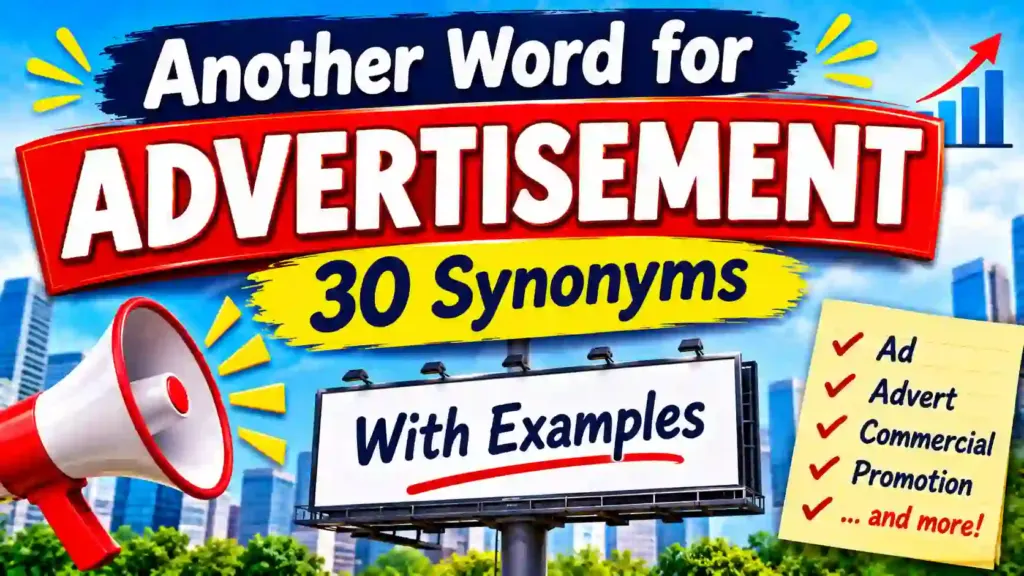
The most common another word for advertisement is ad. Close alternatives include advert, commercial, and promotion. These words overlap, but each fits a slightly different setting.
The best choice depends on meaning and context. Some words name the message itself, such as commercial. Others name the format (poster, billboard), the activity (marketing, publicity), or a simple public notice (announcement).
Quick list: ad, advert, commercial, promotion, promo, poster, notice, announcement, flyer, publicity
This article examines 30 alternatives with meanings, IPA, usage notes, examples, and context.
At a Glance: Advertisement Synonyms and Related Alternatives
| Alternative | Part of Speech | Meaning | Register / Tone | Ideal Context |
| ad | noun | Short form of advertisement | Informal | Everyday speech |
| advert | noun | British short form | Informal (UK) | British writing |
| commercial | noun | Paid broadcast ad | Neutral | TV, radio, streaming |
| promotion | noun | Effort to sell or publicize | Formal | Business |
| poster | noun | Large printed notice | Neutral | Walls, streets |
| flyer | noun | Single printed sheet | Neutral | Events, local shops |
| notice | noun | Public announcement | Formal | Boards, offices |
| announcement | noun | Public statement | Neutral | News, events |
| publicity | noun | Public attention | Formal | Media, press |
| slogan | noun | Short catchy phrase | Neutral | Branding |
Which Word Should You Use?
| If you want to… | Use | Why |
| Sound casual | ad | It is short and widely understood. |
| Refer to TV or radio | commercial | It names broadcast ads. |
| Describe a sales effort | promotion | It covers discounts and campaigns. |
| Name a printed sheet | flyer | It describes the format. |
| Describe a large outdoor ad | billboard | It names the exact medium. |
| Share official information | notice | It suggests no selling. |
| Describe media attention | publicity | It need not be paid. |
| Name a brand phrase | slogan | It refers to the wording only. |
Exploring the Multiple Meanings of “Advertisement”
1. A Paid Promotion
- Meaning: A public message that promotes a product, service, or event.
- Explanation: This is the main modern sense. The message is usually paid for and meant to persuade.
- Example: The company placed an advertisement in the local paper.
2. A Public Notice
- Meaning: A notice that informs people of something.
- Explanation: This sense is older and less common today. It appears in phrases like classified advertisement, which may simply offer a job or a room.
- Example: She answered an advertisement for a part-time job.
3. A Single Ad Item
- Meaning: One specific ad, such as a TV spot or a web banner.
- Explanation: Here the word names one piece, not the whole industry. The mass noun advertising covers the wider activity.
- Example: That advertisement ran during the football match.
4. A Figurative Example of Quality
- Meaning: Something that shows how good, or how bad, something else is.
- Explanation: People use this in phrases like “a good advertisement for.”
- Example: Her calm answer was a good advertisement for the training program.
Sources: Merriam-Webster; Collins Dictionary; Dictionary.com
Analyzing 30 Advertisement Alternatives in Detail
Some alternatives below are direct synonyms, while others are related words for specific formats or purposes.
Everyday Core Synonyms
1. Ad
IPA: /æd/ (US and UK)
Definition: A short form of advertisement.
- Usage: A direct synonym. It is informal and common in speech.
- Example: I saw an ad for that phone online.
2. Advert
IPA: US /ˈædvɜːrt/ · UK /ˈædvɜːt/
Definition: A British short form of advertisement.
- Usage: A direct synonym, mainly used in British English.
- Example: The advert made everyone laugh.
3. Commercial
IPA: US /kəˈmɜːrʃəl/ · UK /kəˈmɜːʃəl/
Definition: An advertisement broadcast on television or radio.
- Usage: A close synonym, limited to broadcast or streaming media.
- Example: The commercial plays before every video.
4. Spot
IPA: US /spɑːt/ · UK /spɒt/
Definition: A short broadcast advertisement or time slot.
- Usage: A related term used in broadcasting and media jobs.
- Example: They bought a thirty-second spot on the radio.
5. Promo
IPA: US /ˈproʊmoʊ/ · UK /ˈprəʊməʊ/
Definition: A short form of promotion, often a short promotional video or message.
- Usage: Informal. It often promotes a show or an event, not a product.
- Example: The promo for the new series is online.
Formal and Marketing Terms
6. Promotion
IPA: US /prəˈmoʊʃən/ · UK /prəˈməʊʃən/
Definition: Activity that supports the sale or awareness of something.
- Usage: Related and formal. It can include discounts, not only ads.
- Example: The store launched a summer promotion.
7. Advertising
IPA: US /ˈædvərtaɪzɪŋ/ · UK /ˈædvətaɪzɪŋ/
Definition: The business of promoting products through paid messages.
- Usage: A related mass noun. It names the activity, not one ad.
- Example: Online advertising keeps growing.
8. Publicity
IPA: /pʌbˈlɪsəti/ (US and UK)
Definition: Public attention given to a person, product, or event.
- Usage: Related, but not the same. Publicity may be unpaid.
- Example: The festival gained free publicity from the news.
9. Marketing
IPA: US /ˈmɑːrkɪtɪŋ/ · UK /ˈmɑːkɪtɪŋ/
Definition: The wider process of promoting and selling goods or services.
- Usage: Related, and broader than advertising.
- Example: Marketing includes research, pricing, and ads.
10. Campaign
IPA: /kæmˈpeɪn/ (US and UK)
Definition: A planned series of actions to reach a goal.
- Usage: Related. It names a group of ads, not a single one.
- Example: The charity ran a month-long campaign.
Notices and Announcements
11. Notice
IPA: US /ˈnoʊtɪs/ · UK /ˈnəʊtɪs/
Definition: A written or printed announcement.
- Usage: Related and formal. It informs more than it sells.
- Example: A notice about the sale hung by the door.
12. Announcement
IPA: /əˈnaʊnsmənt/ (US and UK)
Definition: A public statement of news or plans.
- Usage: Related. It fits the older “public notice” sense.
- Example: The shop made an announcement about its new hours.
13. Bulletin
IPA: /ˈbʊlətɪn/ (US and UK)
Definition: A short official report or notice.
- Usage: Related and formal. It rarely persuades.
- Example: The school posted a bulletin about the fair.
Print and Display Formats
14. Poster
IPA: US /ˈpoʊstər/ · UK /ˈpəʊstə/
Definition: A large printed sheet displayed in public.
- Usage: Related. It names a format, not the idea.
- Example: A poster for the concert covered the wall.
15. Billboard
IPA: US /ˈbɪlbɔːrd/ · UK /ˈbɪlbɔːd/
Definition: A large outdoor board for ads.
- Usage: Related and specific to roadside displays.
- Example: A giant billboard stood beside the highway.
16. Banner
IPA: US /ˈbænər/ · UK /ˈbænə/
Definition: A long strip of cloth or a web graphic carrying a message.
- Usage: Related. It is often used online as a “banner ad.”
- Example: A banner ad appeared at the top of the page.
17. Flyer
IPA: US /ˈflaɪər/ · UK /ˈflaɪə/
Definition: A single printed sheet handed out to promote something.
- Usage: Related and informal, common for local events.
- Example: Volunteers handed out flyers for the market.
18. Leaflet
IPA: /ˈliːflət/ (US and UK)
Definition: A small printed sheet or folded paper with information.
- Usage: Related. It is often more informative than a flyer.
- Example: The clinic gave her a leaflet about the service.
19. Brochure
IPA: US /broʊˈʃʊr/ · UK /ˈbrəʊʃə/
Definition: A small booklet with details about products or services.
- Usage: Related. It describes a longer promotional document.
- Example: The travel agent sent us a brochure.
Listings and Previews
20. Classified
IPA: /ˈklæsɪfaɪd/ (US and UK)
Definition: A small ad placed in a category section, such as jobs or housing.
- Usage: A close synonym for this one type. It is usually short and low-cost.
- Example: He found his flat in the classifieds.
21. Listing
IPA: /ˈlɪstɪŋ/ (US and UK)
Definition: An entry in a list or directory, such as a property for sale.
- Usage: Related. It is common in real estate and online markets.
- Example: The listing included six photos.
22. Teaser
IPA: US /ˈtiːzər/ · UK /ˈtiːzə/
Definition: A short ad that shares only a little to build interest.
- Usage: Related and used before a launch.
- Example: The teaser hinted at a new product.
23. Trailer
IPA: US /ˈtreɪlər/ · UK /ˈtreɪlə/
Definition: A short preview of a film or show.
- Usage: Related, limited to media previews.
- Example: The trailer attracted millions of views.
Persuasive and Brand-Related Terms
24. Plug
IPA: /plʌɡ/ (US and UK)
Definition: A favorable mention that promotes something.
- Usage: Related and informal. A plug is often brief and may be unpaid.
- Example: The host gave her book a plug.
25. Pitch
IPA: /pɪtʃ/ (US and UK)
Definition: A persuasive presentation meant to sell an idea or product.
- Usage: Related. It describes a spoken or written sales message.
- Example: The agency prepared a pitch for the client.
26. Blurb
IPA: US /blɜːrb/ · UK /blɜːb/
Definition: A short description written to promote a book or product.
- Usage: Related and informal. It is a short promotional text.
- Example: The blurb on the back cover caught my eye.
27. Jingle
IPA: /ˈdʒɪŋɡəl/ (US and UK)
Definition: A short, catchy song used in advertising.
- Usage: Related. It names a musical part of an ad.
- Example: I cannot forget that jingle.
28. Slogan
IPA: US /ˈsloʊɡən/ · UK /ˈsləʊɡən/
Definition: A short, memorable phrase linked to a brand.
- Usage: Related. It is only the wording, not the full ad.
- Example: Their slogan is simple and clear.
29. Tagline
IPA: /ˈtæɡlaɪn/ (US and UK)
Definition: A short phrase that sums up a brand’s message.
- Usage: Related and close to slogan, often used in branding.
- Example: The tagline appears under the logo.
30. Hype
IPA: /haɪp/ (US and UK)
Definition: Exaggerated or intense promotion.
- Usage: Related and informal. It often suggests exaggeration.
- Example: The hype around the launch was huge.
Sources: Merriam-Webster; Collins Dictionary; Dictionary.com
Advertisement vs. Advertising vs. Ad vs. Advert
| Word | What It Names | Note |
| advertisement | One message or notice | Standard form |
| ad | One message | Informal |
| advert | One message | British |
| advertising | The activity or industry | Usually uncountable |
Therefore, say “an advertisement” for one item and “advertising” for the general practice.
Sources: Merriam-Webster; Collins Dictionary
Advertisement and Opposite/Paired Word Pairs
| Word | Paired Word | Note |
| advertisement | editorial | Editorial content is not paid promotion. |
| advertiser | consumer | The sender and the audience. |
| advertisement | review | A review is meant to be independent. |
There is no perfect antonym. These pairs show contrast or partnership instead.
Sources: Merriam-Webster; Collins Dictionary
Common Word Partners of “Advertisement”
| Pattern | Common Partners | Example |
| verb + advertisement | place, run, publish | They ran an advertisement last week. |
| adjective + advertisement | full-page, online, television | A full-page advertisement appeared. |
| advertisement + for | a job, a product | I saw an advertisement for a car. |
| noun + advertisement | job, newspaper | The job advertisement closes Friday. |
Sources: Collins Dictionary; Merriam-Webster
Idiomatic Phrases Featuring “Advertisement”
This word has few true idioms. These are established expressions.
1. A good advertisement for
- Meaning: Something that shows the quality of something else.
- Example: Her success is a good advertisement for the course.
2. A walking advertisement
- Meaning: A person who displays or represents a product or idea.
- Example: He is a walking advertisement for the gym.
3. Classified advertisement
- Meaning: A small ad in a categorized section.
- Example: She placed a classified advertisement for her bike.
Sources: Collins Dictionary; Merriam-Webster
Word Formation of “Advertisement”
Etymology & Structure
Advertisement comes from Old French avertissement, meaning warning or notice. That word comes from avertir, from Latin advertere, “to turn toward.” The English word adds the suffix -ment to the verb advertise.
Date and History
Etymonline traces the word to around the early 1400s. It first meant a notice or warning, and the paid-promotion sense came later.
Word Class Variations
- Verb: advertise
- Noun: advertisement, advertiser, advertising
- Adjective: advertised, advertising (as in “advertising budget”)
- Related forms: ad, advert, advertorial
Sources: Etymonline; Merriam-Webster
Common Word-Choice Mistakes
- Make an advertising: say “make an advertisement.”
- Advertisement of a product: say “advertisement for a product.”
- Put an advertise: say “place an advertisement.”
- A poster is a commercial: use commercial only for broadcasts.
- Publicity is always paid: it can be unpaid.
- Advertisements are advertising: use advertising for the activity.
- A slogan is an ad: it is only part of one.
Frequently Asked Questions
1. What is the closest synonym for advertisement?
Ad is the closest and most common synonym. Advert is its British form.
2. What is a formal alternative?
Promotion and announcement fit formal writing.
3. What is the difference between advertisement and commercial?
A commercial is a broadcast ad on TV, radio, or streaming. An advertisement can be in any medium.
4. Is publicity the same as advertisement?
No. Publicity is public attention and may be unpaid.
5. What is another word for a printed advertisement?
Flyer, poster, leaflet, and brochure are good choices.
6. What is an informal alternative?
Ad, promo, and plug are informal.
7. Can advertisement mean a public notice?
Yes. This older sense still appears in phrases like classified advertisement.
Conclusion
The closest alternatives to advertisement are ad, advert, commercial, and promotion. These work in most everyday situations.
However, context matters. Some words name a format, such as poster or flyer. Others name an activity, such as marketing or publicity, or a notice, such as announcement.
To choose well, first decide what you are describing: one message, a format, or the wider effort. Then match the word’s tone to your audience.

Hi, I’m HAROON ,founder of LifeLoomer.com, I started LifeLoomer with one belief: the internet is full of answers, but not enough understanding. So I write guides that actually explain things the meanings behind everyday words, the small habits that make life better, and the how-tos nobody taught us.
Everything I publish is researched, written in plain words, and tested against one question: will this genuinely help someone today?
Thanks for being here. I hope you leave a little wiser than you came.