
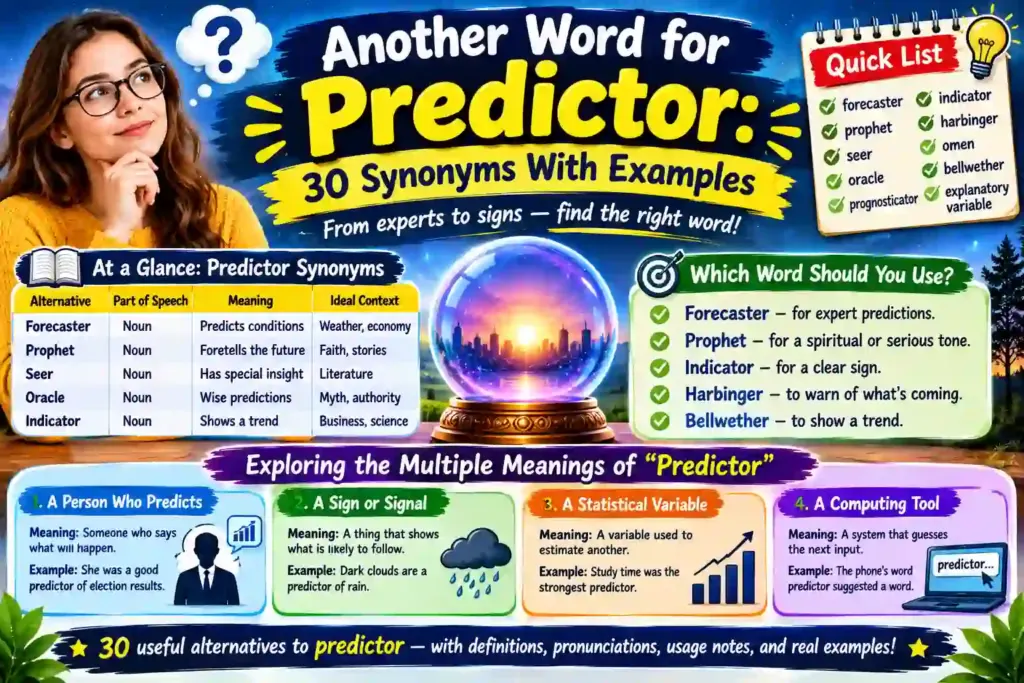
The closest everyday alternatives to predictor are forecaster, prophet, and indicator. A predictor can be a person who says what will happen. It can also be a sign, a tool, or a statistical variable that helps show what will happen. The best word depends on who or what is doing the predicting.
Some alternatives sound scientific, such as forecaster and analyst. Others sound mystical, such as seer and oracle. Still others describe warning signs, such as omen and harbinger. In research writing, explanatory variable is often the better choice.
Quick list: forecaster, prophet, seer, oracle, prognosticator, indicator, harbinger, bellwether, omen, explanatory variable
Below are 30 alternatives with meanings, IPA, usage notes, examples, and context, so you can choose the right word with confidence.
At a Glance: Predictor Synonyms and Related Alternatives
| Alternative | Part of Speech | Meaning | Register / Tone | Ideal Context |
| Forecaster | noun | person who predicts conditions | neutral | weather, economy |
| Prognosticator | noun | person who predicts events | formal | commentary |
| Prophet | noun | person who foretells the future | formal, religious | faith, figurative use |
| Seer | noun | person with special insight | literary | stories, poetry |
| Oracle | noun | trusted source of wise predictions | literary | myth, authority |
| Indicator | noun | sign that shows a trend | neutral | business, science |
| Harbinger | noun | sign that something is coming | literary | news, writing |
| Omen | noun | sign of future luck | literary | folklore, drama |
| Bellwether | noun | thing that shows future trends | neutral | politics, markets |
| Explanatory variable | noun | variable used to predict an outcome | technical | statistics |
Which Word Should You Use?
| If you want to… | Use | Why |
| Describe a weather or economic expert | forecaster | It is neutral and data-based. |
| Sound formal or slightly playful | prognosticator | It suggests learned guessing. |
| Refer to religious foretelling | prophet | It carries a spiritual meaning. |
| Name a sign that shows a trend | indicator | It is clear and widely used. |
| Warn of something coming | harbinger | It points ahead to an event. |
| Show what a group will likely do | bellwether | It signals a wider trend. |
| Write a statistics report | explanatory variable | It is the precise technical term. |
| Describe a wise, trusted source | oracle | It suggests authority. |
Exploring the Multiple Meanings of “Predictor”
1. A Person Who Predicts
- Meaning: Someone who says what will happen.
- Explanation: This is the most common sense. It suits experts and ordinary people alike.
- Example: She was a good predictor of election results.
2. A Sign or Signal
- Meaning: A thing that shows what is likely to follow.
- Explanation: Here the predictor is an object or event, not a person.
- Example: Dark clouds are a predictor of rain.
3. A Statistical Variable
- Meaning: A variable used to estimate another variable.
- Explanation: Researchers use it in models and call the other variable the outcome.
- Example: Study time was the strongest predictor of exam scores.
4. A Computing Tool
- Meaning: A system that guesses the next input or result.
- Explanation: Examples include word predictors and branch predictors in processors.
- Example: The phone’s word predictor suggested the next word.
Sources: Merriam-Webster; Dictionary.com
Analyzing 30 Predictor Alternatives in Detail
Some alternatives below are direct synonyms, while others are related words that fit only certain contexts.
Core Synonyms for a Person Who Predicts
1. Forecaster
IPA: US /ˈfɔrˌkæstər/ · UK /ˈfɔːkɑːstə/
Definition: A person who predicts future conditions, especially weather or economic trends.
- Usage: This is the closest everyday synonym. It is neutral and usually suggests data and probability.
- Example: The forecaster expects heavy rain tonight.
2. Prognosticator
IPA: US /prɑːɡˈnɑːstɪˌkeɪtər/ · UK /prɒɡˈnɒstɪkeɪtə/
Definition: A person who predicts future events.
- Usage: It is a direct synonym. It is formal and can sound learned or slightly humorous.
- Example: Few prognosticators saw the market drop coming.
3. Prophet
IPA: US /ˈprɑːfɪt/ · UK /ˈprɒfɪt/
Definition: A person who foretells the future, often through divine inspiration.
- Usage: It is a direct synonym with a religious tone. Figuratively, it can describe a confident predictor.
- Example: The old farmer was a prophet of bad harvests.
4. Seer
IPA: US /sɪr/ · UK /sɪə/
Definition: A person believed to see future events.
- Usage: It is literary and suggests special insight rather than data.
- Example: The village seer warned of a long winter.
5. Soothsayer
IPA: US /ˈsuːθˌseɪər/ · UK /ˈsuːθseɪə/
Definition: A person who claims to predict the future.
- Usage: It is old-fashioned. It can sound doubtful or mocking in modern writing.
- Example: The king ignored the soothsayer’s warning.
Mystical and Literary Alternatives
6. Oracle
IPA: US /ˈɔːrəkəl/ · UK /ˈɒrəkəl/
Definition: A person or source believed to give wise or true answers.
- Usage: This is a related alternative. It stresses authority more than prediction.
- Example: Investors treated him as an oracle.
7. Augur
IPA: US /ˈɔːɡər/ · UK /ˈɔːɡə/
Definition: A person who predicts events by reading signs.
- Usage: The noun is rare and literary. The verb augur is more common today.
- Example: The augur studied the flight of birds.
8. Diviner
IPA: US /dɪˈvaɪnər/ · UK /dɪˈvaɪnə/
Definition: A person who seeks hidden knowledge by supernatural means.
- Usage: This is a related alternative. It can also mean someone who finds water.
- Example: The diviner claimed to read the future in tea leaves.
9. Clairvoyant
IPA: US /klɛrˈvɔɪənt/ · UK /kleəˈvɔɪənt/
Definition: A person who claims to see things beyond normal senses.
- Usage: It is a related alternative with a paranormal sense.
- Example: The clairvoyant said a trip was coming.
10. Fortune-teller
IPA: US /ˈfɔːrtʃən ˌtɛlər/ · UK /ˈfɔːtʃuːn ˌtelə/
Definition: A person who claims to predict someone’s future, often for pay.
- Usage: It is informal and everyday. It often hints at doubt.
- Example: At the fair, we visited a fortune-teller.
Expert and Analytical Alternatives
11. Futurist
IPA: /ˈfjuːtʃərɪst/ (US and UK)
Definition: A person who studies trends to describe likely future developments.
- Usage: This is a related alternative. It suggests long-range, professional study.
- Example: The futurist spoke about cities in 2050.
12. Analyst
IPA: /ˈænəlɪst/ (US and UK)
Definition: A person who studies data and gives informed views.
- Usage: This is a related alternative. Analysts do not always predict.
- Example: The analyst expects sales to rise.
13. Pundit
IPA: /ˈpʌndɪt/ (US and UK)
Definition: An expert who gives opinions, often in the media.
- Usage: This is a related alternative. It can sound mocking.
- Example: Sports pundits predicted an easy win.
14. Tipster
IPA: US /ˈtɪpstər/ · UK /ˈtɪpstə/
Definition: A person who gives predictions or advice, especially on sports or betting.
- Usage: It is informal and fits racing and sports.
- Example: The tipster picked the winning horse.
15. Estimator
IPA: US /ˈɛstəˌmeɪtər/ · UK /ˈestɪmeɪtə/
Definition: A person or tool that calculates an approximate value.
- Usage: This is a related alternative. It predicts numbers, not events.
- Example: The estimator gave a rough cost.
Signs and Warnings
16. Indicator
IPA: US /ˈɪndɪˌkeɪtər/ · UK /ˈɪndɪkeɪtə/
Definition: A sign or measure that shows a condition or trend.
- Usage: It is the closest everyday word for the “sign” sense.
- Example: Rising prices are an indicator of inflation.
17. Harbinger
IPA: US /ˈhɑːrbɪndʒər/ · UK /ˈhɑːbɪndʒə/
Definition: A person or thing that shows something is coming.
- Usage: It is literary and often points to a notable change.
- Example: Early robins are a harbinger of spring.
18. Omen
IPA: US /ˈoʊmən/ · UK /ˈəʊmən/
Definition: A sign believed to show good or bad luck to come.
- Usage: It is a related alternative. It often suggests danger.
- Example: The storm felt like a bad omen.
19. Portent
IPA: US /ˈpɔːrtɛnt/ · UK /ˈpɔːtent/
Definition: A sign that something important, often bad, will happen.
- Usage: It is formal and slightly stronger than omen.
- Example: The strange silence was a portent of trouble.
20. Herald
IPA: US /ˈhɛrəld/ · UK /ˈherəld/
Definition: A person or thing that shows something is coming.
- Usage: This is a related alternative. It can also mean an announcer.
- Example: Warm winds were the herald of summer.
Trend and Early-Signal Words
21. Forerunner
IPA: US /ˈfɔːrˌrʌnər/ · UK /ˈfɔːˌrʌnə/
Definition: Something that comes before and points to what follows.
- Usage: This is a related alternative. It looks backward from the later event.
- Example: This small trial was a forerunner of larger studies.
22. Precursor
IPA: US /prɪˈkɜːrsər/ · UK /prɪˈkɜːsə/
Definition: Something that comes before another thing and often leads to it.
- Usage: It is a related alternative. It is common in science and medicine.
- Example: Headaches can be a precursor to illness.
23. Bellwether
IPA: US /ˈbɛlˌwɛðər/ · UK /ˈbelˌweðə/
Definition: A thing that shows future trends.
- Usage: It suggests a leader others follow. It is not related to weather.
- Example: This town is a bellwether for retail trends.
24. Barometer
IPA: US /bəˈrɑːmətər/ · UK /bəˈrɒmɪtə/
Definition: Something that measures changes in opinion or conditions.
- Usage: This is a figurative, related alternative.
- Example: The poll is a barometer of public mood.
25. Signal
IPA: /ˈsɪɡnəl/ (US and UK)
Definition: A sign that something exists or will happen.
- Usage: It is neutral and flexible.
- Example: The data sent a clear signal.
Statistical and Technical Alternatives
26. Explanatory variable
IPA: US /ɪkˈsplænəˌtɔːri ˈvɛriəbəl/ · UK /ɪkˈsplænətri ˈveəriəbəl/
Definition: A variable used to explain or predict changes in an outcome.
- Usage: It is the closest technical match and is often used for a predictor variable.
- Example: Age was an explanatory variable in the model.
27. Independent variable
IPA: US /ˌɪndɪˈpɛndənt ˈvɛriəbəl/ · UK /ˌɪndɪˈpendənt ˈveəriəbəl/
Definition: A variable studied for its effect on another variable.
- Usage: This is a related alternative. It suits experiments more than forecasting.
- Example: Dose was the independent variable.
28. Covariate
IPA: US /koʊˈvɛriət/ · UK /kəʊˈveəriət/
Definition: A variable that may relate to the outcome and is included in analysis.
- Usage: This is a related alternative used in research.
- Example: The team adjusted for income as a covariate.
29. Determinant
IPA: US /dɪˈtɜːrmɪnənt/ · UK /dɪˈtɜːmɪnənt/
Definition: A factor that strongly affects an outcome.
- Usage: This is a related alternative. It stresses influence, not just prediction.
- Example: Income is a determinant of housing choice.
30. Risk factor
IPA: US /ˈrɪsk ˌfæktər/ · UK /ˈrɪsk ˌfæktə/
Definition: Something that raises the chance of a harmful outcome.
- Usage: This is a related alternative, common in health writing.
- Example: Smoking is a major risk factor for lung disease.
Sources: Merriam-Webster; Dictionary.com; Etymonline
Forecaster vs. Prophet vs. Prognosticator
These three words all describe people who tell the future, but they differ in tone and method.
| Word | Basis | Tone |
| Forecaster | Observation, facts, and probabilities | Neutral, professional |
| Prophet | Divine or supernatural inspiration | Religious or dramatic |
| Prognosticator | Learned or skilled interpretation | Formal, sometimes playful |
Merriam-Webster notes that forecast usually deals with probabilities rather than certainties. It also says prognosticate is less common and can be a colorful substitute for predict. Dictionary.com adds that prophesy usually involves divine or supernatural inspiration.
Sources: Merriam-Webster; Dictionary.com
Predictor and Opposite/Paired Word Pairs
| Word | Paired Word | Note |
| Predictor | Outcome | Standard pairing in statistics |
| Predictor | Response variable | Another common research pairing |
| Leading indicator | Lagging indicator | One shows change early, the other late |
| Forecaster | Historian | One looks forward, the other backward |
| Good predictor | Poor predictor | Describes accuracy |
Predictor has no true antonym. However, it pairs naturally with the thing it predicts. In contrast, a historian contrasts with a forecaster only by time direction.
Sources: Merriam-Webster; Dictionary.com
Common Word Partners of “Predictor”
| Pattern | Common Partners | Example |
| adjective + predictor | strong, reliable, poor, best | Experience is a reliable predictor of skill. |
| predictor + of | success, risk, outcome | Grades are a predictor of success. |
| predictor + variable | predictor variable | Add each predictor variable to the model. |
| noun + predictor | word, risk | The risk predictor flagged high cases. |
| verb + predictor | serve as, act as | Sleep serves as a predictor of mood. |
Sources: Merriam-Webster; Dictionary.com
Idiomatic Phrases Featuring “Predictor”
Predictor has no true idioms. The expressions below are established phrases, not idioms.
1. The best predictor of future behavior is past behavior
- Meaning: People usually repeat what they have done before.
- Example: He is late again, and past behavior is the best predictor.
2. Predictor variable
- Meaning: A technical term for a variable used to estimate an outcome.
- Example: The study used height as a predictor variable.
3. Word predictor
- Meaning: A feature that suggests the next word as you type.
- Example: My word predictor finished the sentence.
Sources: Merriam-Webster; Dictionary.com
Word Formation of “Predictor”
Etymology & Structure
Predictor is formed from predict plus the agent suffix -or, meaning one who does something. Predict comes from Latin praedictus, from prae- “before” and dicere “to say.”
Date and History
Sources differ on when predict entered English. Merriam-Webster gives 1590, Dictionary.com gives 1540–50, and Etymonline gives the 1620s. A reliable first date for predictor itself was not verified.
Word Class Variations
- Verb: predict
- Noun: prediction, predictor, predictability
- Adjective: predictive, predictable, unpredictable
- Adverb: predictably
Sources: Merriam-Webster; Dictionary.com; Etymonline
Common Word-Choice Mistakes
- The weather prophet said rain: the weather forecaster said rain.
- A strong forecaster of success: a strong predictor of success.
- The bellwether says it will rain: the forecaster says it will rain.
- Harbinger for illness: harbinger of illness.
- Calling an economist a soothsayer: use analyst unless you mean to mock.
- The predictor was wrong: the prediction was wrong.
- A predictor of the data: a predictor variable in the data.
Frequently Asked Questions
What is the closest synonym for predictor?
Forecaster is the closest everyday synonym for a person. Indicator is closest for a sign.
What is a formal alternative?
Prognosticator is formal, and analyst is professional.
What is a literary alternative?
Seer, augur, and harbinger suit literary writing.
Can predictor refer to a thing?
Yes. A sign, tool, or variable can be a predictor.
What is the statistical term?
Explanatory variable or predictor variable is common.
What is the opposite of predictor?
There is no true opposite. Outcome is the natural pair.
Can a soothsayer be a modern predictor?
It can, but it sounds old-fashioned or doubtful.
Conclusion
The closest alternatives to predictor are forecaster, prophet, and indicator. They cover people who predict and signs that point ahead.
Context decides the best choice. Forecaster suits data, prophet suits faith, and harbinger suits warnings. In statistics, explanatory variable is the clearest term.
To choose well, first decide whether you mean a person, a sign, or a variable. Then match the tone to your reader. Formal writing favors prognosticator, and everyday writing favors forecaster.

Hi, I’m ALI HAMZA writer at LifeLoomer.com, I write about the things we all wonder but rarely ask what everyday words really mean, how small habits shape our days, and the practical how-tos that make life a little easier.
My promise is simple: honest research, plain words, and articles that respect your time. If a piece doesn’t genuinely help someone, it doesn’t go live.
Glad you’re here let’s learn the little things that matter.