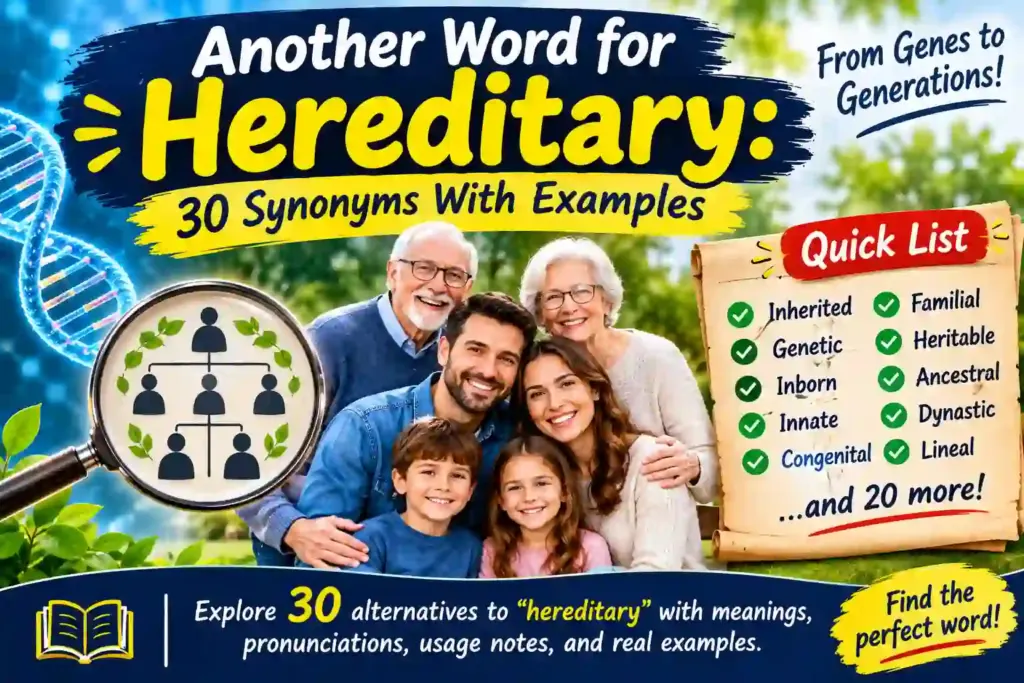
Another word for hereditary is inherited. Other common choices are genetic, inborn, familial, and ancestral. The best one depends on what is passed down: a trait, a disease, a title, or property.
Hereditary covers biology, law, and power. A trait can be hereditary, and so can a title or a throne. Some alternatives fit only one of these areas.
Quick list: inherited, genetic, inborn, innate, congenital, familial, heritable, ancestral, dynastic, lineal
Below are 30 alternatives with meanings, IPA, usage notes, and examples.
At a Glance: Hereditary Synonyms and Related Alternatives
| Alternative | Part of Speech | Meaning | Register / Tone | Ideal Context |
| Inherited | Adjective | Received from a parent or earlier owner | Neutral | Traits, money, property |
| Genetic | Adjective | Relating to genes | Neutral, scientific | Health, biology |
| Inborn | Adjective | Present from birth | Neutral | Talents, instincts |
| Familial | Adjective | Occurring in families | Formal | Medical writing |
| Congenital | Adjective | Present at birth | Formal, medical | Conditions at birth |
| Heritable | Adjective | Able to be passed on | Technical | Science, law |
| Ancestral | Adjective | Coming from ancestors | Neutral | Homes, lands, roots |
| Dynastic | Adjective | Of a ruling family | Formal | Politics, history |
| Lineal | Adjective | Passing down a direct line | Formal | Law, descent |
| Entailed | Adjective | Limited to certain heirs by law | Legal | Property |
Which Word Should You Use?
| If you want to… | Use | Why |
| Describe a trait from parents | Inherited | It is the plainest choice. |
| Talk about genes or DNA | Genetic | It names the biological cause. |
| Describe a health issue in a family | Familial | It stresses family patterns. |
| Describe a condition present at birth | Congenital | It may or may not be genetic. |
| Describe a ruling family | Dynastic | It fits kings and queens. |
| Describe land or money passed down | Entailed | It is a legal term. |
| Describe a natural talent | Inborn | It sounds warm and simple. |
Exploring the Multiple Meanings of Hereditary
1. Passed Through Genes
- Meaning: Passed from parent to child through genes.
- Explanation: This is the main biological sense. It is used for traits and diseases.
- Example: Her brown eyes are hereditary.
2. Passed Through Law or Custom
- Meaning: Passed down by legal right from one holder to the next.
- Explanation: It applies to titles, offices, and property, and genes are not involved.
- Example: The title is hereditary and passes to the eldest son.
3. Held by Family Succession
- Meaning: Based on rule by a family line.
- Explanation: It describes systems of power, such as a monarchy.
- Example: The country is a hereditary monarchy.
4. Long-Standing or Deep-Rooted
- Meaning: Passed down over generations, often figuratively.
- Explanation: It can describe habits or feuds, but this use is less common.
- Example: The two families shared a hereditary rivalry.
Sources: Merriam-Webster; Collins Dictionary; Dictionary.com.
Analyzing 30 Hereditary Alternatives in Detail
Some alternatives below are direct synonyms, while others are related words that fit only certain contexts.
Core Synonyms
1. Inherited
IPA: /ɪnˈherɪtɪd/ (US and UK)
Definition: Received from a parent or earlier generation.
- Usage: This is the closest everyday synonym and works in most contexts.
- Example: He has an inherited love of music.
2. Genetic
IPA: /dʒəˈnetɪk/ (US and UK)
Definition: Relating to genes or heredity.
- Usage: It is narrower than hereditary because it covers biology only.
- Example: Doctors found a genetic cause.
3. Inborn
IPA: US /ˌɪnˈbɔːrn/ · UK /ˌɪnˈbɔːn/
Definition: Present from birth.
- Usage: It suggests a natural trait and does not always mean it came from parents.
- Example: She has an inborn sense of rhythm.
4. Innate
IPA: /ɪˈneɪt/ (US and UK)
Definition: Existing in a person from birth.
- Usage: It is slightly more formal than inborn and is a related alternative.
- Example: Children have an innate need to play.
5. Congenital
IPA: /kənˈdʒenɪtl/ (US and UK)
Definition: Present from birth, especially of a condition.
- Usage: It is a related alternative. A congenital condition may not be inherited.
- Example: He was born with a congenital heart defect.
6. Familial
IPA: /fəˈmɪliəl/ (US and UK)
Definition: Occurring in or relating to a family.
- Usage: It is formal and common in medicine.
- Example: The doctor noted a familial pattern of asthma.
Legal and Property Alternatives
7. Heritable
IPA: /ˈherɪtəbl/ (US and UK)
Definition: Capable of being passed to offspring or heirs.
- Usage: It is technical and common in science and law.
- Example: Height is a heritable trait.
8. Inheritable
IPA: /ɪnˈherɪtəbl/ (US and UK)
Definition: Able to be inherited.
- Usage: It is nearly the same as heritable but a little plainer.
- Example: The estate is inheritable by both children.
9. Patrimonial
IPA: US /ˌpætrɪˈmoʊniəl/ · UK /ˌpætrɪˈməʊniəl/
Definition: Relating to property inherited from a father or ancestors.
- Usage: It is a formal, rare, related alternative that is limited to property.
- Example: The patrimonial lands stayed in the family.
10. Ancestral
IPA: /ænˈsestrəl/ (US and UK)
Definition: Belonging to or coming from one’s ancestors.
- Usage: It points to the distant past, not just parents.
- Example: They returned to their ancestral village.
11. Transmissible
IPA: /trænzˈmɪsəbl/ (US and UK)
Definition: Able to be passed from one to another.
- Usage: It is a related alternative. It also describes diseases that spread by contact.
- Example: The gene is transmissible to children.
Title and Rule Alternatives
12. Dynastic
IPA: US /daɪˈnæstɪk/ · UK /dɪˈnæstɪk/
Definition: Relating to a line of rulers from one family.
- Usage: It fits power and politics, not genes.
- Example: The dynastic rule lasted two centuries.
13. Lineal
IPA: /ˈlɪniəl/ (US and UK)
Definition: Descending in a direct line from an ancestor.
- Usage: It is formal and used for descent and succession.
- Example: He is the lineal heir to the estate.
14. Patrilineal
IPA: /ˌpætrɪˈlɪniəl/ (US and UK)
Definition: Traced through the father’s side of the family.
- Usage: It is a related alternative from anthropology.
- Example: The surname follows a patrilineal pattern.
15. Matrilineal
IPA: /ˌmætrɪˈlɪniəl/ (US and UK)
Definition: Traced through the mother’s side of the family.
- Usage: It is a related alternative from anthropology.
- Example: Their property passes in a matrilineal line.
Natural Trait Alternatives
16. Natural
IPA: /ˈnætʃrəl/ (US and UK)
Definition: Existing from birth rather than learned.
- Usage: It is informal and loose, and it does not stress family.
- Example: She has a natural talent for drawing.
17. Intrinsic
IPA: /ɪnˈtrɪnzɪk/ (US and UK)
Definition: Belonging to the essential nature of something.
- Usage: It is a related alternative. It does not suggest passing down.
- Example: Curiosity is intrinsic to children.
18. Inherent
IPA: US /ɪnˈhɪrənt/ · UK /ɪnˈhɪərənt/
Definition: Existing as a permanent part of something.
- Usage: It is a related alternative. It means built in, not passed on.
- Example: Risk is inherent in investing.
19. Native
IPA: /ˈneɪtɪv/ (US and UK)
Definition: Present by birth or origin.
- Usage: It is a rare related alternative in this sense.
- Example: She has a native gift for languages.
20. Constitutional
IPA: US /ˌkɑːnstɪˈtuːʃənl/ · UK /ˌkɒnstɪˈtjuːʃənl/
Definition: Relating to a person’s basic physical or mental makeup.
- Usage: It is formal and slightly old-fashioned.
- Example: He has a constitutional weakness of the lungs.
Generational Alternatives
21. Generational
IPA: /ˌdʒenəˈreɪʃənl/ (US and UK)
Definition: Relating to a generation.
- Usage: It is a related alternative and suits patterns across time.
- Example: The family faced generational debt.
22. Intergenerational
IPA: US /ˌɪntərdʒenəˈreɪʃənl/ · UK /ˌɪntədʒenəˈreɪʃənl/
Definition: Occurring between generations.
- Usage: It is a related alternative. It is common in social science.
- Example: The study looked at intergenerational wealth.
23. Handed-down
IPA: /ˌhændɪd ˈdaʊn/ (US and UK)
Definition: Passed from older to younger people.
- Usage: It is informal. It often describes objects and stories.
- Example: She wore a handed-down coat.
24. Family
IPA: /ˈfæməli/ (US and UK)
Definition: Belonging to a family.
- Usage: It is a casual, loose alternative.
- Example: Baking is a family tradition.
Figurative and Related Alternatives
25. Atavistic
IPA: /ˌætəˈvɪstɪk/ (US and UK)
Definition: Resembling a distant ancestor’s traits.
- Usage: It is literary and often negative.
- Example: He felt an atavistic fear of the dark.
26. Traditional
IPA: /trəˈdɪʃənl/ (US and UK)
Definition: Handed down by custom.
- Usage: It is a related alternative for customs, not genes.
- Example: It is a traditional family recipe.
27. Built-in
IPA: /ˌbɪlt ˈɪn/ (US and UK)
Definition: Part of something from the start.
- Usage: It is informal and loosely related.
- Example: Cats have a built-in hunting instinct.
28. Deep-rooted
IPA: /ˌdiːp ˈruːtɪd/ (US and UK)
Definition: Firmly fixed over a long time.
- Usage: It is figurative and fits habits and beliefs.
- Example: The feud is deep-rooted.
29. Entailed
IPA: /ɪnˈteɪld/ (US and UK)
Definition: Legally restricted to a certain line of heirs.
- Usage: It is a legal, related alternative.
- Example: The entailed estate could not be sold.
30. Customary
IPA: US /ˈkʌstəmeri/ · UK /ˈkʌstəməri/
Definition: Based on long-standing custom.
- Usage: It is a weak related alternative that suits habits and practices only.
- Example: It is customary for the eldest to lead.
Sources: Merriam-Webster; Collins Dictionary and Thesaurus; Dictionary.com.
Hereditary vs. Genetic vs. Congenital
| Word | Core Idea | Example |
| Hereditary | Passed from parent to child | Hereditary baldness |
| Genetic | Caused by genes, possibly new | A genetic change |
| Congenital | Present at birth | A congenital defect |
A condition can be genetic without being inherited, because a gene can change in one person. A condition can also be congenital without being genetic. Hereditary also covers titles, which genetic and congenital do not.
Sources: Merriam-Webster; Collins Dictionary.
Hereditary and Opposite/Paired Word Pairs
| Word | Paired Word | Note |
| Hereditary | Acquired | Gained during life |
| Hereditary | Elected | Used for offices |
| Hereditary | Earned | Used for titles and wealth |
| Inborn | Learned | Natural versus taught |
| Genetic | Environmental | Often compared in science |
Opposites depend on the meaning. For traits, acquired fits best. For power, elected is the usual contrast.
Sources: Merriam-Webster; Collins Thesaurus.
Common Word Partners of Hereditary
| Pattern | Common Partners | Example |
| hereditary + noun | disease, trait, condition | It is a hereditary disease. |
| hereditary + noun | peer, title, monarchy | He is a hereditary peer. |
| hereditary + noun | ruler, right, succession | The right was hereditary. |
| be + hereditary | be hereditary in nature | The illness is hereditary. |
Sources: Collins Dictionary; Merriam-Webster.
Idiomatic Phrases Featuring Hereditary
Hereditary has no true idioms. The following are established expressions that have fixed meanings.
1. Hereditary peer
- Meaning: A noble who holds a title by family succession.
- Example: The hereditary peer sat in the House of Lords.
2. Hereditary monarchy
- Meaning: A kingdom where the crown passes within a family.
- Example: Britain is a hereditary monarchy.
3. Hereditary principle
- Meaning: The idea that a role passes by birth.
- Example: Critics oppose the hereditary principle.
Sources: Collins Dictionary; Merriam-Webster.
Word Formation of Hereditary
Etymology & Structure
The word comes from Latin hereditarius, from hereditas (inheritance), which comes from heres (heir). The suffix -ary means relating to.
Date and History
Merriam-Webster and Etymonline date the adjective to the 15th century.
Word Class Variations
- Noun: heredity; hereditarian
- Adjective: hereditary
- Adverb: hereditarily
Sources: Etymonline; Merriam-Webster.
Common Word-Choice Mistakes
- Hereditary virus: use contagious virus, since a virus spreads by contact.
- Hereditary to the family: use hereditary in the family.
- Congenital means inherited: it only means present at birth.
- Genetic title: use hereditary title.
- Heredity trait: use hereditary trait, since heredity is a noun.
- Innate wealth: use inherited wealth.
- Hereditary habit: use learned habit unless genes are involved.
Frequently Asked Questions
What is the closest synonym for hereditary?
Inherited is the closest everyday synonym.
What is a formal alternative?
Heritable and familial are formal choices.
What is a literary alternative?
Atavistic and ancestral suit literary writing.
Can hereditary describe a habit?
Rarely. Use family habit or learned habit instead.
What word fits royal rule?
Dynastic fits best.
Is heredity a verb?
No. Heredity is a noun.
Conclusion
Inherited is the closest everyday alternative to hereditary. Genetic, familial, and heritable fit science, while dynastic and lineal fit rule and descent.
Context decides the right word. Some words cover only biology, and others cover only law or power. A few, like congenital and intrinsic, are related but not exact matches.
To choose well, first ask what is being passed on. Then pick the word that fits that area.

Hi, I’m ALI HAMZA writer at LifeLoomer.com, I write about the things we all wonder but rarely ask what everyday words really mean, how small habits shape our days, and the practical how-tos that make life a little easier.
My promise is simple: honest research, plain words, and articles that respect your time. If a piece doesn’t genuinely help someone, it doesn’t go live.
Glad you’re here let’s learn the little things that matter.