
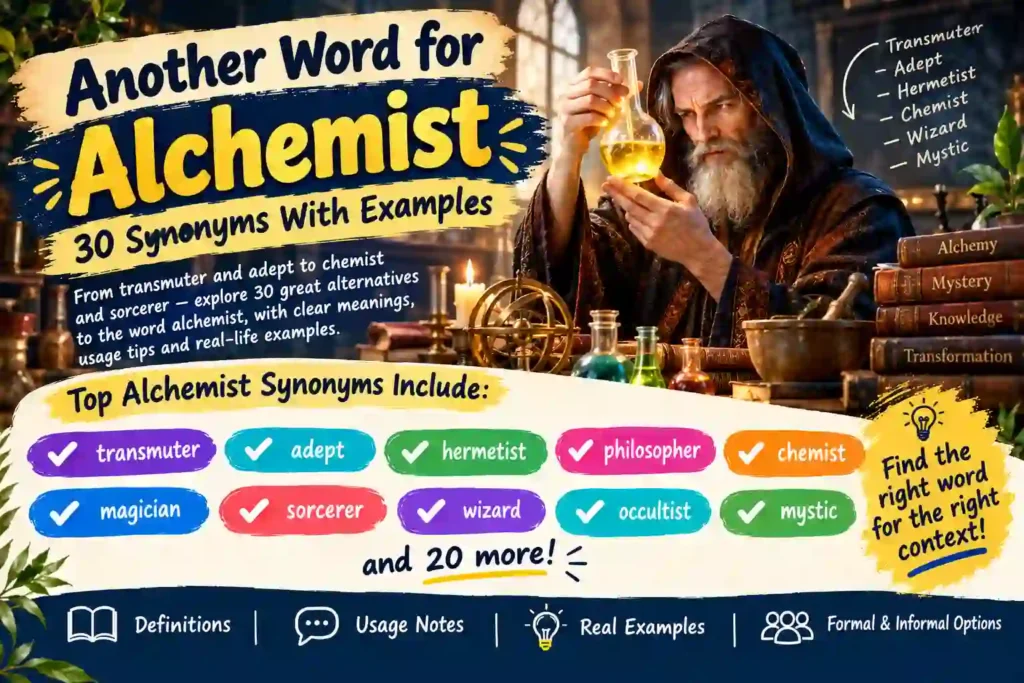
The closest everyday alternatives for alchemist are transmuter, adept, hermetist, and, in older texts, philosopher. Alchemist names a person who practiced alchemy, the medieval art of turning base metals into gold and seeking a universal cure. Because the word is so specific, no single synonym fits every case. Some options describe the same historical practice, while others only share the idea of magic, mystery, or clever transformation.
The best choice therefore depends on context. Some alternatives point to early science, such as chemist or apothecary. Others suggest magic or the occult, such as sorcerer or mystic. A few work figuratively for someone who “transforms” things, such as innovator or visionary.
Quick list: transmuter, adept, hermetist, philosopher, chemist, magician, sorcerer, wizard, occultist, mystic
This article examines 30 alternatives with meanings, IPA, usage notes, examples, and context.
At a Glance: Alchemist Synonyms and Related Alternatives
| Alternative | Part of Speech | Meaning | Register / Tone | Ideal Context |
| Transmuter | noun | One who changes one substance into another | Formal | Historical writing |
| Adept | noun | A highly skilled master of a secret art | Literary | Alchemy and occult texts |
| Hermetist | noun | A follower of Hermetic teachings | Formal, rare | Occult history |
| Philosopher | noun | Archaic: an alchemist | Archaic | Old texts |
| Chemist | noun | A scientist who studies substances | Neutral | Early science history |
| Magician | noun | A person who uses magic | Neutral | Stories, fantasy |
| Sorcerer | noun | A person who uses evil or powerful magic | Literary | Fantasy, folklore |
| Occultist | noun | A student of hidden or supernatural arts | Formal | Esoteric studies |
| Mystic | noun | A person seeking spiritual truth | Neutral | Religion, spirituality |
| Innovator | noun | A person who creates new methods | Neutral | Figurative use |
Which Word Should You Use?
| If you want to… | Use | Why |
| Describe a medieval gold-maker | Transmuter | It names the act of changing metals. |
| Suggest secret, advanced skill | Adept | It stresses mastery of a hidden art. |
| Link alchemy to early science | Chemist | Alchemy led toward modern chemistry. |
| Write a fantasy character | Wizard | Readers know it instantly. |
| Sound mysterious or dark | Sorcerer | It suggests powerful, often wicked magic. |
| Stress spiritual goals | Mystic | Many alchemists sought spiritual change. |
| Praise creative change | Innovator | It works figuratively. |
| Suggest fraud | Charlatan | Some alchemists were accused of cheating. |
Exploring the Multiple Meanings of “Alchemist”
1. The Historical Practitioner
- Meaning: A person who practiced medieval alchemy.
- Explanation: This is the main sense. These people tried to turn base metals into gold and to find an elixir of life.
- Example: The alchemist spent years searching for the philosopher’s stone.
2. The Proto-Scientist
- Meaning: An early experimenter whose work helped lead to chemistry.
- Explanation: Historians often treat alchemists as forerunners of chemists, though their aims were also spiritual.
- Example: Many early chemical tools came from alchemists’ workshops.
3. The Magical Figure
- Meaning: A wise or mysterious magic user in fiction.
- Explanation: Stories often show alchemists as magicians with secret knowledge.
- Example: The alchemist in the tale guarded a locked book of spells.
4. The Figurative Transformer
- Meaning: Someone who changes something ordinary into something valuable.
- Explanation: This sense is metaphorical and works best with an added phrase.
- Example: She is an alchemist in the kitchen, turning simple food into magic.
Sources: Merriam-Webster; Collins Dictionary; Dictionary.com; Encyclopaedia Britannica.
Analyzing 30 Alchemist Alternatives in Detail
Some alternatives below are direct synonyms, while others are related words that fit only certain contexts.
Core Alchemy Terms
1. Transmuter
IPA: US /trænzˈmjuːtɚ/ · UK /trænzˈmjuːtə/
Definition: One who changes something into another form.
- Usage: A close, formal match, tied to changing metals.
- Example: The transmuter hoped to create gold from lead.
2. Adept
IPA: /əˈdɛpt/ (US and UK)
Definition: A skilled expert, especially in a secret art.
- Usage: Historically used for masters of alchemy. In everyday English it only means “expert.”
- Example: Legends say the adept had found the elixir.
3. Hermetist
IPA: US /ˈhɜːrmətɪst/ · UK /ˈhɜːmətɪst/
Definition: A follower of Hermetic, or occult, teachings.
- Usage: A related, rare word. Alchemy belonged to Hermetic tradition, but not every hermetist was an alchemist.
- Example: The hermetist studied old alchemical writings.
4. Spagyrist
IPA: /spəˈdʒɪrɪst/ (US and UK)
Definition: One who practices spagyric, or herbal and mineral, alchemy.
- Usage: A narrow related term for alchemical medicine.
- Example: The spagyrist prepared remedies from plants.
5. Philosopher
IPA: US /fəˈlɑːsəfɚ/ · UK /fɪˈlɒsəfə/
Definition: Archaic: an alchemist.
- Usage: A real but old sense, as in “philosopher’s stone.” Today the word means a thinker.
- Example: The old philosopher guarded his furnace.
6. Magus
IPA: /ˈmeɪɡəs/ (US and UK)
Definition: A learned magician or sage.
- Usage: Related and literary. It suggests deep, ancient wisdom.
- Example: The magus mixed minerals by candlelight.
Early Science Alternatives
7. Chemist
IPA: /ˈkɛmɪst/ (US and UK)
Definition: A scientist who studies substances and their changes.
- Usage: Related, not exact. A chemist uses modern science, not magic.
- Example: Early chemists learned from alchemists.
8. Natural philosopher
IPA: US /ˈnætʃərəl fəˈlɑːsəfɚ/ · UK /ˈnætʃrəl fɪˈlɒsəfə/
Definition: An early student of nature, before modern science.
- Usage: Related. It fits historical writing about early inquiry.
- Example: Newton was a natural philosopher.
9. Iatrochemist
IPA: US /aɪˌætroʊˈkɛmɪst/ · UK /aɪˌætrəʊˈkɛmɪst/
Definition: A chemist who aimed to make medicines.
- Usage: A rare, specialized relative that focuses on medicine.
- Example: The iatrochemist tested mineral cures.
10. Apothecary
IPA: US /əˈpɑːθəˌkɛri/ · UK /əˈpɒθɪkəri/
Definition: A person who prepared and sold medicines.
- Usage: Related. It shares the medicine link but not the gold-making goal.
- Example: The apothecary kept jars of herbs.
11. Metallurgist
IPA: US /ˈmɛtəˌlɜːrdʒɪst/ · UK /mɪˈtælədʒɪst/
Definition: An expert in metals and their properties.
- Usage: Related. It fits the metal-working side of alchemy.
- Example: A metallurgist studies how alloys form.
12. Scientist
IPA: /ˈsaɪəntɪst/ (US and UK)
Definition: A person trained in scientific study.
- Usage: A broad, loose alternative, not a true synonym.
- Example: Some alchemists were early scientists.
Magic Alternatives
13. Magician
IPA: /məˈdʒɪʃən/ (US and UK)
Definition: A person who uses magic.
- Usage: Related and common. It lacks alchemy’s focus on substances.
- Example: The magician lived in a tower.
14. Sorcerer
IPA: US /ˈsɔːrsərɚ/ · UK /ˈsɔːsərə/
Definition: A person who uses magic, often evil magic.
- Usage: Related, with a darker tone.
- Example: The sorcerer brewed a strange potion.
15. Wizard
IPA: US /ˈwɪzɚd/ · UK /ˈwɪzəd/
Definition: A man who has magical powers.
- Usage: Informal and popular in fantasy.
- Example: The wizard studied ancient formulas.
16. Enchanter
IPA: US /ɪnˈtʃæntɚ/ · UK /ɪnˈtʃɑːntə/
Definition: One who casts spells.
- Usage: Literary and related.
- Example: The enchanter blessed the metal.
17. Mage
IPA: /meɪdʒ/ (US and UK)
Definition: A magician or wise person.
- Usage: Mostly used in fantasy.
- Example: The mage mixed rare powders.
18. Conjurer
IPA: US /ˈkɑːndʒərɚ/ · UK /ˈkʌndʒərə/
Definition: One who performs magic tricks or calls up spirits.
- Usage: Related. It often suggests tricks.
- Example: The conjurer amazed the crowd.
Occult and Mystic Alternatives
19. Occultist
IPA: US /əˈkʌltɪst/ · UK /ˈɒkəltɪst/
Definition: A student of hidden or supernatural arts.
- Usage: Formal, and wider than alchemist.
- Example: The occultist collected alchemical manuscripts.
20. Mystic
IPA: /ˈmɪstɪk/ (US and UK)
Definition: A person who seeks spiritual truth.
- Usage: Related. It fits alchemy’s spiritual side.
- Example: The mystic saw alchemy as inner change.
21. Thaumaturge
IPA: US /ˈθɔːməˌtɜːrdʒ/ · UK /ˈθɔːmətɜːdʒ/
Definition: A worker of miracles.
- Usage: Rare and literary.
- Example: The thaumaturge claimed amazing cures.
22. Theurgist
IPA: US /ˈθiːɜːrdʒɪst/ · UK /ˈθiːɜːdʒɪst/
Definition: One who works magic through divine help.
- Usage: Very rare, so use it sparingly.
- Example: The theurgist prayed over his tools.
23. Sage
IPA: /seɪdʒ/ (US and UK)
Definition: A wise person.
- Usage: Loosely related. It suggests wisdom, not practice.
- Example: The sage taught alchemy to a student.
24. Warlock
IPA: US /ˈwɔːrlɑːk/ · UK /ˈwɔːlɒk/
Definition: A man who practices witchcraft.
- Usage: Related, with a darker tone.
- Example: Villagers feared the warlock’s laboratory.
Figurative Alternatives
25. Experimenter
IPA: US /ɪkˈspɛrəmɛntɚ/ · UK /ɪkˈspɛrɪmɛntə/
Definition: A person who tests new ideas.
- Usage: Loosely related, and neutral.
- Example: Alchemists were patient experimenters.
26. Artisan
IPA: US /ˈɑːrtəzən/ · UK /ˌɑːtɪˈzæn/
Definition: A skilled craftsperson.
- Usage: Figurative, for skilled making.
- Example: The artisan turned clay into art.
27. Visionary
IPA: US /ˈvɪʒəˌnɛri/ · UK /ˈvɪʒənri/
Definition: A person with bold, original ideas.
- Usage: Figurative, and positive.
- Example: The visionary reshaped the company.
28. Innovator
IPA: US /ˈɪnəˌveɪtɚ/ · UK /ˈɪnəveɪtə/
Definition: One who introduces new methods.
- Usage: Figurative, for creative change.
- Example: She is an innovator in food science.
29. Miracle worker
IPA: US /ˈmɪrəkəl ˌwɜːrkɚ/ · UK /ˈmɪrəkəl ˌwɜːkə/
Definition: Someone who achieves amazing results.
- Usage: Figurative, and informal.
- Example: The coach was a miracle worker.
30. Charlatan
IPA: US /ˈʃɑːrlətən/ · UK /ˈʃɑːlətən/
Definition: A person who falsely claims special skill.
- Usage: Related only in a negative sense, since some alchemists were called frauds.
- Example: The king jailed the charlatan who promised gold.
Sources: Merriam-Webster; Collins Dictionary; Dictionary.com; Etymonline.
Alchemist vs. Chemist vs. Sorcerer
| Word | Main Aim | Method | Typical Setting |
| Alchemist | Change metals, find an elixir | Experiment plus mystical belief | Medieval and early modern |
| Chemist | Understand substances | Scientific method | Modern |
| Sorcerer | Control forces | Spells | Fantasy and folklore |
Sources: Encyclopaedia Britannica; Merriam-Webster.
Alchemist and Opposite/Paired Word Pairs
| Word | Paired Word | Note |
| Alchemist | Chemist | Old belief versus modern science |
| Alchemist | Skeptic | Believer versus doubter |
| Alchemist | Charlatan | Honest seeker versus fraud |
| Alchemist | Layperson | Expert versus outsider |
Alchemist has no true antonym. These pairs show contrast rather than strict opposites.
Sources: Collins Thesaurus; Merriam-Webster.
Common Word Partners of “Alchemist”
| Pattern | Common Partners | Example |
| adjective + alchemist | medieval, ancient, famous | A medieval alchemist wrote the guide. |
| alchemist + verb | seeks, experiments, claims | The alchemist claims to make gold. |
| noun + alchemist | court, kitchen | The court alchemist served the king. |
| alchemist’s + noun | laboratory, workshop | The alchemist’s laboratory was full of jars. |
Sources: Collins Dictionary; Merriam-Webster.
Idiomatic Phrases Featuring “Alchemist”
Alchemist has few fixed idioms. The following are established expressions linked to alchemy, not true idioms.
1. Philosopher’s stone
- Meaning: A legendary substance said to turn metal into gold.
- Example: Finding the philosopher’s stone was every alchemist’s dream.
2. Turn lead into gold
- Meaning: To make something worthless valuable.
- Example: The designer can turn lead into gold.
3. A modern-day alchemist
- Meaning: Someone who makes clever, valuable changes.
- Example: The chef is a modern-day alchemist.
Sources: Merriam-Webster; Collins Dictionary.
Word Formation of “Alchemist”
Etymology & Structure
Alchemist comes from alchemy plus the suffix -ist. Alchemy traces back through Old French and Medieval Latin to Arabic al-kimiya, likely from Greek khemeia.
Date and History
Etymonline dates alchemy to the late 14th century. Reference works place alchemist in the early 1500s.
Word Class Variations
- Noun: alchemist, alchemy
- Adjective: alchemical, alchemistic
- Adverb: alchemically
- Verb: alchemize (rare)
Sources: Etymonline; Merriam-Webster.
Frequently Asked Questions
What is the closest synonym for alchemist?
Transmuter is the closest, followed by adept in historical writing.
Is an alchemist a chemist?
No. Alchemy influenced chemistry, but chemists use scientific methods.
What is a formal alternative?
Transmuter and hermetist are formal choices.
What is a literary alternative?
Magus, adept, and thaumaturge suit literary writing.
What is a figurative alternative?
Innovator, visionary, and miracle worker work figuratively.
Can alchemist describe a woman?
Yes. The word is gender-neutral.
Is alchemist the same as wizard?
No. A wizard uses magic, while an alchemist works with substances.
Conclusion
The closest alternatives for alchemist are transmuter, adept, and hermetist. Related words such as chemist, magician, and mystic capture only one side of the original meaning.
Context decides which word is best. Historical writing favors transmuter or adept, fantasy favors wizard or sorcerer, and everyday figurative use favors innovator or visionary.
To choose well, ask what you want to stress: science, magic, spirit, or creativity. Then pick the word that fits and avoid treating related terms as exact synonyms.

Hi, I’m ALI HAMZA writer at LifeLoomer.com, I write about the things we all wonder but rarely ask what everyday words really mean, how small habits shape our days, and the practical how-tos that make life a little easier.
My promise is simple: honest research, plain words, and articles that respect your time. If a piece doesn’t genuinely help someone, it doesn’t go live.
Glad you’re here let’s learn the little things that matter.