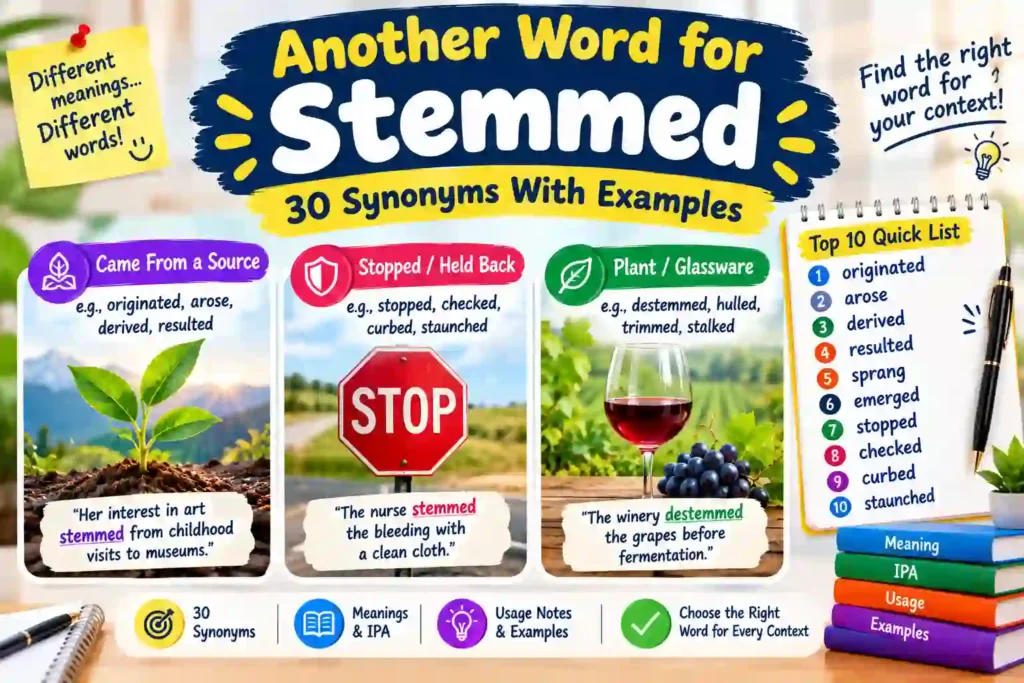
The closest everyday alternatives for stemmed are originated, arose, derived, and resulted when it means came from (as in her fear stemmed from a bad experience). When it means stopped, try stopped, checked, curbed, or staunched. The right word depends on which meaning you need.
Stemmed has three main areas of meaning: origin, stopping, and plants or glassware. This guide covers all three, so you can pick a word that fits your sentence.
Quick list: originated, arose, derived, resulted, sprang, emerged, stopped, checked, curbed, staunched
Below you will find 30 alternatives with meanings, IPA, usage notes, and examples.
At a Glance: Stemmed Synonyms and Related Alternatives
| Alternative | Part of Speech | Meaning | Register / Tone | Ideal Context |
| Originated | Verb | Began from a source | Neutral | Causes, history |
| Arose | Verb | Came into being | Neutral | Problems, ideas |
| Derived | Verb | Came from a source | Formal | Words, ideas |
| Resulted | Verb | Happened as an effect | Neutral | Cause and effect |
| Emanated | Verb | Came out from a source | Formal | Feelings, light |
| Stopped | Verb | Ended movement or flow | Everyday | General use |
| Checked | Verb | Held back or slowed | Neutral | Growth, spread |
| Curbed | Verb | Limited or controlled | Neutral | Costs, habits |
| Staunched | Verb | Stopped a flow of blood | Formal | Wounds, losses |
| Destemmed | Verb | Removed the stems | Technical | Grapes, herbs |
Which Word Should You Use?
| If you want to… | Use | Why |
| Say what caused something | Resulted | It points to an effect |
| Name the starting point | Originated | It stresses the source |
| Sound formal or academic | Derived | It suits ideas and words |
| Describe a sudden start | Sprang | It feels quick and lively |
| Stop bleeding or a leak | Staunched | It fits flowing liquid |
| Limit something harmful | Curbed | It means held in check |
| Describe removing stalks | Destemmed | It is a precise cooking term |
| Write plainly | Stopped | It works almost anywhere |
Exploring the Multiple Meanings of Stemmed
1. Came From a Source
- Meaning: Had its origin in something.
- Explanation: This is the most common use, almost always with from. It suggests a cause growing out of an earlier event.
- Example: Her interest in art stemmed from childhood visits to museums.
2. Stopped or Held Back
- Meaning: Stopped or checked something, such as a flow.
- Explanation: This is the older verb sense, from damming a river. It is used for blood, losses, and problems that spread.
- Example: The nurse stemmed the bleeding with a clean cloth.
3. Made Headway Against
- Meaning: Moved forward against a tide or wind.
- Explanation: This is a separate, rarer sense with a nautical feel. It is often confused with stem the tide, which means holding back.
- Example: The small boat stemmed the current and reached the shore.
4. Removed the Stem
- Meaning: Took the stem off fruit, leaves, or vegetables.
- Explanation: This is common in cooking and winemaking.
- Example: She stemmed the cherries before baking.
5. Having a Stem
- Meaning: Having a stem of a stated kind.
- Explanation: Here stemmed works as an adjective, as in a stemmed glass or long-stemmed roses.
- Example: He set out six stemmed glasses for dinner.
Sources: Merriam-Webster; Dictionary.com (Collins English Dictionary); Etymonline.
Analyzing 30 Stemmed Alternatives in Detail
Some alternatives below are direct synonyms, while others only fit one sense of stemmed, and each entry says which.
Core Synonyms for Came From
1. Originated
IPA: US /əˈrɪdʒəˌneɪtɪd/ · UK /əˈrɪdʒɪneɪtɪd/
Definition: Began or came into being from a source.
- Usage: The closest direct synonym for stemmed from. Neutral and widely used.
- Example: The custom originated in rural Japan.
2. Arose
IPA: US /əˈroʊz/ · UK /əˈrəʊz/
Definition: Came into existence or notice.
- Usage: A direct synonym, best for problems, questions, or conflicts.
- Example: The confusion arose from a poorly worded email.
3. Derived
IPA: (US and UK) /dɪˈraɪvd/
Definition: Obtained or traced from a source.
- Usage: A direct synonym with a formal tone. Common with words, ideas, and income.
- Example: The word salary derived from Latin.
4. Resulted
IPA: (US and UK) /rɪˈzʌltɪd/
Definition: Happened as an effect of something.
- Usage: A direct synonym that focuses on consequence. It is usually followed by from.
- Example: The delay resulted from heavy snow.
5. Sprang
IPA: (US and UK) /spræŋ/
Definition: Came suddenly into being.
- Usage: A close synonym, often with from or up. It suggests speed.
- Example: Her confidence sprang from months of practice.
6. Came
IPA: (US and UK) /keɪm/
Definition: Moved from a source or arrived from it.
- Usage: A simple everyday alternative, mostly with from. It is less precise than originated.
- Example: His strength came from daily training.
Growth and Emergence
7. Grew
IPA: (US and UK) /ɡruː/
Definition: Developed gradually from a starting point.
- Usage: A related alternative, best when the cause developed slowly.
- Example: The project grew from a simple sketch.
8. Developed
IPA: (US and UK) /dɪˈveləpt/
Definition: Grew or advanced to a fuller form.
- Usage: A related alternative. It suits step-by-step change rather than a single cause.
- Example: The plan developed from a casual chat.
9. Emerged
IPA: US /ɪˈmɜːrdʒd/ · UK /ɪˈmɜːdʒd/
Definition: Came into view or became known.
- Usage: A related alternative for things that appear out of a situation.
- Example: A new trend emerged from the study.
10. Sprouted
IPA: (US and UK) /ˈspraʊtɪd/
Definition: Began to grow or appear quickly.
- Usage: A figurative, related alternative. It matches the plant image behind stem.
- Example: New businesses sprouted from the market’s success.
Formal Alternatives
11. Emanated
IPA: (US and UK) /ˈeməneɪtɪd/
Definition: Came out from a source.
- Usage: A formal synonym, often for light, feelings, or ideas.
- Example: The rumor emanated from an anonymous post.
12. Proceeded
IPA: US /proʊˈsiːdɪd/ · UK /prəˈsiːdɪd/
Definition: Came forth from a source.
- Usage: A formal synonym used with from. It is rarer than originated.
- Example: His advice proceeded from long experience.
13. Issued
IPA: (US and UK) /ˈɪʃuːd/
Definition: Flowed or came out from a place.
- Usage: A formal, somewhat literary synonym. It can sound old-fashioned.
- Example: A low hum issued from the machine.
14. Ensued
IPA: US /ɪnˈsuːd/ · UK /ɪnˈsjuːd/
Definition: Followed as a result.
- Usage: A related alternative. It shows what came next, not where something started, and is not followed by from.
- Example: A long debate ensued.
Stopping a Flow
15. Stopped
IPA: US /stɑːpt/ · UK /stɒpt/
Definition: Ended the movement or progress of something.
- Usage: The plainest synonym for stemmed in the stopping sense.
- Example: They stopped the leak with a patch.
16. Staunched
IPA: (US and UK) /stɔːntʃt/
Definition: Stopped a flow, especially of blood.
- Usage: A close synonym. Stanched is a common variant spelling, and the word is formal.
- Example: The medic staunched the wound.
17. Plugged
IPA: (US and UK) /plʌɡd/
Definition: Blocked a hole or opening.
- Usage: A close synonym for physical leaks, with a casual tone.
- Example: He plugged the gap under the door.
18. Dammed
IPA: (US and UK) /dæmd/
Definition: Blocked water with a barrier.
- Usage: A related alternative for water only. It shows the origin of the stopping sense.
- Example: Workers dammed the stream.
19. Checked
IPA: (US and UK) /tʃekt/
Definition: Slowed or held back.
- Usage: A close synonym. It suggests control, not a complete stop.
- Example: Cold weather checked the spread of insects.
20. Curbed
IPA: US /kɜːrbd/ · UK /kɜːbd/
Definition: Limited or kept under control.
- Usage: A close synonym for habits, costs, and growth.
- Example: The city curbed noise at night.
Holding Back and Limiting
21. Halted
IPA: (US and UK) /ˈhɔːltɪd/
Definition: Brought to a stop.
- Usage: A close synonym, slightly more formal than stopped and often used in news.
- Example: Officials halted the decline.
22. Contained
IPA: (US and UK) /kənˈteɪnd/
Definition: Kept within limits.
- Usage: A related alternative for things that might spread, such as fires or disease.
- Example: Firefighters contained the blaze.
23. Restrained
IPA: (US and UK) /rɪˈstreɪnd/
Definition: Held back from action or growth.
- Usage: A related alternative with a formal tone. It suggests deliberate control.
- Example: The bank restrained spending.
24. Stifled
IPA: (US and UK) /ˈstaɪfəld/
Definition: Held back or suppressed.
- Usage: A related alternative that often implies harm.
- Example: Strict rules stifled new ideas.
25. Arrested
IPA: (US and UK) /əˈrestɪd/
Definition: Stopped the progress of something.
- Usage: A formal alternative for processes such as decline or disease, not people, in this sense.
- Example: Early treatment arrested the damage.
Removing Stems and Describing Plants
26. Destemmed
IPA: (US and UK) /diːˈstemd/
Definition: Had the stems removed.
- Usage: A precise synonym for the removed the stem sense, mainly for grapes and herbs.
- Example: The winery destemmed the grapes first.
27. Hulled
IPA: (US and UK) /hʌld/
Definition: Removed the outer cap or leaves from fruit.
- Usage: A related alternative for strawberries and nuts. It removes the top, not only the stem.
- Example: She hulled the strawberries.
28. Trimmed
IPA: (US and UK) /trɪmd/
Definition: Cut away unwanted parts.
- Usage: A related alternative. It is broader than stemmed.
- Example: He trimmed the beans.
29. Stripped
IPA: (US and UK) /strɪpt/
Definition: Pulled off a covering or part.
- Usage: A related alternative for leaves taken from stalks.
- Example: We stripped the leaves from the stalks.
30. Stalked
IPA: (US and UK) /stɔːkt/
Definition: Having a stalk.
- Usage: An adjective that loosely matches stemmed in plant descriptions, such as stalked flowers. It does not fit the glassware sense.
- Example: The garden had tall, stalked lilies.
Sources: Merriam-Webster; Collins Dictionary; Dictionary.com.
Stemmed From vs. Resulted From vs. Originated From
| Phrase | Focus | Best Use |
| Stemmed from | Cause growing from a source | Everyday and formal writing |
| Resulted from | Effect of a cause | Clear cause and effect |
| Originated from | Starting point | History and sources |
Merriam-Webster notes that stem implies branching off from something as an outgrowth. For that reason, stemmed from suits ideas and problems with a clear root.
Sources: Merriam-Webster.
Stemmed and Opposite/Paired Word Pairs
| Word | Paired Word | Note |
| Stemmed (from) | Led to | Looks forward to the effect |
| Originated | Ended | Marks start and finish |
| Stopped (a flow) | Started | Natural opposite |
| Curbed | Encouraged | Limiting versus supporting |
| Destemmed | Left whole | Stems removed or kept |
Stemmed has no single opposite because each sense differs. The pairs above work best in their own meaning.
Sources: Merriam-Webster; Collins Dictionary.
Common Word Partners of Stemmed
| Pattern | Common Partners | Example |
| Stemmed + from | a problem, fear, belief | The delay stemmed from a supply issue. |
| Stemmed + the flow/tide | blood, losses, decline | The company stemmed its losses. |
| Stemmed + noun | glass, wine glass | She held a stemmed glass. |
| Long-stemmed + noun | roses | He bought long-stemmed roses. |
Sources: Merriam-Webster; Dictionary.com.
Idiomatic Phrases Featuring Stemmed
These come from the verb stem. Only the third is a true idiom, and the others are established expressions.
1. Stem the tide
- Meaning: To hold back something that keeps growing.
- Example: New rules stemmed the tide of complaints.
2. Stem from
- Meaning: To come from a source. This is a standard phrasal verb.
- Example: The disagreement stemmed from a misunderstanding.
3. From stem to stern
- Meaning: From one end of a ship to the other, or completely.
- Example: They cleaned the boat from stem to stern.
4. Stem the bleeding
- Meaning: To stop blood loss, or reduce a problem like losses.
- Example: The firm acted to stem the bleeding.
Sources: Merriam-Webster; Dictionary.com; Etymonline.
Common Word-Choice Mistakes
- Stemmed to: use stemmed from.
- Stemmed the cause: say stemmed from the cause.
- Resulted to: use resulted in (effect) or resulted from (cause).
- Originated in the idea: say originated from the idea or originated in a place.
- Stem the tide as move forward: it means to hold back.
- Curbed the disease for a complete stop: use halted, since curbed only limits.
- Hulled for stems only: hulled removes the cap too, so use destemmed.
Frequently Asked Questions
What is the closest synonym for stemmed?
Originated and arose are the closest for came from.
What is a formal alternative?
Derived, emanated, and proceeded suit formal writing.
Does stemmed always mean came from?
No. It can also mean stopped, had the stem removed, or having a stem.
What is the difference between stemmed from and resulted from?
Stemmed from shows a source, while resulted from stresses a direct effect.
Can stemmed describe people?
Not directly. You can say a person’s habit stemmed from something.
What is a figurative alternative?
Sprouted and sprang fit the plant image.
Is staunched the same as stanched?
Yes, they are variant spellings.
Conclusion
The closest alternatives to stemmed are originated, arose, derived, and resulted for origin, and stopped, checked, and curbed for holding back.
Context matters because stemmed has several senses. A word that fits one meaning may fail in another, such as hulled for stems or ensued for causes.
To choose well, first decide which sense you mean. Then match the tone and use the word with its usual partner, such as from.

Hi, I’m HAROON ,founder of LifeLoomer.com, I started LifeLoomer with one belief: the internet is full of answers, but not enough understanding. So I write guides that actually explain things the meanings behind everyday words, the small habits that make life better, and the how-tos nobody taught us.
Everything I publish is researched, written in plain words, and tested against one question: will this genuinely help someone today?
Thanks for being here. I hope you leave a little wiser than you came.