
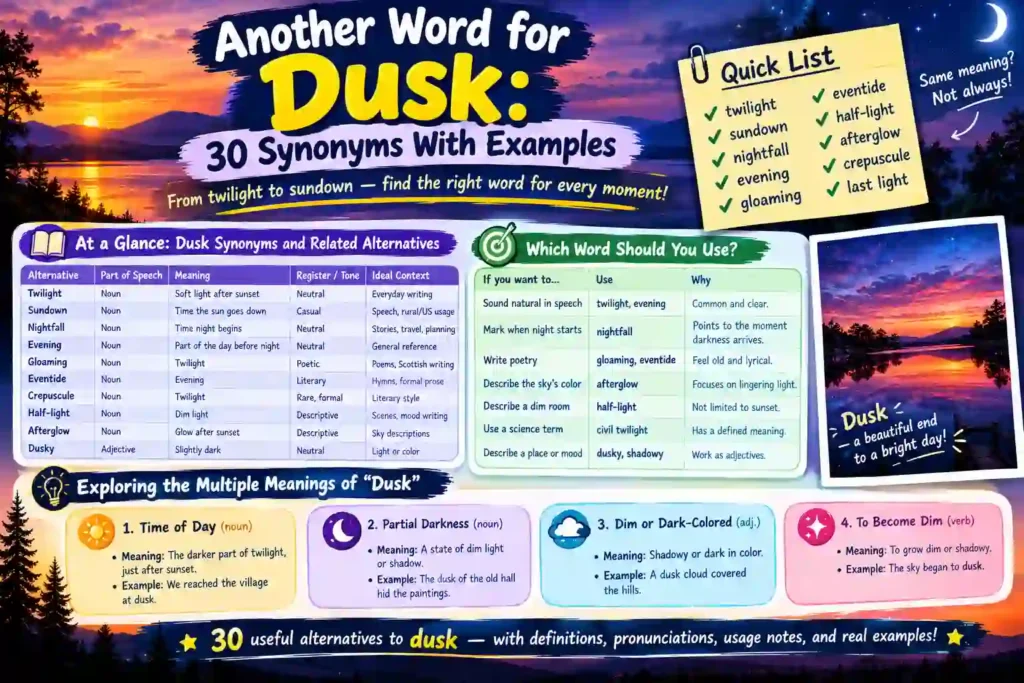
Another word for dusk is twilight. Other common choices are sundown, nightfall, and evening. Dusk means the dim time just after the sun sets, so the best word depends on the exact moment, the mood, and how formal you want to sound.
Some alternatives name the time. Others describe the light, the mood, or the tone of the writing. Some suit poems, and some suit science.
Quick list: twilight, sundown, nightfall, evening, gloaming, eventide, half-light, afterglow, crepuscule, last light
Below, you will find 30 alternatives with meanings, IPA, usage notes, and examples.
At a Glance: Dusk Synonyms and Related Alternatives
| Alternative | Part of Speech | Meaning | Register / Tone | Ideal Context |
| Twilight | noun | Soft light after sunset | Neutral | Everyday and descriptive writing |
| Sundown | noun | Time the sun goes down | Casual | Speech, rural or US usage |
| Nightfall | noun | Time night begins | Neutral | Stories, travel, planning |
| Evening | noun | Part of the day before night | Neutral | General time reference |
| Gloaming | noun | Twilight | Poetic | Poems, Scottish writing |
| Eventide | noun | Evening | Literary | Hymns, formal prose |
| Crepuscule | noun | Twilight | Rare, formal | Literary style |
| Half-light | noun | Dim light | Descriptive | Scenes, mood writing |
| Afterglow | noun | Glow after sunset | Descriptive | Sky and color descriptions |
| Dusky | adjective | Slightly dark | Neutral | Describing light or color |
Which Word Should You Use?
| If you want to… | Use | Why |
| Sound natural in speech | twilight, evening | Both are common and clear. |
| Mark when night starts | nightfall | It points to the moment darkness arrives. |
| Write poetry | gloaming, eventide | Both feel old and lyrical. |
| Describe the sky’s color | afterglow | It focuses on lingering light. |
| Describe a dim room | half-light | It is not limited to sunset. |
| Use a science term | civil twilight | It has a defined meaning. |
| Describe a place or mood | dusky, shadowy | These are adjectives. |
Exploring the Multiple Meanings of “Dusk”
1. Time of Day
- Meaning: The darker part of twilight, just after sunset.
- Explanation: This is the main sense. Dusk usually means the light is fading but not fully gone.
- Example: We reached the village at dusk.
2. Partial Darkness
- Meaning: A state of dim light or shadow.
- Explanation: Dusk can describe dimness in general, such as a dim room.
- Example: The dusk of the old hall hid the paintings.
3. Dim or Dark-Colored (Poetic Adjective)
- Meaning: Shadowy or dark in color.
- Explanation: This use is old and poetic. Most people now say dusky.
- Example: A dusk cloud covered the hills.
4. To Become Dim (Poetic Verb)
- Meaning: To grow dim or shadowy.
- Explanation: This verb is rare and literary.
- Example: The sky began to dusk.
Sources: Merriam-Webster; Collins English Dictionary via Dictionary.com
Analyzing 30 Dusk Alternatives in Detail
Some alternatives below are direct synonyms, while others are related terms for specific contexts.
Core Everyday Alternatives
1. Twilight
IPA: /ˈtwaɪˌlaɪt/ (US and UK)
Definition: The soft light in the sky after sunset or before sunrise.
- Usage: The closest synonym. It is slightly broader because it can also mean dawn light.
- Example: The mountains looked blue in the twilight.
2. Sundown
IPA: /ˈsʌnˌdaʊn/ (US and UK)
Definition: The time when the sun goes below the horizon.
- Usage: Casual and common in the US. It marks the moment of sunset, not the whole dim period.
- Example: The farmers headed home at sundown.
3. Sunset
IPA: /ˈsʌnˌsɛt/ (US and UK)
Definition: The daily disappearance of the sun, or the time it happens.
- Usage: Related, not exact. Sunset comes just before dusk.
- Example: Dusk followed the sunset.
4. Nightfall
IPA: US /ˈnaɪtˌfɔl/ · UK /ˈnaɪtfɔːl/
Definition: The time when night begins.
- Usage: Close in meaning, but it points to the end of dusk.
- Example: We must camp before nightfall.
5. Evening
IPA: /ˈiːvnɪŋ/ (US and UK)
Definition: The last part of the day, before night.
- Usage: Broader than dusk, since evening can start well before sunset.
- Example: We walked along the river in the evening.
Literary and Poetic Alternatives
6. Gloaming
IPA: US /ˈɡloʊmɪŋ/ · UK /ˈɡləʊmɪŋ/
Definition: Twilight, especially in the evening.
- Usage: Poetic, with Scottish roots. It is a true synonym.
- Example: Bats came out in the gloaming.
7. Eventide
IPA: /ˈiːvənˌtaɪd/ (US and UK)
Definition: Evening, in old or poetic usage.
- Usage: Literary and slightly religious in tone. It is closer to evening than dusk.
- Example: The hymn spoke of peace at eventide.
8. Crepuscule
IPA: /krɪˈpʌskjuːl/ (US and UK)
Definition: Twilight.
- Usage: Rare and formal. Use it only in elevated writing.
- Example: The poem describes the crepuscule over the sea.
9. Evenfall
IPA: US /ˈivənˌfɔl/ · UK /ˈiːvənfɔːl/
Definition: The beginning of evening; twilight.
- Usage: Literary and uncommon.
- Example: Lamps were lit at evenfall.
10. Vesper
IPA: US /ˈvɛspər/ · UK /ˈvɛspə/
Definition: Evening, in old or poetic usage.
- Usage: Archaic. It is also the evening star and a church service, so context matters.
- Example: The bells rang at vesper.
Light and Darkness Alternatives
11. Half-light
IPA: US /ˈhæfˌlaɪt/ · UK /ˈhɑːf laɪt/
Definition: Dim light, as at dusk or dawn.
- Usage: Related. It describes the light, not the time.
- Example: In the half-light, shapes looked soft.
12. Afterglow
IPA: US /ˈæftərˌɡloʊ/ · UK /ˈɑːftəɡləʊ/
Definition: The glow left in the sky after sunset.
- Usage: Related. It names the color, not the whole period.
- Example: An orange afterglow lit the clouds.
13. Dimness
IPA: /ˈdɪmnəs/ (US and UK)
Definition: Lack of bright light.
- Usage: Related and general. It does not say when the dimness occurs.
- Example: The dimness made reading hard.
14. Semidarkness
IPA: US /ˌsɛmiˈdɑrknəs/ · UK /ˌsɛmiˈdɑːknəs/
Definition: Partial darkness.
- Usage: Related and neutral. It fits rooms and streets as well as dusk.
- Example: We sat in semidarkness.
15. Gloom
IPA: /ɡluːm/ (US and UK)
Definition: Partial darkness; also a sad mood.
- Usage: Related. It sounds heavier and more negative than dusk.
- Example: Gloom filled the valley.
Descriptive Adjectives
16. Dusky
IPA: /ˈdʌski/ (US and UK)
Definition: Somewhat dark or dim.
- Usage: Related adjective. It can describe light or color.
- Example: The dusky sky turned purple.
17. Crepuscular
IPA: US /krɪˈpʌskjələr/ · UK /krɪˈpʌskjʊlə/
Definition: Relating to twilight; active at twilight.
- Usage: Formal and scientific. It describes animals active at dusk and dawn.
- Example: Deer are crepuscular animals.
18. Vespertine
IPA: US /ˈvɛspərˌtaɪn/ · UK /ˈvɛspətaɪn/
Definition: Relating to the evening.
- Usage: Formal and rare. It is broader than dusk.
- Example: The garden has vespertine flowers.
19. Twilit
IPA: /ˈtwaɪˌlɪt/ (US and UK)
Definition: Lit by twilight.
- Usage: Literary adjective.
- Example: We walked down the twilit road.
20. Shadowy
IPA: US /ˈʃædoʊi/ · UK /ˈʃædəʊi/
Definition: Full of shadows; dim.
- Usage: Related. It describes places, not the time of day.
- Example: The shadowy yard felt quiet.
Context-Specific Alternatives
21. Blue hour
IPA: US /bluː ˈaʊər/ · UK /bluː ˈaʊə/
Definition: The period of deep blue light around twilight.
- Usage: Related. This is a photography term, not a strict synonym.
- Example: She photographed the bridge during blue hour.
22. Golden hour
IPA: US /ˈɡoʊldən ˈaʊər/ · UK /ˈɡəʊldən ˈaʊə/
Definition: The warm-lit time soon after sunrise or before sunset.
- Usage: Related, but not dusk. It comes before dusk.
- Example: The golden hour ended, and dusk began.
23. Civil twilight
IPA: /ˈsɪvəl ˈtwaɪlaɪt/ (US and UK)
Definition: The early twilight period, when the sun is just below the horizon.
- Usage: Technical. It is only part of dusk.
- Example: Civil twilight lasts a short time.
24. Nautical twilight
IPA: /ˈnɔːtɪkəl ˈtwaɪlaɪt/ (US and UK)
Definition: A darker stage of twilight, when the horizon is hard to see.
- Usage: Technical and navigational. It comes after civil twilight.
- Example: Sailors checked the stars in nautical twilight.
25. Lighting-up time
IPA: /ˈlaɪtɪŋ ʌp taɪm/ (US and UK)
Definition: The time when vehicle lights must be switched on.
- Usage: Related. It is mainly British and used in traffic rules.
- Example: Lighting-up time was 6:15 p.m.
Phrases for the End of the Day
26. Last light
IPA: US /ˈlæst laɪt/ · UK /ˈlɑːst laɪt/
Definition: The final daylight before dark.
- Usage: Related. It is common in hiking and photography.
- Example: We reached the summit at last light.
27. Close of day
IPA: US /kloʊz əv ˈdeɪ/ · UK /kləʊz əv ˈdeɪ/
Definition: The end of the day.
- Usage: Formal and general. It is related, not exact.
- Example: Shops shut at the close of day.
28. Day’s end
IPA: /ˈdeɪz ˈɛnd/ (US and UK)
Definition: The end of the day.
- Usage: Related, with a calm tone.
- Example: At day’s end, the town grew quiet.
29. Early evening
IPA: US /ˈɜrli ˈiːvnɪŋ/ · UK /ˈɜːli ˈiːvnɪŋ/
Definition: The first part of the evening.
- Usage: Related. Useful when the time is not precise.
- Example: We ate in the early evening.
30. Late evening
IPA: /ˈleɪt ˈiːvnɪŋ/ (US and UK)
Definition: The last part of the evening.
- Usage: Related, but later than dusk.
- Example: The train arrived in the late evening.
Sources: Merriam-Webster; Collins English Dictionary; Dictionary.com; Wiktionary (IPA check)
Dusk vs. Twilight vs. Sundown
| Word | What It Marks | Note |
| Sundown | The sun going below the horizon | A moment |
| Dusk | The darker part of twilight | A short period |
| Twilight | Soft light before sunrise or after sunset | Can be morning or evening |
Dusk sits after sundown and before full night. Twilight is the broader word.
Sources: Merriam-Webster; Collins English Dictionary
Dusk and Opposite/Paired Word Pairs
| Word | Paired Word | Note |
| Dusk | Dawn | The closest natural contrast |
| Dusk | Daybreak | Emphasizes the start of day |
| Dusk | Sunrise | Matches sundown |
| Sundown | Sunup | Casual pair |
| Dusk | Daylight | Contrasts dim and bright |
Dusk has no perfect antonym. Dawn is the closest, because both are soft-lit times between day and night.
Sources: Merriam-Webster; Collins Thesaurus
Common Word Partners of “Dusk”
| Pattern | Common Partners | Example |
| Preposition + dusk | at, before, after, until | We left before dusk. |
| Dusk + verb | falls, settles, descends | Dusk fell quickly. |
| Adjective + dusk | gathering, early, deep | The gathering dusk cooled the air. |
| Dusk + noun | patrol, walk, sky | They took a dusk walk. |
Sources: Collins English Dictionary; Merriam-Webster example sentences
Idiomatic Phrases Featuring “Dusk”
These are established expressions, not strict idioms.
1. From dusk till dawn
- Meaning: All through the night.
- Example: The guards watched the gate from dusk till dawn.
2. From dawn to dusk
- Meaning: All day long.
- Example: They worked from dawn to dusk.
3. At dusk
- Meaning: When the light is fading in the evening.
- Example: The streetlights come on at dusk.
Sources: Merriam-Webster; Collins English Dictionary
Word Formation of “Dusk”
Etymology & Structure
Merriam-Webster traces dusk to Middle English dosk, an alteration of Old English dox, meaning “dark” or “swarthy.” It is a short, single-root word.
Date and History
Old English dox is the ancestor. The adjective came first. I did not confirm an exact first-use date for the noun, so check the OED or Merriam-Webster for one.
Word Class Variations
- Noun: dusk (the common use)
- Adjective: dusk (poetic), dusky
- Verb: dusk (poetic)
- Adverb: duskily
- Noun (derived): duskiness
Sources: Merriam-Webster; Collins English Dictionary
Frequently Asked Questions
What is the closest synonym for dusk?
Twilight is the closest, though it can also describe the light before sunrise.
What is a casual alternative?
Sundown is the most casual choice, especially in everyday speech.
What is a formal alternative?
Crepuscule and eventide are formal or literary options.
What is a poetic alternative?
Gloaming is a well-known poetic word.
What is the opposite of dusk?
Dawn is the closest opposite.
Is dusk the same as sunset?
No. Sunset is the moment the sun disappears, and dusk follows it.
Is dusk the same as twilight?
Mostly. Dusk is the evening part, while twilight can also mean the light before sunrise.
Conclusion
The closest alternatives to dusk are twilight, sundown, nightfall, and evening. They are clear, common, and suit most writing.
Context matters because these words are not all identical. Some name a moment, some describe light, and some belong to poetry or science.
To choose the right one, decide what you want to show: the time, the light, or the mood. Then pick the simplest word that fits.

Hi, I’m ALI HAMZA writer at LifeLoomer.com, I write about the things we all wonder but rarely ask what everyday words really mean, how small habits shape our days, and the practical how-tos that make life a little easier.
My promise is simple: honest research, plain words, and articles that respect your time. If a piece doesn’t genuinely help someone, it doesn’t go live.
Glad you’re here let’s learn the little things that matter.