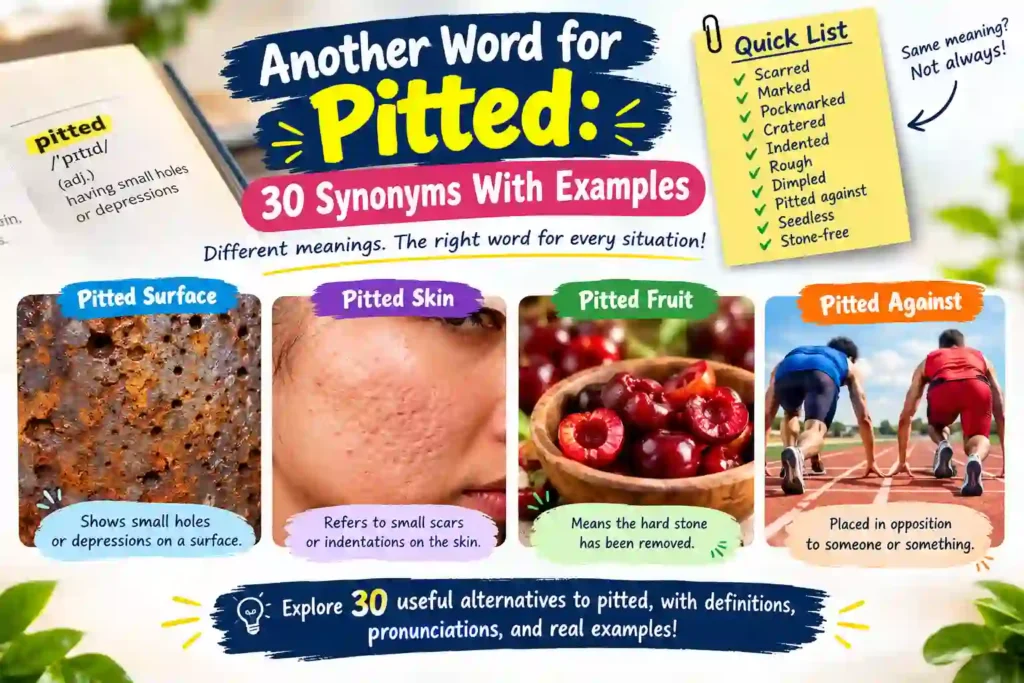
The closest everyday alternative for a surface with small holes or dents is pockmarked, but pitted has no single replacement because it has several meanings. Besides pockmarked, other common choices are scarred, dented, cratered, eroded, and corroded.
For fruit with the stone removed, British English often uses stoned. In addition, for two sides set in competition, as in pitted against, the best alternatives are matched and opposed.
As a result, the right word depends on what the writer describes: skin, metal, rock, fruit, or a contest. Some alternatives describe the look of the holes, while others describe what caused them. Some describe a fruit’s preparation or a rivalry, so these are only related to pitted, not exact synonyms.
Quick list: pockmarked, pocked, scarred, dented, cratered, eroded, corroded, honeycombed, stoned, matched, opposed
This article covers 30 alternatives, and each has a meaning, IPA, a usage note, and an example. Therefore, the notes explain which words are true synonyms and which only fit certain contexts.
At a Glance: Pitted Synonyms and Related Alternatives
| Alternative | Part of Speech | Meaning | Register / Tone | Ideal Context |
|---|---|---|---|---|
| Pockmarked | Adjective | Marked with small pits or scars | Neutral, can sound harsh for people | Skin, roads, walls, the moon |
| Scarred | Adjective | Marked by scars | Neutral | Skin, wood, metal |
| Dented | Adjective | Having hollows made by a blow | Neutral, everyday | Cars, metal, containers |
| Cratered | Adjective | Marked with large bowl-shaped hollows | Neutral to descriptive | Moon, planets, bombed ground |
| Eroded | Adjective | Worn away by water, wind, or ice | Neutral to technical | Rock, soil, coastlines |
| Corroded | Adjective | Damaged by rust or chemical action | Neutral to technical | Metal, pipes, batteries |
| Honeycombed | Adjective | Full of many small holes | Descriptive | Rock, ice, wood |
| Stoned | Adjective | Fruit with the stone removed | Everyday, mainly British | Cherries, olives, dates |
| Matched | Verb / past participle | Set to compete against another | Neutral | Sports, debates, contests |
| Opposed | Verb / past participle | Set on the other side of | Neutral to formal | Politics, rivalries, conflict |
Which Word Should You Use?
| If you want to… | Use | Why |
|---|---|---|
| Describe skin marked by acne or smallpox | Pockmarked | It is the standard word for pit-like scars on skin. |
| Describe a road or wall full of small holes | Pockmarked | It suggests many small holes across a surface, so it fits well. |
| Describe the moon or a bombed field | Cratered | It fits large, bowl-shaped hollows. |
| Describe metal damaged by rust or acid | Corroded | It names the cause as well as the result. |
| Describe rock or land worn by water or wind | Eroded | It points to slow natural wearing away. |
| Say a cherry or olive has no stone | Stoned (UK) or pitted (US) | Stoned is the usual British word for this. |
| Say two sides were set to compete | Matched | It is neutral, and it is common in sports writing. |
| Say two groups are on opposite sides | Opposed | It stresses disagreement or rivalry. |
Five Meanings of Pitted
1. Marked With Small Holes or Dents
Meaning: Having a surface covered with small hollows, holes, or scars.
Explanation: This is the most common adjective sense. Because the pits are usually shallow, they do not go all the way through. In addition, people use it for skin, metal, glass, roads, and rock.
Example: The old table had a pitted top covered in burn marks.
2. Fruit With the Stone Removed
Meaning: Describing fruit that has had its hard central seed taken out.
Explanation: Also, this sense is common on food labels, especially in American English. For example, a pitted olive has no stone inside.
Example: She added pitted cherries to the cake batter.
3. Set Against Someone or Something
Meaning: Placed in competition or conflict with another person, team, or force.
Explanation: This is the past tense and past participle of the verb pit. Also, writers almost always use it with against, as in pitted against.
Example: The final pitted the two best teams in the league against each other.
4. Made a Pit Stop
Meaning: Stopped in the pits during a motor race, usually for fuel, tyres, or repairs.
Explanation: This is a technical racing sense of the verb. Although it appears in sports reporting, it is rare elsewhere.
Example: The leader pitted on lap 30 to change tyres.
5. Having Tiny Pits in a Plant Structure
Meaning: In botany, having small thin spots or pits in a cell wall.
Explanation: This is a specialist sense found in scientific writing. Moreover, it is unrelated to everyday meanings of damage or fruit.
Example: Under the microscope, the pitted cell walls of the wood were easy to see.
Sources: Merriam-Webster (pit); Dictionary.com (pitted, pit); Oxford Advanced Learner’s Dictionary (pitted); Etymonline (pit); Webster’s Revised Unabridged Dictionary, 1913 (pitted)
30 Pitted Alternatives in Detail
Some of these words are close synonyms of pitted, while others fit only one sense or one context. Therefore, the usage notes say which is which.
Group 1: Core Synonyms for a Marked Surface
1. Pockmarked
IPA: US /ˈpɑːkmɑːrkt/ · UK /ˈpɒkmɑːkt/
Definition: Marked with small pits or scars, especially from a skin disease such as acne or smallpox.
Usage: This is the closest everyday synonym for pitted in its surface sense. It works for skin and also for roads, walls, and moons. However, said about a person, it can sound unkind.
Example: The old wall was pockmarked with bullet holes.
2. Pocked
IPA: US /pɑːkt/ · UK /pɒkt/
Definition: Marked with small pits or hollows.
Usage: This is a shorter, less common form that means almost the same as pockmarked, but it feels slightly more literary.
Example: The pocked surface of the stone showed years of weather.
3. Scarred
IPA: US /skɑːrd/ · UK /skɑːd/
Definition: Marked by scars or lasting damage.
Usage: This is a broader word than pitted. It fits pitted skin, but it also covers lines, ridges, and other marks. Thus, it is a related alternative, not an exact match.
Example: His cheeks were scarred by bad acne in his teens.
4. Dented
IPA: (US and UK) /ˈdentɪd/
Definition: Having a hollow made by a blow or pressure.
Usage: This is a related alternative. Dents are usually larger and fewer than pits, so the word suits metal and hard objects.
Example: The delivery van was dented along one side.
5. Dimpled
IPA: (US and UK) /ˈdɪmpld/
Definition: Marked with small, shallow hollows.
Usage: This is a related alternative with a softer, gentler tone. Because it describes smooth, shallow hollows, it does not suggest damage.
Example: A golf ball has a dimpled surface.
6. Indented
IPA: (US and UK) /ɪnˈdentɪd/
Definition: Having a notch, hollow, or cut pressed into the surface or edge.
Usage: This is a related alternative with a neutral, slightly formal tone. Since it describes a shape, it does not suggest damage. For example, writers use it for coastlines, edges, and printed text.
Example: The coastline is deeply indented with small bays.
7. Cratered
IPA: US /ˈkreɪtərd/ · UK /ˈkreɪtəd/
Definition: Marked with craters, which are large bowl-shaped hollows.
Usage: This is a related alternative for a larger scale than pitted. For example, it suits the moon, planets, and ground hit by explosions.
Example: The moon’s cratered surface is easy to see through a telescope.
Group 2: Damage From Wear, Weather, or Chemicals
8. Eroded
IPA: US /ɪˈroʊdɪd/ · UK /ɪˈrəʊdɪd/
Definition: Worn away slowly by water, wind, ice, or other natural forces.
Usage: This is a related alternative that names the cause, not the look. Pits are one possible result. However, eroded surfaces can also be smooth or grooved.
Example: The cliff face was pitted and eroded by years of wind and rain.
9. Corroded
IPA: US /kəˈroʊdɪd/ · UK /kəˈrəʊdɪd/
Definition: Slowly damaged by chemical action, such as rust.
Usage: This is a related alternative for metals. Corrosion often leaves small pits, so the two words often appear together. Still, corroded describes the process.
Example: The corroded pipe began to leak.
10. Etched
IPA: (US and UK) /etʃt/
Definition: Cut or eaten into a surface, often by acid or a sharp tool.
Usage: This is a related alternative that is weaker than most others here. Instead of random small holes, it usually means lines or designs.
Example: The glass was etched by years of harsh cleaning chemicals.
11. Worn
IPA: US /wɔːrn/ · UK /wɔːn/
Definition: Damaged or thinned by long use.
Usage: This is a related alternative that is much vaguer than pitted, so use it when the surface is simply old and used.
Example: The steps were worn and uneven.
12. Weathered
IPA: US /ˈweðərd/ · UK /ˈweðəd/
Definition: Changed or worn by wind, rain, or sun.
Usage: This is a related alternative. It suggests a rough surface, but it does not promise pits.
Example: The weathered stone was covered in tiny holes.
13. Gouged
IPA: (US and UK) /ɡaʊdʒd/
Definition: Dug or scooped out roughly, leaving a deep hollow or groove.
Usage: This is a related alternative. Gouges are deeper and rougher than pits. In addition, they usually come from a tool or force.
Example: The floor was gouged where the heavy table had been dragged.
14. Blemished
IPA: (US and UK) /ˈblemɪʃt/
Definition: Marked by a flaw that spoils the appearance.
Usage: This is a related alternative. It is broad, so it covers spots, stains, and pits on skin or fruit.
Example: The apple was blemished but still good to eat.
15. Marred
IPA: US /mɑːrd/ · UK /mɑːd/
Definition: Damaged in appearance or quality.
Usage: This is a related alternative with a slightly formal tone. It says the surface is spoiled, but it does not say how.
Example: Small holes marred the surface of the painting.
Group 3: Rough or Uneven Surfaces
16. Rough
IPA: (US and UK) /rʌf/
Definition: Not smooth or even to the touch.
Usage: This is a related alternative. It describes the feel of a pitted surface, but it does not describe the holes themselves.
Example: The pitted metal felt rough under his hand.
17. Uneven
IPA: (US and UK) /ʌnˈiːvn/
Definition: Not flat, level, or smooth.
Usage: This is a related alternative. It is a general word for any surface with bumps or hollows, so it is less exact than pitted.
Example: The uneven road made the bus shake.
18. Furrowed
IPA: US /ˈfɜːroʊd/ · UK /ˈfʌrəʊd/
Definition: Marked by long grooves or deep lines.
Usage: This is a related alternative that is not a true synonym. Furrows are long lines, while pits are small, separate hollows.
Example: The farmer’s field was furrowed after the plough.
Group 4: Surfaces Full of Holes
19. Honeycombed
IPA: US /ˈhʌnikoʊmd/ · UK /ˈhʌnikəʊmd/
Definition: Full of many small holes or hollow spaces, like a honeycomb.
Usage: This is a close alternative when the holes are many and tightly packed. In particular, it suits rock, ice, and wood.
Example: The old rock was honeycombed with tiny holes.
20. Perforated
IPA: US /ˈpɜːrfəreɪtɪd/ · UK /ˈpɜːfəreɪtɪd/
Definition: Having holes made through it.
Usage: This is a related alternative with a key difference. Perforated holes go all the way through, whereas pits do not.
Example: The perforated sheet let water drain away.
21. Riddled
IPA: (US and UK) /ˈrɪdld/
Definition: Filled with holes, or filled with something unwanted.
Usage: This is a related alternative. Writers often use it in the phrase riddled with, for holes (bullet holes) or for faults (errors). In both cases, the holes usually go through.
Example: The old fence was riddled with holes.
Group 5: Fruit With the Stone Removed
22. Stoned
IPA: US /stoʊnd/ · UK /stəʊnd/
Definition: Having the stone removed, said of fruit.
Usage: This is the usual British word for what Americans call pitted fruit. In informal English, however, stoned also means under the influence of drugs, so check the context.
Example: The recipe calls for stoned cherries.
23. Deseeded
IPA: (US and UK) /diːˈsiːdɪd/
Definition: Having had the seeds removed.
Usage: This is a related alternative. Use it for fruits and vegetables with seeds, such as peppers, but not for fruit with a single hard stone.
Example: Add one deseeded chilli to the sauce.
24. Cored
IPA: US /kɔːrd/ · UK /kɔːd/
Definition: Having the central part removed.
Usage: This is a related alternative that suits apples and pears. However, it is not a synonym for stone fruit.
Example: She sliced the cored apples into thin pieces.
25. Seedless
IPA: (US and UK) /ˈsiːdləs/
Definition: Having no seeds.
Usage: This is a related alternative, but it is not the same. Seedless fruit never had seeds, while pitted fruit had its stone taken out.
Example: We bought seedless grapes for the trip.
Group 6: Set Against an Opponent
26. Matched
IPA: (US and UK) /mætʃt/
Definition: Set to compete against someone or something.
Usage: This is a close alternative to pitted against, especially in sports. It is more neutral, so it does not stress conflict.
Example: The league matched the top team against the bottom team.
27. Opposed
IPA: US /əˈpoʊzd/ · UK /əˈpəʊzd/
Definition: Set on the other side of, or against.
Usage: This is a close alternative for sides in conflict. It is more formal than pitted, so writers often use it in sports and politics.
Example: The final opposed two old rivals.
28. Set
IPA: (US and UK) /set/
Definition: Placed in opposition to something.
Usage: This is a related alternative that works only in the phrase set against. On its own, however, set does not carry this meaning.
Example: The story sets brother against brother.
29. Ranged
IPA: (US and UK) /reɪndʒd/
Definition: Placed or lined up on one side.
Usage: This is a related alternative with a formal or literary tone. For example, writers use it in the phrase ranged against.
Example: Several unions were ranged against the plan.
30. Arrayed
IPA: (US and UK) /əˈreɪd/
Definition: Arranged in order, often in a display or battle line.
Usage: This is a related alternative that is formal and literary. When used in arrayed against, it suggests a large group facing an opponent.
Example: A huge army was arrayed against them.
Sources: Merriam-Webster (pit); Dictionary.com (pitted, pit; includes Collins English Dictionary content); Oxford Advanced Learner’s Dictionary (pitted); Wordsmyth (pit); Wiktionary and WordNet entries for pitted (honeycombed)
Pitted vs. Pockmarked vs. Cratered vs. Perforated
These four words all describe surfaces with holes or hollows, but they are not interchangeable.
| Word | Size of hollows | Do they go through? | Typical use |
|---|---|---|---|
| Pitted | Small to medium | No | Skin, metal, stone, glass |
| Pockmarked | Small | No | Skin, roads, walls |
| Cratered | Large, bowl-shaped | No | Moon, planets, bombed ground |
| Perforated | Small, often regular | Yes | Paper, sheets, filters |
Pitted is the broadest of the four. Pockmarked suggests many small scars, cratered suggests big hollows, and perforated suggests holes that open to the other side. Therefore, if you are unsure, pitted is usually safe for shallow holes of any size.
Sources: Merriam-Webster (pit, pockmark); Dictionary.com (pitted); Oxford Advanced Learner’s Dictionary (pitted); Wordsmyth (pit)
Opposites and Paired Words for Pitted
| Word | Paired Word | Note |
|---|---|---|
| Pitted (surface) | Smooth | The most natural opposite for a marked surface |
| Pitted (surface) | Polished | Suggests a surface that has been finished or cared for |
| Pitted (fruit) | Unpitted | Fruit still containing its stone |
| Pitted (fruit) | Whole | Often used on food labels for fruit with the stone in |
| Pitted against | Allied with | Opposite in meaning: on the same side |
| Pitted against | Teamed up with | Informal opposite for working together |
Pitted has no single perfect opposite because it has several meanings. For a surface, smooth is the natural opposite. In contrast, for fruit, unpitted is the clear one. Finally, for competition, words about cooperation, such as allied with, work best.
Sources: Merriam-Webster (pit); Dictionary.com (pitted); Oxford Advanced Learner’s Dictionary (pitted)
Common Word Partners for Pitted
| Pattern | Common Partners | Example |
|---|---|---|
| pitted + noun (surface) | skin, face, complexion, surface, shell | A pitted shell covered the egg. |
| pitted + noun (fruit) | olives, dates, cherries | She served pitted olives with the cheese. |
| pitted + by | acne, smallpox, erosion, rust | His face was pitted by acne. |
| pitted + with | holes, craters, marks | The road was pitted with holes. |
| pitted + against | rival, opponent, champion | The final pitted her against an old rival. |
| pitted against + each other | teams, parties, siblings | The contest pitted the two schools against each other. |
Sources: Merriam-Webster (pit); Dictionary.com (pitted); Oxford Advanced Learner’s Dictionary (pitted)
Idioms and Expressions with Pitted
Pitted has very few true idioms. In fact, the first three below are established expressions, not idioms. The last belongs to the base word pit, so it is included as a related expression.
1. Pitted against
Meaning: Set in competition or conflict with someone or something.
Example: The two best chess players in the country were pitted against each other.
2. Pit your wits against (pitted his wits against)
Meaning: To test your intelligence in a contest against someone or something.
Example: The young detective pitted her wits against a clever thief.
3. Pitted against each other
Meaning: Made to compete or fight with one another, often by outside forces.
Example: The new rules pitted the workers against each other.
4. The pits (related idiom of pit)
Meaning: The worst possible thing, place, or situation.
Example: Being stuck in traffic for three hours was the pits.
Sources: Merriam-Webster (pit); Dictionary.com (pit, pitted); Etymonline (pit)
Word Formation of Pitted
Etymology and Structure
Pitted is formed from the base word pit plus the ending -ed. In fact, there are two unrelated words spelled pit. The older one, meaning a hole in the ground, comes from Old English pytt and is likely an early borrowing from Latin puteus, well, pit, shaft. In contrast, the second pit, meaning the hard seed of a fruit, comes from Dutch pit, kernel, seed. Thus, the verb meaning to place in a pit comes from the first word, while the fruit sense, having the pit removed, comes from the second.
Date and History
Etymonline records the verb pit from the mid-1400s, with the meaning to put or place in a pit. The sense of setting animals or fighters against each other, such as cocks, dogs, or boxers, is recorded from the 1700s, which explains pitted against. Later, the fruit-seed noun pit is recorded from 1841. Dictionary.com traces the marked with pits adjective to before 1050 in Old English, but it notes that the word does not appear in Middle English.
Word Class Variations
Noun: pit, pits; pitter (a tool for removing fruit pits, as in cherry pitter)
Verb: pit, pits, pitting, pitted
Adjective: pitted, unpitted
Noun (technical): pitting, as in pitting corrosion
Adverb: none
Sources: Etymonline (pit); Dictionary.com (pitted, pit); Merriam-Webster (pit); Wiktionary (pit)
Common Word-Choice Mistakes
Pitted with against: use pitted against, not pitted with or pitted to, for a rival.
Pitted olives have pits: they do not. Instead, pitted fruit has had the stone removed.
The war pit two nations: use pitted for the past tense of the verb, because pit is only the base form.
Pitted and pitied: these are different words, so do not mix them up. Pitied means felt sorry for someone.
Pitched against a rival: pitched is a different verb, so use pitted for being set against someone.
Pockmarked cherries: use pitted cherries or stoned cherries for fruit with the stone removed, because pockmarked describes marks on a surface.
Perforated skin: use pitted or pockmarked for skin with shallow marks. This is because perforated means holes pass all the way through.
Frequently Asked Questions
What is the closest synonym for pitted?
For a marked surface, pockmarked is the closest everyday synonym. For skin, scarred is also common, though it is broader.
What does pitted mean on olives?
It means the stone has been removed. In contrast, unpitted olives still have the stone inside.
Is stoned the same as pitted for fruit?
Yes, in meaning. Stoned is the usual British word, while pitted is the usual American word. However, stoned also has an informal meaning related to drug use, so context matters.
What is the difference between pockmarked and pitted?
Pockmarked mainly describes small pit-like scars on skin and surfaces. On the other hand, pitted is wider, and it also covers fruit and the pitted against sense.
What is a formal alternative for pitted against?
Opposed, arrayed against, and ranged against are all formal. Matched, in contrast, is neutral.
What is the opposite of pitted?
For a surface, the opposite is smooth, but for fruit, it is unpitted.
Can pitted describe a person?
It can describe a person’s skin, as in a pitted complexion. However, this can sound unkind, so a careful writer may choose softer wording.
Does pitted always mean damaged?
No. Pitted fruit is simply prepared fruit, and pitted cell walls in plants are a normal feature. Therefore, the damage meaning applies only to surfaces such as skin, metal, or stone.
Why do we say pitted against?
People used the verb pit for setting animals to fight in a pit, such as cocks and dogs, from the 1700s. Over time, the meaning widened to any contest or conflict.
Can pitted be both an adjective and a verb form?
Yes. Pitted is the past tense and past participle of the verb pit. Also, it works as an adjective, as in pitted olives.
Conclusion
The closest alternatives to pitted depend on its sense. For marked surfaces, pockmarked, scarred, cratered, and dented are the most common. For fruit with the stone removed, stoned is the British equivalent. Finally, for rivals set against each other, matched and opposed are the closest.
Context matters because pitted covers several unrelated ideas. Words like perforated, cored, and seedless are related but different. Also, some alternatives name a cause, such as eroded and corroded, while others describe a size, such as cratered.

Hi, I’m HAROON ,founder of LifeLoomer.com, I started LifeLoomer with one belief: the internet is full of answers, but not enough understanding. So I write guides that actually explain things the meanings behind everyday words, the small habits that make life better, and the how-tos nobody taught us.
Everything I publish is researched, written in plain words, and tested against one question: will this genuinely help someone today?
Thanks for being here. I hope you leave a little wiser than you came.