
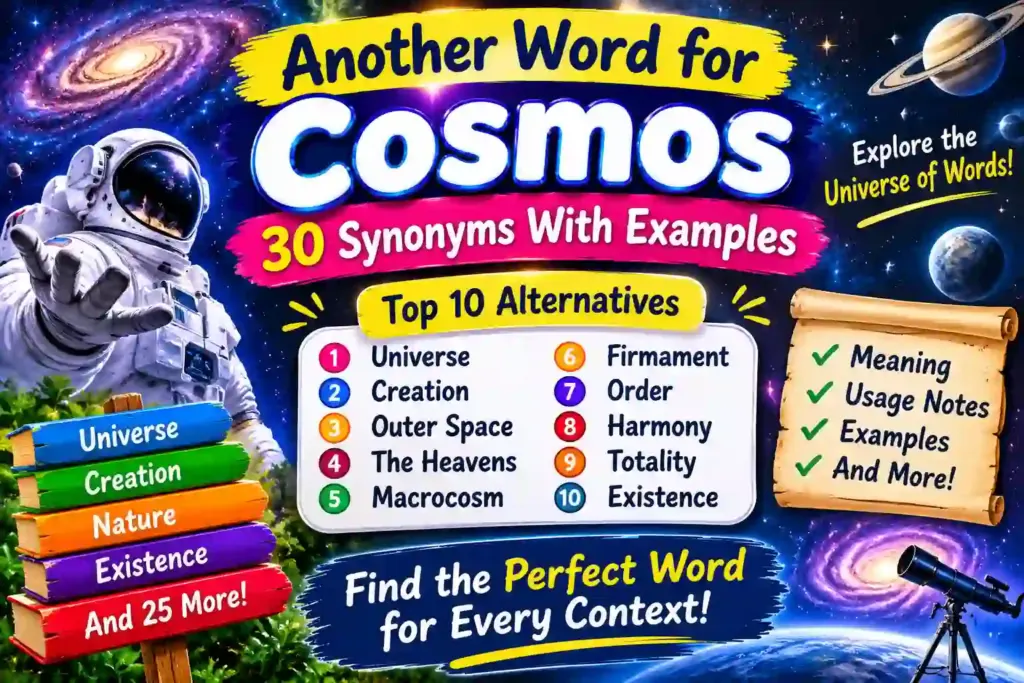
The closest everyday word for cosmos is universe. You can also use creation, space, or the heavens, depending on the sentence. Because cosmos can mean the whole universe or an ordered system, the best alternative depends on context.
The main meanings are the universe as one whole, outer space, and order as opposed to chaos. In literary writing, cosmos can also suggest a complete, ordered world.
Quick list: universe, creation, outer space, the heavens, macrocosm, firmament, order, harmony, totality, existence
This article explains 30 alternatives with meanings, IPA, usage notes, and examples. It also shows which words are true synonyms and which are only related.
At a Glance: Cosmos Synonyms and Related Alternatives
| Alternative | Part of Speech | Meaning | Register / Tone | Ideal Context |
| Universe | noun | All space, matter, and energy | Neutral | Science, everyday speech |
| Creation | noun | Everything that exists, seen as made | Formal, religious | Faith, philosophy |
| Outer space | noun | Space beyond Earth’s atmosphere | Neutral | Astronomy, news |
| Heavens | noun | The sky and space above | Literary | Poetry, religious writing |
| Macrocosm | noun | The great whole, as opposed to a small model | Formal | Philosophy, science |
| Firmament | noun | The sky, seen as a vault | Literary | Poetry, scripture |
| Order | noun | A state of arrangement without chaos | Neutral | Philosophy, general writing |
| Harmony | noun | Agreement among parts | Neutral, poetic | Figurative writing |
| Totality | noun | The whole of something | Formal | Academic writing |
| Existence | noun | All that exists | Formal | Philosophy |
Which Word Should You Use?
| If you want to… | Use | Why |
| Name everything in space and time | Universe | It is the standard, clear word. |
| Refer to space beyond Earth | Outer space | It is specific and neutral. |
| Write poetry about the sky | Heavens | It sounds elevated and familiar. |
| Speak of the world as made by a creator | Creation | It carries a religious sense. |
| Contrast order with chaos | Order | It matches the Greek idea of the word. |
| Compare a small system with the whole | Macrocosm | It pairs with microcosm. |
| Discuss physics | Spacetime | It is the scientific term. |
| Mean everything that is | Existence | It is broad and abstract. |
Exploring the Multiple Meanings of Cosmos
1. The Universe as a Whole
- Meaning: The universe seen as a complete, ordered system.
- Explanation: This is the main sense. Cosmos stresses order and unity, while universe is more neutral.
- Example: Astronomers study how the cosmos began.
2. Outer Space
- Meaning: The space beyond Earth.
- Explanation: People often use cosmos this way in everyday speech, especially in writing about space travel.
- Example: The probe drifted into the cosmos.
3. Order as Opposed to Chaos
- Meaning: An orderly, harmonious arrangement.
- Explanation: This is the older Greek idea. It is the direct opposite of chaos.
- Example: Ancient thinkers believed in a cosmos, not random disorder.
4. A Complete World or System
- Meaning: A self-contained, ordered whole.
- Explanation: Writers use this figuratively for a world with its own rules.
- Example: The novel builds a cosmos of its own.
5. The Cosmos Flower
- Meaning: A garden plant of the genus Cosmos, with daisy-like flowers.
- Explanation: This is a separate, botanical use of the same word.
- Example: Cosmos flowers bloom well in full sun.
Sources: Merriam-Webster, Collins Dictionary, Dictionary.com, Etymonline
Analyzing 30 Cosmos Alternatives in Detail
Some alternatives below are direct synonyms, while others are related words that fit only certain contexts. The usage notes mark the difference.
Core Everyday Alternatives
1. Universe
IPA: US /ˈjuːnɪˌvɜːrs/ · UK /ˈjuːnɪvɜːs/
Definition: All space, time, matter, and energy.
- Usage: The closest direct synonym. It is more neutral and scientific than cosmos.
- Example: The universe is billions of years old.
2. World
IPA: US /wɜːrld/ · UK /wɜːld/
Definition: The earth, or all existing things.
- Usage: A related alternative, and a broad one. It often means Earth, so it is weaker than cosmos.
- Example: She wanted to understand the world.
3. Creation
IPA: /kriˈeɪʃn/ (US and UK)
Definition: All things that exist, seen as made.
- Usage: Formal and often religious. It implies a creator.
- Example: The poem praises the beauty of creation.
4. Nature
IPA: US /ˈneɪtʃər/ · UK /ˈneɪtʃə/
Definition: The physical world and its forces.
- Usage: A related alternative. It covers the natural world, not necessarily space.
- Example: Nature follows its own laws.
5. Existence
IPA: /ɪɡˈzɪstəns/ (US and UK)
Definition: The state of being, or all that exists.
- Usage: Abstract and philosophical. It is a related, not exact, synonym.
- Example: He questioned the purpose of existence.
6. Space
IPA: /speɪs/ (US and UK)
Definition: The vast area beyond Earth.
- Usage: Everyday and clear. It matches the outer space sense only.
- Example: The telescope looks deep into space.
Outer Space Alternatives
7. Outer space
IPA: US /ˌaʊtər ˈspeɪs/ · UK /ˌaʊtə ˈspeɪs/
Definition: Space beyond Earth’s atmosphere.
- Usage: Specific and neutral. It does not carry the sense of order.
- Example: Satellites orbit in outer space.
8. Heavens
IPA: /ˈhevənz/ (US and UK)
Definition: The sky and the space above it.
- Usage: Literary or religious. It is a related alternative.
- Example: She gazed at the heavens.
9. Firmament
IPA: US /ˈfɜːrməmənt/ · UK /ˈfɜːməmənt/
Definition: The sky, seen as a vault above the earth.
- Usage: Literary and old-fashioned. It refers to the visible sky, not the whole universe.
- Example: Stars filled the firmament.
10. Deep space
IPA: /ˌdiːp ˈspeɪs/ (US and UK)
Definition: Regions far beyond Earth and its nearby planets.
- Usage: Technical and news-friendly. It is narrower than cosmos.
- Example: The signal came from deep space.
11. Celestial sphere
IPA: US /səˈlestʃəl sfɪr/ · UK /səˈlestiəl sfɪə/
Definition: The imaginary sphere around Earth on which stars appear to sit.
- Usage: A technical, related term used in astronomy.
- Example: Old maps show stars on the celestial sphere.
Scientific and Formal Alternatives
12. Macrocosm
IPA: US /ˈmækroʊˌkɑːzəm/ · UK /ˈmækrəʊkɒzəm/
Definition: The whole of a system, as opposed to a small part.
- Usage: Formal. It can mean the universe, or any large whole.
- Example: The city is a macrocosm of the nation.
13. Spacetime
IPA: /ˈspeɪstaɪm/ (US and UK)
Definition: The combined framework of space and time.
- Usage: A physics term, not a general synonym.
- Example: Gravity bends spacetime.
14. Multiverse
IPA: US /ˈmʌltiˌvɜːrs/ · UK /ˈmʌltivɜːs/
Definition: A hypothetical set of many universes.
- Usage: Related, but not equal. It means more than one universe.
- Example: Some physicists discuss a multiverse.
15. Observable universe
IPA: US /əbˈzɜːrvəbl ˈjuːnɪvɜːrs/ · UK /əbˈzɜːvəbl ˈjuːnɪvɜːs/
Definition: The part of the universe we can detect.
- Usage: A narrower scientific term.
- Example: The observable universe holds billions of galaxies.
16. Reality
IPA: /riˈælɪti/ (US and UK)
Definition: Everything that actually exists.
- Usage: Philosophical and related, not a direct synonym.
- Example: Science tries to describe reality.
Order and Harmony Alternatives
17. Order
IPA: US /ˈɔːrdər/ · UK /ˈɔːdə/
Definition: A state of proper arrangement.
- Usage: Matches the original Greek idea. It is the opposite of chaos.
- Example: They sought order in the natural world.
18. Harmony
IPA: US /ˈhɑːrməni/ · UK /ˈhɑːməni/
Definition: A pleasing agreement among parts.
- Usage: Figurative and poetic. It captures the ordered whole sense only.
- Example: The planets move in harmony.
19. System
IPA: /ˈsɪstəm/ (US and UK)
Definition: A set of connected parts forming a whole.
- Usage: A related, neutral word for an ordered whole.
- Example: The universe works as one system.
20. Orderliness
IPA: US /ˈɔːrdərlinəs/ · UK /ˈɔːdəlinəs/
Definition: The quality of being neat and well organized.
- Usage: Rare for the universe. It names the quality cosmos implies.
- Example: The orderliness of the stars amazed him.
21. Arrangement
IPA: /əˈreɪndʒmənt/ (US and UK)
Definition: The way things are put in order.
- Usage: A weak, related alternative. Use it for the ordered pattern idea.
- Example: The arrangement of the planets is not random.
Literary Alternatives
22. Empyrean
IPA: /ˌempɪˈriːən/ (US and UK)
Definition: The highest heaven, or the sky.
- Usage: Rare and poetic. It is a related word.
- Example: The poet looked to the empyrean.
23. Welkin
IPA: /ˈwelkɪn/ (US and UK)
Definition: The sky, or the vault of heaven.
- Usage: Archaic and literary. Use it sparingly.
- Example: The cheers made the welkin ring.
24. Ether
IPA: US /ˈiːθər/ · UK /ˈiːθə/
Definition: The upper air, or the clear sky, in poetry.
- Usage: Poetic and related. It does not mean the whole universe.
- Example: The song floated into the ether.
25. Infinity
IPA: /ɪnˈfɪnɪti/ (US and UK)
Definition: Endless space, time, or quantity.
- Usage: Figurative. It suggests the cosmos’s vastness.
- Example: The night sky seemed to stretch to infinity.
Alternatives for The Whole of Everything
26. Totality
IPA: US /toʊˈtælɪti/ · UK /təʊˈtælɪti/
Definition: The whole amount of something.
- Usage: Formal and related. It works when the cosmos is meant as everything.
- Example: Philosophers ask about the totality of being.
27. Entirety
IPA: US /ɪnˈtaɪərti/ · UK /ɪnˈtaɪərəti/
Definition: The whole of something.
- Usage: Formal. It is a weak, related alternative.
- Example: No one can see the cosmos in its entirety.
28. Everything
IPA: /ˈevriθɪŋ/ (US and UK)
Definition: All things.
- Usage: Informal and broad. It is plain but vague.
- Example: Everything began with a single event.
29. The whole
IPA: US /ðə ˈhoʊl/ · UK /ðə ˈhəʊl/
Definition: The complete thing, with nothing left out.
- Usage: A general, related phrase.
- Example: Each star is a part of the whole.
30. All things
IPA: /ˌɔːl ˈθɪŋz/ (US and UK)
Definition: Everything that exists.
- Usage: Formal or religious in tone.
- Example: The prayer thanks the maker of all things.
Sources: Merriam-Webster, Collins Dictionary and Thesaurus, Dictionary.com
Cosmos vs. Universe vs. World
| Word | Main Focus | Typical Use |
| Cosmos | The universe as an ordered whole | Scientific, poetic, philosophical |
| Universe | All space, time, and matter | Science, everyday speech |
| World | Earth, or a person’s own sphere | Everyday speech |
In short, universe is the neutral choice. Cosmos adds a sense of order and wonder, and world is usually smaller.
Sources: Merriam-Webster, Collins Dictionary
Cosmos and Opposite/Paired Word Pairs
| Word | Paired Word | Note |
| Cosmos | Chaos | The classic Greek contrast between order and disorder |
| Macrocosm | Microcosm | The large whole versus a small model of it |
| Cosmos | Earth | Cosmos is everything, while Earth is one planet |
| Cosmos | Void | Order and fullness versus emptiness |
Cosmos has one true opposite, chaos. The other pairs are contrasts of scale or idea.
Sources: Merriam-Webster, Etymonline
Common Word Partners of Cosmos
| Pattern | Common Partners | Example |
| Verb + cosmos | explore, understand, study | Scientists explore the cosmos. |
| Adjective + cosmos | vast, infinite, known | The cosmos is vast. |
| Cosmos + noun | cosmos flower | She planted a cosmos flower. |
| Preposition + cosmos | in the cosmos, across the cosmos | Life may exist elsewhere in the cosmos. |
Sources: Collins Dictionary, Merriam-Webster
Idiomatic Phrases Featuring Cosmos
Cosmos has no widely accepted idioms. The items below are established expressions, not true idioms.
1. Out of chaos, cosmos
- Meaning: Order arising from disorder, a traditional idea in philosophy and myth.
- Example: The myth describes the world as cosmos rising from chaos.
2. Cosmos and chaos
- Meaning: The pairing of order and disorder.
- Example: The story moves between cosmos and chaos.
3. A cosmos of its own
- Meaning: A world with its own rules and character.
- Example: The village is a cosmos of its own.
Sources: Merriam-Webster, Collins Dictionary
Word Formation of Cosmos
Etymology & Structure
Cosmos comes from the Greek kosmos, meaning order or orderly arrangement. Later, it also meant world and ornament. Greek thinkers, traditionally including Pythagoras, used it for the universe as an ordered system. The English word is a single, simple noun.
Date and History
Etymonline gives the English sense of the universe as mid-1600s. Check the OED for the exact earliest citation.
Word Class Variations
- Noun: cosmos (plural: cosmoses, or cosmos)
- Adjective: cosmic
- Adverb: cosmically
- Related nouns: cosmology, cosmonaut, cosmopolitan (these share the root but differ in meaning)
Sources: Etymonline, Merriam-Webster, Collins Dictionary
Common Word-Choice Mistakes
- Cosmos for the planet Earth: use world or Earth.
- Cosmos for a single galaxy: use galaxy.
- Confusing cosmos with cosmetic: the two words share a Greek root but mean different things.
- Cosmos as the opposite of universe: they are near synonyms, not opposites.
- Firmament for the whole universe: it means the visible sky.
- Multiverse as a synonym of cosmos: it means many universes.
Frequently Asked Questions
What is the closest synonym for cosmos?
Universe is the closest. It covers everything in space and time.
Is cosmos the same as universe?
Mostly, yes. Cosmos adds the idea of order and is more poetic.
What is a formal alternative?
Macrocosm and totality are formal choices.
Is cosmos a flower?
Yes, Cosmos is also a garden plant genus. The word is the same, but the sense is different.
What does cosmos mean in Greek?
It meant order or orderly arrangement.
Can cosmos describe a person’s world?
Yes, figuratively, as in a cosmos of her own.
Is cosmos singular or plural?
It is singular. The plural, cosmoses, is rare.
Conclusion
The closest alternative to cosmos is universe. Creation, space, and the heavens also work, depending on the sentence.
Context matters because cosmos has several senses: the universe, outer space, order, and a complete world. A word that fits one sense may not fit another.
To choose well, first decide your meaning. Then match the tone: scientific, formal, or poetic. Finally, check If the word means the whole universe or only part of it.

Hi, I’m HAROON ,founder of LifeLoomer.com, I started LifeLoomer with one belief: the internet is full of answers, but not enough understanding. So I write guides that actually explain things the meanings behind everyday words, the small habits that make life better, and the how-tos nobody taught us.
Everything I publish is researched, written in plain words, and tested against one question: will this genuinely help someone today?
Thanks for being here. I hope you leave a little wiser than you came.