
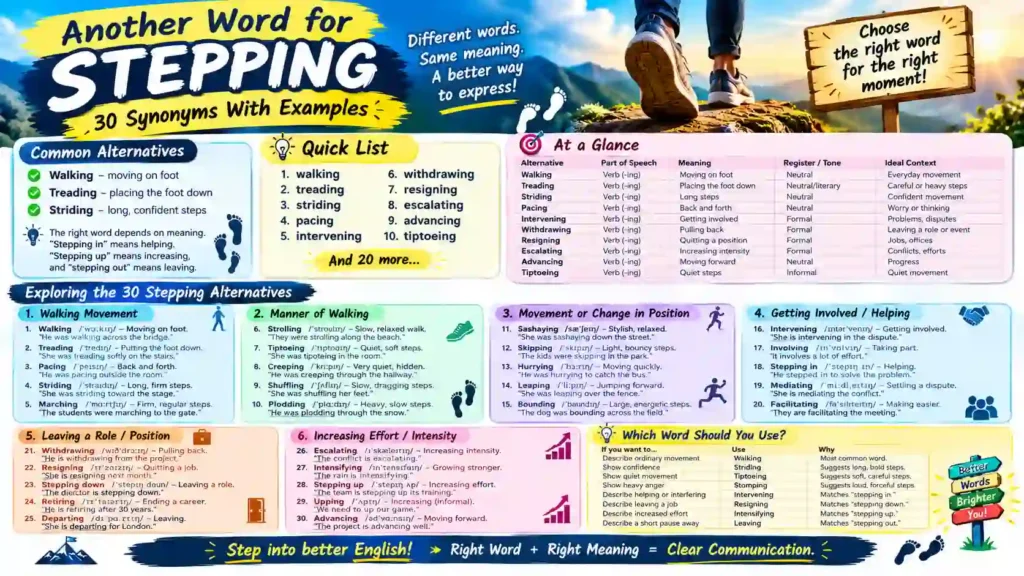
For a movement of the feet, the closest everyday alternatives are walking, treading, and striding. The right word depends on meaning, because stepping can describe a physical movement, a change of position, or a rise in effort. For example, stepping in means helping, while stepping up means increasing.
Context also decides tone. A casual speaker may say stepping out, but a formal writer may prefer leaving or withdrawing. In the same way, stepping up is often more natural than escalating in conversation.
Quick list: walking, treading, striding, pacing, intervening, withdrawing, resigning, escalating, advancing, tiptoeing
This article explains 30 alternatives with meanings, IPA, usage notes, and examples. Therefore, you can choose the word that fits your sentence exactly.
At a Glance: Stepping Synonyms and Related Alternatives
| Alternative | Part of Speech | Meaning | Register / Tone | Ideal Context |
| Walking | Verb (-ing) | Moving on foot | Neutral | Everyday movement |
| Treading | Verb (-ing) | Placing the foot down | Neutral/literary | Careful or heavy steps |
| Striding | Verb (-ing) | Walking with long steps | Neutral | Confident movement |
| Pacing | Verb (-ing) | Walking back and forth | Neutral | Worry or thinking |
| Intervening | Verb (-ing) | Getting involved | Formal | Problems, disputes |
| Withdrawing | Verb (-ing) | Pulling back | Formal | Leaving a role or event |
| Resigning | Verb (-ing) | Quitting a position | Formal | Jobs, offices |
| Escalating | Verb (-ing) | Increasing in intensity | Formal | Conflicts, efforts |
| Advancing | Verb (-ing) | Moving forward | Neutral | Progress |
| Tiptoeing | Verb (-ing) | Walking quietly on toes | Informal | Quiet movement |
Which Word Should You Use?
| If you want to… | Use | Why |
| Describe ordinary movement | Walking | It is the most common word. |
| Show confidence | Striding | It suggests long, bold steps. |
| Show quiet movement | Tiptoeing | It suggests soft, careful steps. |
| Show heavy anger | Stomping | It suggests loud, forceful steps. |
| Describe helping or interfering | Intervening | It matches stepping in. |
| Describe leaving a job | Resigning | It matches stepping down. |
| Describe increased effort | Intensifying | It matches stepping up. |
| Describe a short pause away | Leaving | It matches stepping out. |
Exploring the Multiple Meanings of Stepping
1. Moving the Feet
- Meaning: Lifting and placing a foot to move or change position.
- Explanation: This is the basic physical sense. It can describe one movement or a series of movements.
- Example: She was stepping carefully over the wet floor.
2. Entering or Leaving a Place
- Meaning: Moving into or out of a space.
- Explanation: This sense usually appears with in, out, or into. The movement may be short.
- Example: He was stepping out for some fresh air.
3. Getting Involved
- Meaning: Taking action in a situation.
- Explanation: Stepping in often means helping or intervening. Sometimes it means replacing someone.
- Example: The manager is stepping in to solve the problem.
4. Leaving a Role
- Meaning: Giving up a position or duty.
- Explanation: Stepping down is usually permanent. Stepping aside may be temporary or permanent.
- Example: The director is stepping down next month.
5. Increasing Effort
- Meaning: Raising speed, effort, or level.
- Explanation: This sense almost always uses up. It is common in business and everyday speech.
- Example: The team is stepping up its training.
Sources: Merriam-Webster; Collins Dictionary; Dictionary.com.
Analyzing 30 Stepping Alternatives in Detail
Some alternatives below are direct synonyms, while others are related words that fit only certain senses of stepping.
Walking Movement
1. Walking
IPA: US /ˈwɑːkɪŋ/ · UK /ˈwɔːkɪŋ/
Definition: Moving on foot at a regular pace.
- Usage: This is the closest everyday synonym for the physical sense.
- Example: He was walking across the bridge.
2. Treading
IPA: /ˈtredɪŋ/ (US and UK)
Definition: Putting the foot down on something.
- Usage: It is slightly literary and often implies care or weight.
- Example: She was treading softly on the old stairs.
3. Pacing
IPA: /ˈpeɪsɪŋ/ (US and UK)
Definition: Walking back and forth in a regular way.
- Usage: It is related but narrower, because it suggests worry or thought.
- Example: He was pacing outside the exam room.
4. Striding
IPA: /ˈstraɪdɪŋ/ (US and UK)
Definition: Walking with long, firm steps.
- Usage: It is a close synonym that adds confidence or purpose.
- Example: She was striding toward the stage.
5. Marching
IPA: US /ˈmɑːrtʃɪŋ/ · UK /ˈmɑːtʃɪŋ/
Definition: Walking with regular, firm steps.
- Usage: It is a related word that suggests discipline or determination.
- Example: The students were marching to the gate.
6. Strolling
IPA: US /ˈstroʊlɪŋ/ · UK /ˈstrəʊlɪŋ/
Definition: Walking in a slow, relaxed way.
- Usage: It is an informal, gentle alternative to walking.
- Example: They were strolling along the beach.
Manner of Walking
7. Tiptoeing
IPA: US /ˈtɪptoʊɪŋ/ · UK /ˈtɪptəʊɪŋ/
Definition: Walking quietly on the front of the feet.
- Usage: It is informal and close to quiet, careful stepping.
- Example: He was tiptoeing past the sleeping baby.
8. Trudging
IPA: /ˈtrʌdʒɪŋ/ (US and UK)
Definition: Walking slowly with effort.
- Usage: It is a related word that suggests tiredness.
- Example: They were trudging through deep snow.
9. Stomping
IPA: US /ˈstɑːmpɪŋ/ · UK /ˈstɒmpɪŋ/
Definition: Walking with heavy, noisy steps.
- Usage: It is informal and suggests anger or force.
- Example: She was stomping up the stairs.
10. Shuffling
IPA: /ˈʃʌflɪŋ/ (US and UK)
Definition: Walking without lifting the feet fully.
- Usage: It is related, not exact, and suggests age, tiredness, or reluctance.
- Example: He was shuffling toward the door.
11. Sauntering
IPA: /ˈsɔːntərɪŋ/ (US and UK)
Definition: Walking in a slow, confident way.
- Usage: It is a related word that suggests ease.
- Example: She was sauntering into class late.
Stepping On or Over Something
12. Trampling
IPA: /ˈtræmplɪŋ/ (US and UK)
Definition: Stepping heavily on something and crushing it.
- Usage: It fits stepping on only when damage is involved.
- Example: The crowd was trampling the flowers.
13. Stamping
IPA: /ˈstæmpɪŋ/ (US and UK)
Definition: Bringing the foot down hard.
- Usage: It is related and stronger than stepping.
- Example: He was stamping out the fire.
14. Crossing
IPA: US /ˈkrɔːsɪŋ/ · UK /ˈkrɒsɪŋ/
Definition: Going from one side to another.
- Usage: It fits stepping over or stepping across.
- Example: She was crossing the stream on stones.
15. Climbing
IPA: /ˈklaɪmɪŋ/ (US and UK)
Definition: Going up using the feet and sometimes hands.
- Usage: It fits stepping up stairs or ladders, but it is not a general synonym.
- Example: He was climbing the steps slowly.
Changing Position or Role
16. Intervening
IPA: US /ˌɪntərˈviːnɪŋ/ · UK /ˌɪntəˈviːnɪŋ/
Definition: Coming between to affect a situation.
- Usage: It is a formal match for stepping in.
- Example: The teacher is intervening in the argument.
17. Withdrawing
IPA: /wɪðˈdrɔːɪŋ/ (US and UK)
Definition: Pulling back or removing oneself.
- Usage: It is formal and fits stepping aside or stepping back.
- Example: She is withdrawing from the race.
18. Resigning
IPA: /rɪˈzaɪnɪŋ/ (US and UK)
Definition: Formally leaving a job or position.
- Usage: It matches stepping down, but it is more official.
- Example: The minister is resigning today.
19. Leaving
IPA: /ˈliːvɪŋ/ (US and UK)
Definition: Going away from a place.
- Usage: It is a neutral substitute for stepping out.
- Example: He is leaving the room for a moment.
20. Entering
IPA: /ˈentərɪŋ/ (US and UK)
Definition: Coming or going into a place.
- Usage: It is a neutral alternative to stepping in in the physical sense.
- Example: The guests are entering the hall.
Increasing or Progressing
21. Escalating
IPA: /ˈeskəleɪtɪŋ/ (US and UK)
Definition: Becoming greater or more serious.
- Usage: It fits stepping up, but it often sounds negative.
- Example: The company is escalating its security.
22. Intensifying
IPA: /ɪnˈtensɪfaɪɪŋ/ (US and UK)
Definition: Making something stronger.
- Usage: It is a formal alternative to stepping up effort.
- Example: They are intensifying their search.
23. Boosting
IPA: /ˈbuːstɪŋ/ (US and UK)
Definition: Increasing or improving something.
- Usage: It is informal and fits stepping up results or output.
- Example: The coach is boosting the team’s confidence.
24. Advancing
IPA: US /ədˈvænsɪŋ/ · UK /ədˈvɑːnsɪŋ/
Definition: Moving forward or making progress.
- Usage: It is a related word for forward movement.
- Example: The army is advancing slowly.
25. Progressing
IPA: US /prəˈɡresɪŋ/ · UK /prəʊˈɡresɪŋ/
Definition: Developing toward a goal.
- Usage: It is related and fits step-by-step improvement.
- Example: She is progressing well in her studies.
Light and Quick Movement
26. Skipping
IPA: /ˈskɪpɪŋ/ (US and UK)
Definition: Moving with light hops and steps.
- Usage: It is a related word with a playful tone.
- Example: The child was skipping home.
27. Hopping
IPA: US /ˈhɑːpɪŋ/ · UK /ˈhɒpɪŋ/
Definition: Jumping on one foot or lightly.
- Usage: It is related, because stepping uses alternate feet.
- Example: He was hopping over puddles.
28. Wading
IPA: /ˈweɪdɪŋ/ (US and UK)
Definition: Walking through water or soft ground.
- Usage: It is context-specific and fits stepping through water.
- Example: They were wading across the river.
29. Dancing
IPA: US /ˈdænsɪŋ/ · UK /ˈdɑːnsɪŋ/
Definition: Moving the feet to music.
- Usage: It fits rhythmic stepping, but it is not a general synonym.
- Example: The couple was dancing in the square.
30. Bounding
IPA: /ˈbaʊndɪŋ/ (US and UK)
Definition: Moving with large, springy steps.
- Usage: It is a related word that suggests energy.
- Example: The dog was bounding across the field.
Sources: Merriam-Webster; Collins Dictionary; Dictionary.com.
Stepping In vs. Stepping Up vs. Stepping Out
Phrasal verbs change the meaning of step completely. The table below shows the difference.
| Phrase | Meaning | Better Alternative |
| Stepping in | Helping or intervening | Intervening |
| Stepping up | Increasing effort | Intensifying |
| Stepping out | Leaving briefly | Leaving |
| Stepping down | Quitting a role | Resigning |
| Stepping aside | Giving way | Withdrawing |
Sources: Merriam-Webster; Collins Dictionary.
Stepping and Opposite Word Pairs
| Word | Paired Word | Note |
| Stepping forward | Stepping back | Opposite directions |
| Stepping in | Stepping out | Entering versus leaving |
| Stepping up | Stepping down | Increase versus decrease or resignation |
| Stepping on | Stepping off | Contact versus leaving a surface |
These pairs work best with the same preposition or adverb. However, stepping aside has no perfect opposite, so stepping in is the usual contrast.
Sources: Merriam-Webster; Collins Dictionary.
Common Word Partners of Stepping
| Pattern | Common Partners | Example |
| Stepping + particle | in, out, up, down, aside, back | She is stepping back from work. |
| Stepping + preposition | over, onto, into, across | He was stepping over the puddle. |
| Stepping + noun | stone | The job was a stepping stone. |
| Adverb + stepping | carefully, quickly | They were stepping carefully. |
Sources: Collins Dictionary; Merriam-Webster.
Idiomatic Phrases Featuring Stepping
1. Stepping Stone
- Meaning: An action or event that helps you reach a goal. This is a well-established expression, and it also names a real stone used to cross water.
- Example: This internship is a stepping stone to a career.
2. Stepping on Someone’s Toes
- Meaning: Offending someone by interfering in their work or area.
- Example: I’m worried about stepping on her toes.
3. Stepping Out of Line
- Meaning: Behaving in an unacceptable way.
- Example: He was stepping out of line again.
4. Stepping Into Someone’s Shoes
- Meaning: Taking over another person’s role.
- Example: She is stepping into her boss’s shoes.
Sources: Merriam-Webster; Collins Dictionary.
Word Formation of Stepping
Etymology & Structure
Stepping is the verb step plus the suffix -ing. According to Etymonline, step comes from Old English and is related to other Germanic words for stepping and walking.
Date and History
The word goes back to Old English, so it is a very old part of the language. For exact first-use dates of specific phrases, consult the Oxford English Dictionary.
Word Class Variations
- Verb: step, steps, stepped, stepping
- Noun: step, stepping
- Related forms: stepper, misstep, sidestep, footstep
Sources: Etymonline; Merriam-Webster.
Common Word-Choice Mistakes
- Stepping in the room: use stepping into the room.
- Stepping on the stage: use stepping onto the stage.
- Stepping up the price: use raising the price.
- Stepping out the company: use leaving the company.
- Tiptoeing loudly: use stomping loudly.
- Stepping down means temporary leave: use stepping aside for temporary breaks.
- Striding slowly: use strolling slowly.
Frequently Asked Questions
What is the closest synonym for stepping?
Walking is the closest everyday synonym for the physical sense.
What does stepping up mean?
It means increasing effort, speed, or level.
What is the difference between stepping down and stepping aside?
Stepping down usually means quitting. Stepping aside can be temporary.
Is stepping the same as walking?
Not always. Stepping can mean one movement, while walking is continuous.
What is the opposite of stepping up?
Stepping down is the common opposite, although it often means resigning.
Can stepping describe a person’s role?
Yes. Phrases like stepping in and stepping down describe roles.
Is stepping stone one word?
No. It is usually written as two words.
Which word fits angry movement?
Stomping fits angry, heavy steps best.
Conclusion
The closest alternatives to stepping are walking, treading, and striding. For phrasal meanings, intervening, leaving, resigning, and intensifying are the most useful.
However, context matters. A word that fits one sense of stepping may sound wrong in another. For instance, resigning fits stepping down but not stepping over.
To choose well, first identify the sense. Then check the tone and the preposition. Finally, test your sentence aloud.

Hi, I’m HAROON ,founder of LifeLoomer.com, I started LifeLoomer with one belief: the internet is full of answers, but not enough understanding. So I write guides that actually explain things the meanings behind everyday words, the small habits that make life better, and the how-tos nobody taught us.
Everything I publish is researched, written in plain words, and tested against one question: will this genuinely help someone today?
Thanks for being here. I hope you leave a little wiser than you came.