
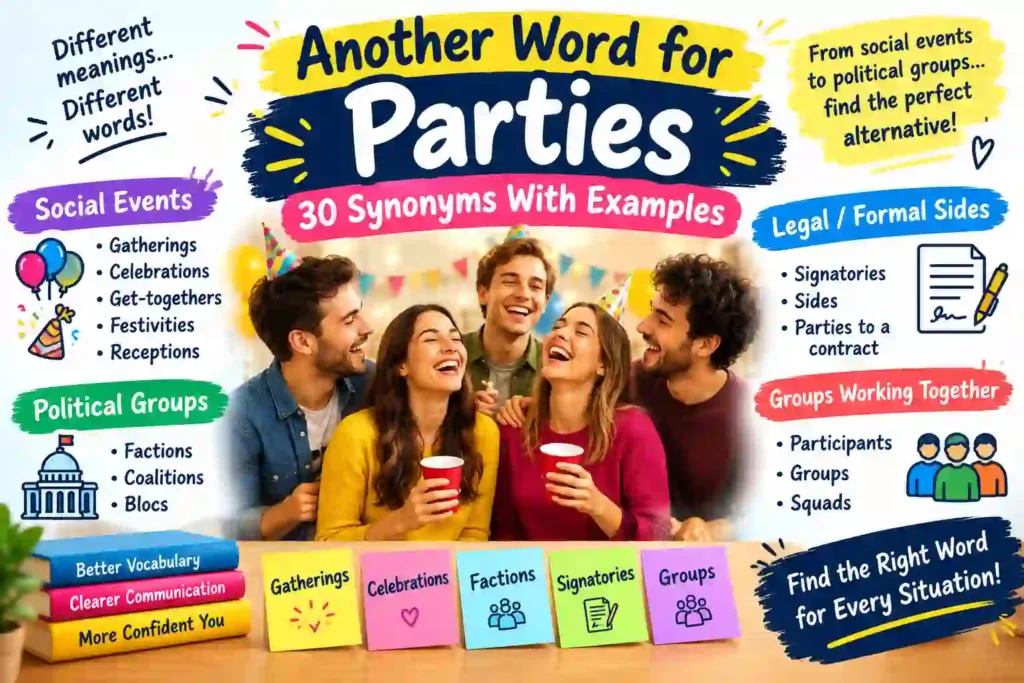
The closest everyday alternatives to parties are gatherings, celebrations, and get-togethers. Those three work when you mean social events. However, parties has other meanings, so the right replacement depends on context. For example, a political party might be called a faction or bloc. Likewise, the two sides in a contract might be called signatories or sides. Similarly, a search party might be called a group or squad.
This article covers four main areas: social events, political groups, legal or formal sides, and groups of people working together. Each alternative is explained so you can see how it differs from parties.
Quick list: gatherings, celebrations, get-togethers, festivities, receptions, bashes, factions, coalitions, sides, groups
Below you will find 30 alternatives, each with a meaning, IPA, usage note, and example. The article also covers word partners, idioms, word history, common mistakes, and answers to frequent questions.
At a Glance: Parties Synonyms and Related Alternatives
| Alternative | Part of Speech | Meaning | Register / Tone | Ideal Context |
|---|---|---|---|---|
| Gatherings | noun | Meetings of people for a shared purpose or for fun | Neutral | Social events of any size |
| Celebrations | noun | Events held to mark a special occasion | Neutral, warm | Birthdays, weddings, achievements |
| Get-togethers | noun | Casual, friendly meetings | Informal | Small events with friends or family |
| Festivities | noun | Joyful events or activities that mark an occasion | Neutral to slightly formal | Holidays, public events |
| Receptions | noun | Formal social events to welcome guests | Formal | Weddings, openings, official events |
| Factions | noun | Groups within a larger group, often opposing others | Neutral to negative | Politics, organizations |
| Coalitions | noun | Temporary alliances of groups | Formal | Politics, campaigns |
| Sides | noun | Opposing people or groups in a dispute or deal | Neutral | Contracts, negotiations, disputes |
| Participants | noun | People who take part in something | Neutral, formal | Research, events, legal matters |
| Groups | noun | Sets of people together | Neutral | Search, travel, work |
Which Word Should You Use?
| If you want to… | Use | Why |
|---|---|---|
| Describe any friendly social event | gatherings | Because it is neutral, it fits almost any size. |
| Keep it casual and relaxed | get-togethers | It usually suggests a small, informal meeting. |
| Mark a special occasion | celebrations | It also points to the reason for the event. |
| Describe a formal welcome event | receptions | It usually suggests an organized event with guests. |
| Refer to political groups that compete | factions | It often suggests internal conflict or rivalry. |
| Refer to groups that work together temporarily | coalitions | It mainly stresses a joint effort. |
| Name the people who signed an agreement | signatories | It is also precise and formal. |
| Refer to the two ends of a dispute in plain English | sides | It is short, clear, and especially neutral. |
Exploring the Multiple Meanings of Parties
1. Social Events
Meaning: Social gatherings of invited guests, usually for enjoyment or celebration.
Explanation: This is the most common sense. For example, it covers birthday parties, dinner parties, and office parties. Also, most synonyms for this sense describe the size, mood, or formality of the event.
Example: In fact, we had two parties to plan this month, one for her birthday and one for the school fair.
2. Political Organizations
Meaning: Organized groups of people who share political goals and compete in elections.
Explanation: In this sense, parties names formal organizations. It is not a social term, so words like celebrations do not apply. Alternatives usually describe how the groups relate, such as factions, blocs, or coalitions.
Example: After weeks of talks, several parties agreed to support the new law.
3. Sides in a Legal Matter or Agreement
Meaning: The people or groups involved in a contract, dispute, or legal case.
Explanation: Lawyers and officials use the parties for those directly involved. It often appears with to, as in the parties to the agreement.
Example: Then both parties signed the contract on Monday.
4. Groups Doing a Task Together
Meaning: Small groups of people traveling or working together toward a goal.
Explanation: This sense appears in phrases such as search parties and rescue parties. However, it is an older, more formal use today, so groups or teams are common replacements.
Example: Then two search parties went out before dawn to look for the missing hikers.
5. Individual People Involved in Something
Meaning: Persons concerned in an action or event, often in formal or legal language.
Explanation: This sense treats each person as a party. It appears in phrases like guilty party and interested parties. However, it is rarely used in casual speech.
Example: Also, all interested parties were invited to the meeting.
Sources: Merriam-Webster; Collins English Dictionary; Dictionary.com
Analyzing 30 Parties Alternatives in Detail
Some alternatives below are direct synonyms for one meaning of parties, while others are related alternatives that only fit certain contexts, and the usage notes say which is which.
Group 1: Everyday Social Alternatives
1. Gatherings
IPA: /ˈɡæðərɪŋz/ (US and UK)
Definition: Meetings or assemblies of people.
Usage: A neutral, flexible synonym for the social sense of parties. For example, it can describe anything from a family dinner to a large reunion, but it has less of a festive tone than parties.
Example: Their holiday gatherings also always include music and good food.
2. Get-togethers
IPA: US /ˈɡɛt təˌɡɛðərz/ · UK /ˈɡet təˌɡeðəz/
Definition: Informal social meetings.
Usage: A close synonym for small, relaxed parties. It usually suggests friends or family rather than a planned event with many guests.
Example: We usually have monthly get-togethers at my aunt’s house.
3. Celebrations
IPA: /ˌsɛləˈbreɪʃənz/ (US and UK)
Definition: Events held to mark a special day or achievement.
Usage: A direct synonym when the party has a clear reason. Because it focuses on the occasion rather than the mood, it is less casual than bashes.
Example: In fact, the wedding celebrations lasted three days.
4. Bashes
IPA: /ˈbæʃɪz/ (US and UK)
Definition: Lively, informal parties.
Usage: An informal synonym that suggests a big, fun event. It is common in casual speech and also in headlines.
Example: Indeed, her birthday bashes are known for loud music and great food.
5. Festivities
IPA: /fɛˈstɪvɪtiz/ (US and UK)
Definition: Joyful activities or events held for a special occasion.
Usage: A synonym for a larger or more public kind of celebration, often tied to a holiday or season. Therefore, it usually describes a set of events rather than a single party.
Example: The town’s New Year festivities also include a parade and fireworks.
6. Socials
IPA: US /ˈsoʊʃəlz/ · UK /ˈsəʊʃəlz/
Definition: Informal social events, especially those organized by a group or club.
Usage: A related alternative rather than an exact synonym. It usually refers to events run by clubs, schools, or workplaces, so it sounds less private than get-togethers.
Example: The club usually holds socials every second Friday.
Group 2: Formal and Organized Events
7. Receptions
IPA: /rɪˈsɛpʃənz/ (US and UK)
Definition: Formal social events held to welcome guests or mark an occasion.
Usage: A formal alternative to parties. It is common for weddings, openings, and official visits. However, it is not a good fit for casual events.
Example: Both wedding receptions were also held in the hotel ballroom.
8. Soirées
IPA: US /swɑːˈreɪz/ · UK /ˈswɑːreɪz/
Definition: Social gatherings held in the evening.
Usage: A formal or slightly elegant synonym borrowed from French. Since it suggests refined evening events, it is not used for casual parties.
Example: She often hosted elegant soirées for artists and writers.
9. Banquets
IPA: /ˈbæŋkwɪts/ (US and UK)
Definition: Large, formal meals for many people, often to honor someone or mark an event.
Usage: A related alternative rather than an exact synonym. Therefore, it fits only parties built around a formal meal.
Example: The school also holds two banquets each year for its top students.
10. Galas
IPA: US /ˈɡeɪləz/ · UK /ˈɡɑːləz/
Definition: Special social events, often large, formal, and held for entertainment or fundraising.
Usage: A related alternative for grand, organized events. It is also much more formal than parties and often implies a charity or cultural purpose.
Example: The museum’s fall galas mainly raise money for new exhibits.
11. Functions
IPA: /ˈfʌŋkʃənz/ (US and UK)
Definition: Organized social or official events.
Usage: A formal, somewhat neutral term for planned events. It sounds more serious than parties and is especially common in work or institutional settings.
Example: She also had to attend several official functions during the trip.
12. Balls
IPA: /bɔːlz/ (US and UK)
Definition: Formal events at which people dance.
Usage: A related alternative for parties that center on dancing and formal dress. However, it does not suit casual events.
Example: Likewise, the university holds two balls each year.
Group 3: Large and Lively Events
13. Shindigs
IPA: /ˈʃɪndɪɡz/ (US and UK)
Definition: Lively, informal parties.
Usage: A playful, informal synonym. It suggests noisy, fun events, but it can sound slightly old-fashioned or humorous.
Example: The neighbors often throw summer shindigs with live music.
14. Jamborees
IPA: /ˌdʒæmbəˈriːz/ (US and UK)
Definition: Large, lively gatherings, often with many different activities.
Usage: A related alternative for big, cheerful events. Although it is not a standard term for private parties, it works for large festive meetings.
Example: In fact, the scouts held two jamborees this summer.
15. Revelries
IPA: /ˈrɛvəlriz/ (US and UK)
Definition: Noisy, lively celebrations.
Usage: A literary or formal synonym for wild or joyful parties. It also sounds more dramatic than everyday speech.
Example: Their revelries often lasted until dawn.
16. Raves
IPA: /reɪvz/ (US and UK)
Definition: Large dance parties, usually with electronic music.
Usage: A related alternative limited to a specific style of party. For this reason, it should not be used for ordinary social events.
Example: Finally, the city banned late-night raves in the old warehouse district.
Group 4: Political and Organizational Groups
17. Factions
IPA: /ˈfækʃənz/ (US and UK)
Definition: Smaller groups within a larger group that hold different views or goals.
Usage: A related alternative for the political sense. It often suggests conflict or division inside an organization, so it is not a neutral replacement for political parties.
Example: Meanwhile, two factions inside the council disagreed about the budget.
18. Blocs
IPA: US /blɑːks/ · UK /blɒks/
Definition: Groups of countries or parties that act together for shared interests.
Usage: A related alternative for political groups that cooperate. It is also often used in international or legislative contexts.
Example: After talks, the two blocs voted together on the new law.
19. Coalitions
IPA: US /ˌkoʊəˈlɪʃənz/ · UK /ˌkəʊəˈlɪʃənz/
Definition: Temporary alliances of groups or parties working toward a shared goal.
Usage: A related alternative that fits when several parties join forces. However, it does not mean the same thing as parties by itself.
Example: As a result, three small coalitions formed to oppose the plan.
20. Camps
IPA: /kæmps/ (US and UK)
Definition: Groups of people who share a particular view or side.
Usage: An informal, figurative alternative. Instead of naming an organization, it describes people grouped by opinion, such as the two camps in the debate.
Example: Then, the committee split into two camps over the proposal.
21. Caucuses
IPA: /ˈkɔːkəsɪz/ (US and UK)
Definition: Groups within a political party or legislature that meet to decide policy or choose candidates.
Usage: A narrow, related alternative used mostly in American politics. Therefore, it does not replace parties and is only suitable when referring to organized subgroups.
Example: Both caucuses also met before the vote.
Group 5: Sides and Participants
22. Sides
IPA: /saɪdz/ (US and UK)
Definition: The opposing people or groups in a dispute, deal, or contest.
Usage: A plain-English synonym for the legal or negotiating sense. It is easier to read than parties and is therefore common in everyday writing.
Example: After the talks, both sides agreed to meet again next week.
23. Litigants
IPA: /ˈlɪtɪɡənts/ (US and UK)
Definition: People involved in a lawsuit.
Usage: A narrow, formal alternative for legal cases only. Therefore, it is not a general replacement for parties.
Example: Meanwhile, the litigants waited outside the courtroom.
24. Signatories
IPA: US /ˈsɪɡnəˌtɔːriz/ · UK /ˈsɪɡnətriz/
Definition: People or countries that have signed an agreement.
Usage: A precise, formal term for parties to a signed document. However, it does not apply until the agreement is signed.
Example: Then, the signatories met to review the treaty.
25. Participants
IPA: US /pɑːrˈtɪsɪpənts/ · UK /pɑːˈtɪsɪpənts/
Definition: People who take part in an activity or event.
Usage: A neutral, formal synonym for the people involved sense. It works, for example, for studies, meetings, and events.
Example: First, all participants must sign the form before the session.
26. Counterparties
IPA: US /ˈkaʊntərˌpɑːrtiz/ · UK /ˈkaʊntəˌpɑːtiz/
Definition: The other people or companies in a financial or legal agreement.
Usage: A narrow, technical term used in finance and law. It means the party on the opposite side, not all parties, so it is not an exact synonym.
Example: Before lending, the bank checked the credit of its counterparties.
Group 6: Groups With a Task or Purpose
27. Groups
IPA: /ɡruːps/ (US and UK)
Definition: Sets of people who are together or work together.
Usage: The most common replacement for the search party or travel party sense. It is also plain and widely understood.
Example: In fact, three groups of volunteers searched the forest.
28. Squads
IPA: US /skwɑːdz/ · UK /skwɒdz/
Definition: Small organized groups of people with a specific job.
Usage: A related alternative for task-focused groups, such as rescue or police squads. It also sounds more organized and urgent than parties.
Example: Finally, two rescue squads reached the stranded climbers.
29. Bands
IPA: /bændz/ (US and UK)
Definition: Groups of people joined by a shared purpose or trait.
Usage: An older, slightly literary alternative for groups traveling or acting together. However, it is rare in modern business or news writing.
Example: Then small bands of travelers crossed the valley.
30. Delegations
IPA: /ˌdɛlɪˈɡeɪʃənz/ (US and UK)
Definition: Groups of people chosen to represent others.
Usage: A formal related alternative for groups that visit or negotiate on behalf of others. However, it only fits when the group has an official role.
Example: Next, the two delegations met to discuss trade.
Sources: Merriam-Webster; Collins English Dictionary; Dictionary.com; Cambridge Dictionary
Parties in Different Contexts: Which Meaning Is Which?
The word parties looks the same in every context, so clues in the sentence matter. The table below shows what to look for.
| Context | What parties means | Clue words | Better alternative |
|---|---|---|---|
| Social | Events for fun or celebration | birthday, host, guests, music | gatherings, celebrations |
| Political | Organized political groups | election, vote, leader, policy | factions, blocs, coalitions |
| Legal | People or groups on each side of an agreement or case | contract, sign, court, dispute | sides, signatories, litigants |
| Task | Small groups working or traveling together | search, rescue, expedition | groups, squads, teams |
| Formal | Persons involved in something | interested, guilty, injured, concerned | participants, persons involved |
Note that party in the legal sense does not mean side in every case. In fact, several people can make up one party, such as a group of companies named together in a contract.
Sources: Merriam-Webster; Collins English Dictionary; Cambridge Dictionary
Parties and Opposite/Paired Word Pairs
| Word | Paired Word | Note |
|---|---|---|
| Parties (social) | Solitude / quiet evenings | A contrast in mood rather than a true antonym. |
| Parties (political) | Independents | Independents are people or candidates who belong to no party. |
| Hosts | Guests | The two natural roles at a social party. |
| Parties (legal) | Third parties | A third party is someone outside the agreement or dispute. |
| First party | Second party | Often used in contracts to name the two main sides. |
| Government | Opposition | Common pair in politics. |
| Winning side | Losing side | Mainly used to describe outcomes in disputes or votes. |
Parties has no single clear opposite. In the social sense, the closest contrast is quiet time alone or with few people. However, in political and legal settings, pairs matter more than opposites. People talk about both parties, opposing parties, or third parties, so the useful relationship is who is inside or outside the agreement.
Sources: Merriam-Webster; Collins English Dictionary
Common Word Partners of Parties
| Pattern | Common Partners | Example |
|---|---|---|
| verb + parties | host, hold, throw, attend, plan | She loves to throw parties for her friends. |
| adjective + parties | political, rival, opposing, warring, interested | The warring parties agreed to talk. |
| type + parties | birthday parties, dinner parties, garden parties | They hosted two garden parties in June. |
| quantity + parties | both parties, all parties, several parties | Both parties must sign the form. |
| third + parties | third parties | The data was shared with third parties. |
| parties + to | parties to the agreement, parties to the contract | The parties to the contract met on Friday. |
| parties + involved | parties involved, parties concerned | All parties involved were informed. |
Sources: Collins English Dictionary; Cambridge Dictionary; Merriam-Webster
Idiomatic Phrases Featuring Parties
The idioms below use the singular party, since that is how they are fixed in English.
1. Life of the party
Meaning: A person who is lively and fun and makes a gathering more enjoyable.
Example: In fact, Tom is always the life of the party at family events.
2. Party pooper
Meaning: Someone who spoils other people’s fun, often by being negative or leaving early.
Example: Don’t be a party pooper, so stay for one more dance.
3. Toe the party line
Meaning: To follow the official rules or beliefs of a group, usually without questioning them.
Example: Instead of speaking out, he chose to toe the party line.
4. The party’s over
Meaning: The enjoyable time has ended, or a favorable situation has come to an end.
Example: Since the party’s over, it’s time to start cleaning up.
Sources: Merriam-Webster; Collins English Dictionary; Cambridge Dictionary
Word Formation of Parties
Etymology & Structure
Parties is the plural of the noun party. The word came into English from Old French partie, meaning a part or side, which comes from Latin roots connected with dividing something into parts. Additionally, the plural form is made by changing y to ies, as in city and cities. Then, the social-event sense developed from the idea of a group of people.
Date and History
Etymonline traces party in English to around 1300, in the sense of a part or side. After that, meanings related to groups of people and political organizations developed over the following centuries, and the social-gathering sense became common by the 1700s.
Word Class Variations
Noun: party, parties
Verb: to party (informal), parties, partied, partying
Adjective use: party (as in party dress or party line)
Related forms: partier (informal), partygoer
Sources: Etymonline; Merriam-Webster; Collins English Dictionary
Common Word-Choice Mistakes
Make a party: instead, use throw, host, or have a party.
Do a party: instead, use hold or host a party.
Attend to a party: instead, use attend a party or go to a party.
The two parties of the contract: instead, use the two parties to the contract.
A soirée for a child’s birthday: use birthday party, since soirée suggests a formal evening event.
Faction as a neutral word for a group: use group or team, since faction often suggests conflict.
A rave for any loud party: instead, use rave only for dance events with electronic music.
Frequently Asked Questions
What is the closest synonym for parties?
For social events, the closest everyday synonyms are gatherings and celebrations. Also, get-togethers is the closest informal choice.
What is a formal alternative to parties?
Receptions and functions are common formal alternatives for events. However, in legal writing, signatories or participants may fit better.
What is a casual word for parties?
Get-togethers and bashes are casual. Also, shindigs is playful and a little old-fashioned.
What is another word for political parties?
Factions, blocs, and coalitions are related alternatives, but they are not exact synonyms. Parties names organized groups, while the others describe how those groups behave or combine.
What does both parties mean in a contract?
It means the two sides, people, or organizations involved. In plain English, you can also say both sides.
Is parties the same as participants?
Not always. Participants are people taking part in an activity, while parties often means sides in a formal matter or the organizations involved.
What is another word for a search party?
Search group and search team are the most natural. Squad is also possible when the group is organized and trained.
What is the difference between a gala and a party?
A gala is a large, formal event, often for entertainment or fundraising. In contrast, a party can be any social event.
Can parties be used for people?
Yes, in formal and legal language. For example, a guilty party or interested parties means individual people or groups involved in something.
Is there an opposite of parties?
There is no single true opposite. Instead, solitude or quiet evenings contrast with social parties, and independents contrast with political parties.
Conclusion
For social events, the closest alternatives to parties are gatherings, celebrations, and get-togethers. However, for more formal events, receptions, galas, and functions fit better. Finally, words like factions, coalitions, sides, and signatories are more accurate for political or legal meanings.
Context decides which word works. Parties can mean a social event, a political group, a legal side, or a task group, and each meaning has its own set of good replacements. In fact, a word that is perfect for a birthday can be wrong for a contract.

Hi, I’m HAROON ,founder of LifeLoomer.com, I started LifeLoomer with one belief: the internet is full of answers, but not enough understanding. So I write guides that actually explain things the meanings behind everyday words, the small habits that make life better, and the how-tos nobody taught us.
Everything I publish is researched, written in plain words, and tested against one question: will this genuinely help someone today?
Thanks for being here. I hope you leave a little wiser than you came.