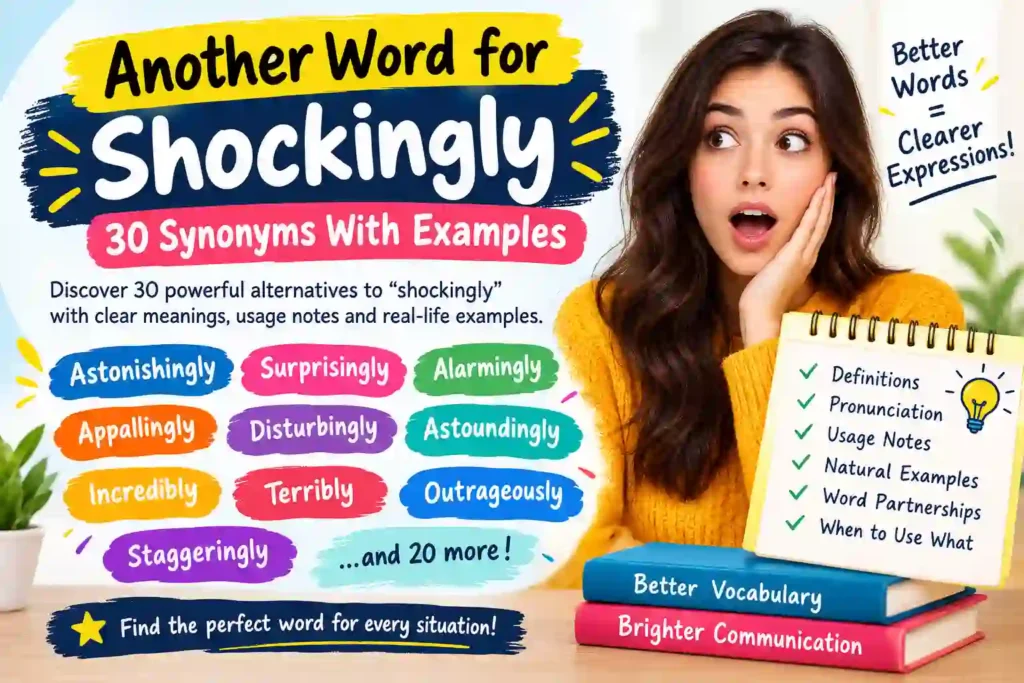
Another word for shockingly is usually surprisingly, astonishingly, or incredibly. These work when the point is that something is unexpected or extreme. When shockingly means that something is horrible or offensive, use appallingly, outrageously, or horrifically. In British English, shockingly can also just mean very badly, as in shockingly bad, where terribly or dreadfully fit.
The best alternative depends on which meaning you intend. Shockingly can mean in a way that causes horror or outrage, to a surprising degree, very badly, or in an improper way. Each meaning has different best matches.
Quick list: surprisingly, astonishingly, amazingly, incredibly, unbelievably, extremely, appallingly, outrageously, terribly, startlingly
This article looks at 30 alternatives. Each one has a meaning, IPA, usage note, and example, and the words are grouped by context so you can find the right one quickly.
At a Glance: Shockingly Synonyms and Related Alternatives
| Alternative | Part of Speech | Meaning | Register / Tone | Ideal Context |
| Surprisingly | Adverb | In a way that is unexpected | Neutral | Everyday speech and writing |
| Astonishingly | Adverb | To a very surprising degree | Neutral to formal | News, storytelling |
| Amazingly | Adverb | In a way that causes wonder or surprise | Neutral, often positive | Casual and general writing |
| Incredibly | Adverb | To an extreme or hard-to-believe degree | Neutral, informal | Emphasis, conversation |
| Extremely | Adverb | To a very high degree | Neutral | Plain emphasis, no surprise implied |
| Startlingly | Adverb | In a sudden, surprising way | Neutral to formal | Contrasts, sharp changes |
| Unexpectedly | Adverb | Without being expected | Neutral | Events, results |
| Appallingly | Adverb | In a way that causes horror or disgust | Strong, formal to neutral | Bad conditions, behavior |
| Outrageously | Adverb | In a way that is shocking and unacceptable | Strong, emotional | Prices, rudeness, injustice |
| Terribly | Adverb | Very badly, or to a very bad degree | Neutral, common in British English | Poor quality or performance |
Which Word Should You Use?
| If you want to… | Use | Why |
| Say something was unexpected | Surprisingly | It is the plainest and most neutral choice. |
| Add strong emphasis without a negative tone | Incredibly | It means extremely and can be positive or negative. |
| Describe something morally horrible | Appallingly | It carries disgust and moral judgment. |
| Complain about a price or unfair treatment | Outrageously | It signals anger about something unacceptable. |
| Say something was very poor in quality | Terribly | It fits shockingly bad in everyday speech. |
| Write about a sharp, sudden contrast | Startlingly | It suggests a jolt of surprise. |
| Sound formal or literary | Astoundingly | It is stronger and more formal than amazingly. |
| Be neutral with no emotion | Extremely | It adds degree only, with no shock or judgment. |
Exploring the Multiple Meanings of Shockingly
1. In a Way That Causes Shock or Horror
- Meaning: In a way that causes strong surprise, horror, or disgust.
- Explanation: This is the core sense, matching the dictionary meaning in a shocking manner. It describes events or actions that upset people.
- Example: The report described the conditions as shockingly cruel.
2. To a Surprising Degree
- Meaning: To an extent that is unexpected or hard to believe.
- Explanation: Here shockingly works as an intensifier that stresses surprise rather than horror. It can be used for good things too.
- Example: The test was shockingly easy.
3. As a Sentence Adverb Meaning Surprisingly
- Meaning: Used at the start or middle of a sentence to show that a fact is surprising.
- Explanation: It comments on the whole statement and is usually set off by commas.
- Example: Shockingly, the underdog team won by twenty points.
4. Very Badly (Informal, Especially British)
- Meaning: To a very poor or unacceptable standard.
- Explanation: It is often paired with bad or poor. The idea is that the quality is so low that it is almost offensive.
- Example: The trains were running shockingly late all week.
5. In an Improper or Offensive Way
- Meaning: In a way that breaks accepted standards of manners or morals.
- Explanation: This sense is older and more formal. It relates to the early meaning of shocking as offensive.
- Example: He behaved shockingly toward the guests.
Sources: Merriam-Webster (shockingly, shocking); Collins Dictionary; Dictionary.com; Online Etymology Dictionary (shocking).
Analyzing 30 Shockingly Alternatives in Detail
Some of these words are close synonyms of shockingly, while others fit only one of its meanings. Usage notes say which is which.
Group 1: Everyday Surprise Words
1. Surprisingly
IPA: US /sərˈpraɪzɪŋli/ · UK /səˈpraɪzɪŋli/
Definition: In a way that is unexpected.
- Usage: This is the closest everyday synonym for the unexpected sense. It is weaker than shockingly because it carries no horror.
- Example: The soup was surprisingly good.
2. Astonishingly
IPA: US /əˈstɑːnɪʃɪŋli/ · UK /əˈstɒnɪʃɪŋli/
Definition: In a way that causes great surprise.
- Usage: A strong synonym for the surprise sense. It is a little more formal than amazingly.
- Example: Astonishingly, nobody was hurt in the crash.
3. Amazingly
IPA: (US and UK) /əˈmeɪzɪŋli/
Definition: In a way that causes wonder or great surprise.
- Usage: It often has a positive tone. Use it when the surprise is pleasant, not upsetting.
- Example: Amazingly, she finished the race with a broken toe.
4. Incredibly
IPA: (US and UK) /ɪnˈkrɛdəbli/
Definition: To an extreme degree, or in a way that is hard to believe.
- Usage: This is a general intensifier. It matches the to a surprising degree sense but adds no shock or judgment.
- Example: The view was incredibly beautiful.
5. Unbelievably
IPA: (US and UK) /ˌʌnbɪˈliːvəbli/
Definition: To a degree that is hard to believe.
- Usage: A close synonym in informal speech. It can be positive or negative.
- Example: The line moved unbelievably slowly.
6. Remarkably
IPA: US /rɪˈmɑːrkəbli/ · UK /rɪˈmɑːkəbli/
Definition: In a way that is worth noticing because it is unusual.
- Usage: A related alternative, not an exact synonym. It suggests admiration or interest rather than shock.
- Example: The old bridge survived the flood remarkably well.
Group 2: Strong Intensifiers
7. Extremely
IPA: (US and UK) /ɪkˈstriːmli/
Definition: To a very high degree.
- Usage: A neutral intensifier. It matches the degree sense of shockingly but carries no surprise.
- Example: The water was extremely cold.
8. Exceptionally
IPA: (US and UK) /ɪkˈsɛpʃənəli/
Definition: To an unusually high degree.
- Usage: Usually positive and somewhat formal. It is a related alternative that suggests rare quality.
- Example: She is exceptionally talented.
9. Extraordinarily
IPA: US /ɪkˌstrɔːrdnˈɛrəli/ · UK /ɪkˈstrɔːdnrəli/
Definition: In a way that goes far beyond what is usual.
- Usage: More formal than incredibly. It suits writing where you want to stress that something is out of the ordinary.
- Example: The task was extraordinarily difficult.
10. Staggeringly
IPA: (US and UK) /ˈstæɡərɪŋli/
Definition: In a way that is so large or surprising that it is hard to take in.
- Usage: Often used with numbers, sizes, or costs. It is a close match for the surprise-by-scale sense.
- Example: The company lost a staggeringly large sum of money.
11. Startlingly
IPA: US /ˈstɑːrtlɪŋli/ · UK /ˈstɑːtlɪŋli/
Definition: In a way that gives a sudden shock of surprise.
- Usage: It suggests a jolt, often from a sharp contrast. It is close to shockingly in the surprise sense.
- Example: The two twins were startlingly different in character.
12. Strikingly
IPA: (US and UK) /ˈstraɪkɪŋli/
Definition: In a way that strongly attracts attention.
- Usage: A related alternative. It stresses that something is easy to notice, not that it is upsetting.
- Example: The two reports were strikingly similar.
Group 3: Horror, Disgust, and Outrage
13. Appallingly
IPA: (US and UK) /əˈpɔːlɪŋli/
Definition: In a way that causes horror, shock, or disgust.
- Usage: One of the closest matches for the horror sense. It is stronger than terribly and often implies moral judgment.
- Example: The prisoners were treated appallingly.
14. Horrifically
IPA: US /hɔːˈrɪfɪkli/ · UK /hɒˈrɪfɪkli/
Definition: In a way that causes horror.
- Usage: Used for violence, injury, or disasters. It is stronger and darker than shockingly.
- Example: The building was horrifically damaged in the fire.
15. Outrageously
IPA: (US and UK) /aʊtˈreɪdʒəsli/
Definition: In a way that is shocking and unacceptable.
- Usage: It shows anger. It fits unfair prices, rude behavior, or unjust rules. It can also be used playfully, as in outrageously funny.
- Example: The hotel charged outrageously high prices.
16. Disturbingly
IPA: US /dɪˈstɜːrbɪŋli/ · UK /dɪˈstɜːbɪŋli/
Definition: In a way that causes worry or unease.
- Usage: Milder than appallingly. It suits unsettling facts or trends.
- Example: The numbers were disturbingly high.
17. Scandalously
IPA: (US and UK) /ˈskændələsli/
Definition: In a way that is shocking because it is morally wrong.
- Usage: Used for public wrongdoing or unfairness. It is slightly formal.
- Example: The workers were scandalously underpaid.
18. Atrociously
IPA: US /əˈtroʊʃəsli/ · UK /əˈtrəʊʃəsli/
Definition: In an extremely bad or cruel way.
- Usage: In literal use it is very strong. In casual speech it can simply mean very badly, as in atrociously bad spelling.
- Example: The team played atrociously in the first half.
Group 4: Very Badly or Poor Quality
19. Dreadfully
IPA: (US and UK) /ˈdrɛdfəli/
Definition: In a very bad way, or to a very high degree.
- Usage: Common in British English. It matches the very badly sense of shockingly.
- Example: The weather was dreadfully cold.
20. Terribly
IPA: (US and UK) /ˈtɛrəbli/
Definition: Very badly, or to a very great degree.
- Usage: An everyday word for the very badly sense. In casual use it can also be a plain intensifier (terribly sorry).
- Example: The meeting went terribly.
21. Awfully
IPA: (US and UK) /ˈɔːfəli/
Definition: Very badly, or very much.
- Usage: Informal. It often works as a soft intensifier, especially in British English (awfully kind), so it is weaker than shockingly.
- Example: The room was awfully quiet.
22. Abysmally
IPA: (US and UK) /əˈbɪzməli/
Definition: In an extremely bad way.
- Usage: Used for poor performance or results. It is a strong choice for shockingly bad.
- Example: The students performed abysmally on the exam.
23. Woefully
IPA: US /ˈwoʊfəli/ · UK /ˈwəʊfəli/
Definition: To a sadly or disappointingly bad degree.
- Usage: Often paired with words like inadequate or unprepared. It adds a tone of disappointment.
- Example: The city was woefully unprepared for the storm.
24. Disgracefully
IPA: (US and UK) /dɪsˈɡreɪsfəli/
Definition: In a way that brings shame.
- Usage: It fits the improper or offensive sense. It judges behavior as shameful.
- Example: The crowd behaved disgracefully after the match.
Group 5: Formal, Literary, and Contrast-Based Alternatives
25. Astoundingly
IPA: (US and UK) /əˈstaʊndɪŋli/
Definition: In a way that is extremely surprising.
- Usage: A formal, strong alternative for the surprise sense.
- Example: The old photograph was astoundingly clear.
26. Stunningly
IPA: (US and UK) /ˈstʌnɪŋli/
Definition: In a way that is extremely impressive or surprising.
- Usage: Often positive, as in stunningly beautiful. It matches shockingly only when the surprise is what you want to stress.
- Example: The results were stunningly good.
27. Unexpectedly
IPA: (US and UK) /ˌʌnɪkˈspɛktɪdli/
Definition: In a way that was not expected.
- Usage: A plain, neutral synonym for the surprise sense. It says nothing about how strong the reaction is.
- Example: The shop closed unexpectedly.
28. Unusually
IPA: (US and UK) /ʌnˈjuːʒuəli/
Definition: In a way that is not typical.
- Usage: A related alternative, not an exact synonym. It points to something outside the norm without any shock.
- Example: The lake was unusually calm that morning.
29. Jarringly
IPA: (US and UK) /ˈdʒɑːrɪŋli/
Definition: In a way that clashes strongly or feels sharply out of place.
- Usage: A related alternative for sharp contrast. It does not mean very or horrifying on its own.
- Example: The cheerful music was jarringly out of place in the sad scene.
30. Alarmingly
IPA: US /əˈlɑːrmɪŋli/ · UK /əˈlɑːmɪŋli/
Definition: In a way that causes worry or fear.
- Usage: A good fit when the surprising fact is also a warning. It is milder than appallingly.
- Example: The river was rising alarmingly fast.
Sources: Merriam-Webster (entries and thesaurus for the listed words); Collins Dictionary and Collins Thesaurus; Dictionary.com; Cambridge Dictionary for pronunciation checks.
Shockingly vs. Surprisingly vs. Appallingly
These three words are often confused. The main difference is the feeling that comes with the surprise.
| Word | Main feeling | Can it describe something good? | Example |
| Surprisingly | Mild surprise | Yes | The trip was surprisingly cheap. |
| Shockingly | Strong surprise, often upset | Yes, but it sounds dramatic | The movie was shockingly good. |
| Appallingly | Horror or disgust | No | The factory was appallingly dirty. |
Shockingly sits in the middle. It is stronger than surprisingly but does not always carry the moral disgust of appallingly. When you describe something good, it sounds more dramatic than surprisingly, so use it sparingly.
Sources: Merriam-Webster; Collins Dictionary; Dictionary.com.
Shockingly and Opposite/Paired Word Pairs
| Word | Paired Word | Note |
| Shockingly | Unsurprisingly | The clearest contrast. Both can open a sentence. |
| Shockingly | Predictably | Describes results that anyone could have expected. |
| Shockingly | Mildly | Contrasts a strong reaction with a gentle one. |
| Shockingly | Calmly | Contrasts a shocking manner with a quiet one. |
| Shockingly bad | Remarkably good | Contrast of quality, not a strict antonym. |
Shockingly has no single perfect opposite, because the word works in several ways. For the surprise sense, unsurprisingly is the nearest contrast. For the degree sense, words like slightly or mildly work better.
Sources: Merriam-Webster Thesaurus; Collins Thesaurus.
Common Word Partners of Shockingly
| Pattern | Common Partners | Example |
| shockingly + adjective (quality) | bad, poor, good, cheap | The service was shockingly poor. |
| shockingly + adjective (difficulty) | easy, simple, hard | The puzzle was shockingly simple. |
| shockingly + adjective (degree) | high, low, large, small | Prices are shockingly high. |
| shockingly + adjective (behavior) | rude, cruel, brutal | He was shockingly rude to the staff. |
| shockingly + adverb | quickly, slowly, little | She learned the language shockingly quickly. |
| Sentence opener | Shockingly, + comma | Shockingly, the vote was tied. |
These patterns reflect how the word is typically used with common adjectives and adverbs.
Sources: Collins Dictionary (example sentences); Merriam-Webster.
Idiomatic Phrases Featuring Shockingly
Shockingly itself does not appear in any widely recognized idiom. The expressions below belong to the same word family and are established phrases built on shock or shocking.
1. Shocking Pink
- Meaning: A very bright, strong pink. Etymonline notes that the color name was introduced in February 1937 by the designer Elsa Schiaparelli.
- Example: She wore a shocking pink scarf to the party.
2. Shock and Awe
- Meaning: An overwhelming display of power or force meant to stun an opponent. In general use it describes any very dramatic impact.
- Example: The company’s new product launch was pure shock and awe.
3. Come as a Shock
- Meaning: To be a sudden, unpleasant surprise.
- Example: The news of the closure came as a shock to the staff.
4. Shock Horror
- Meaning: A humorous British phrase that mocks dramatic news headlines. It is used when something is not really surprising.
- Example: Shock horror: the bus was late again.
Sources: Online Etymology Dictionary (shocking); Merriam-Webster; Collins Dictionary; Cambridge Dictionary.
Word Formation of Shockingly
Etymology & Structure
Shockingly is built from three parts: the verb shock, the ending -ing (which makes the adjective shocking), and the ending -ly (which makes the adverb). Etymonline explains that shocking is the present-participle adjective of the verb shock.
Date and History
According to Etymonline, shocking appears in the 1690s with the meaning offensive, giving offense. By 1704 it was used in a stronger sense, causing a jolt of indignation, horror, and by 1798 it could mean deplorably bad. The verb shock meaning to offend or strike with horror dates to the 1650s. Etymonline lists shockingly as a related form but does not give its own date.
Word Class Variations
- Verb: shock (to shock someone)
- Noun: shock; shocker
- Adjective: shocking; shocked
- Adverb: shockingly
- Related noun: shockingness (listed in Merriam-Webster as a nearby entry)
Sources: Online Etymology Dictionary: shocking; Merriam-Webster: shockingly.
Common Word-Choice Mistakes
- Shockingly good news for ordinary pleasant news: use surprisingly good or wonderful.
- Appallingly happy: appallingly needs a negative idea; use incredibly happy.
- Shockingly as a neutral word for very: use extremely when there is no surprise.
- The shockingly man: shockingly is an adverb; use shocking before a noun.
- I was shockingly by the news: use shocked for the feeling and shockingly for the manner.
- Astounding fast: the adverb is needed, so write astoundingly fast.
- Surprisingly and unexpectedly as exact twins: unexpectedly describes timing or events, while surprisingly comments on facts.
Frequently Asked Questions
1. What is the closest synonym for shockingly?
Surprisingly is the closest everyday synonym for the common sense. For the horror sense, appallingly is closest.
2. What is a formal alternative to shockingly?
Astoundingly, extraordinarily, and scandalously suit formal writing, depending on the meaning.
3. What is the difference between shockingly and surprisingly?
Shockingly is stronger and often suggests upset or disbelief. Surprisingly simply means unexpected.
4. Can shockingly describe something good?
Yes. Shockingly good is common, but the word sounds dramatic, so it works best when the surprise is large.
5. What is the opposite of shockingly?
Unsurprisingly is the nearest opposite for the surprise meaning. For the degree meaning, slightly or mildly contrast with it.
6. What does shockingly bad mean?
It means extremely bad, in a way that is hard to accept. In British English it is often just a strong way to say very poor.
7. What is a stronger word than shockingly?
Appallingly and horrifically are stronger when horror or disgust is involved.
8. Is shockingly an adverb?
Yes. Merriam-Webster lists it as an adverb meaning in a shocking manner.
9. When should I use outrageously instead of shockingly?
Use outrageously when you want to show anger or say that something is unacceptable, such as prices or rude behavior.
10. Can I start a sentence with shockingly?
Yes. Use a comma after it: Shockingly, the plan worked.
Conclusion
The closest everyday alternatives to shockingly are surprisingly, astonishingly, and incredibly. For horror or outrage, appallingly, outrageously, and horrifically fit better. For very badly, try terribly, dreadfully, or abysmally.
Context matters because shockingly has several meanings: horror, surprise, a high degree, and poor quality. A word that fits one meaning can be wrong for another. Appallingly cannot describe something pleasant, and extremely cannot show surprise.

Hi, I’m HAROON ,founder of LifeLoomer.com, I started LifeLoomer with one belief: the internet is full of answers, but not enough understanding. So I write guides that actually explain things the meanings behind everyday words, the small habits that make life better, and the how-tos nobody taught us.
Everything I publish is researched, written in plain words, and tested against one question: will this genuinely help someone today?
Thanks for being here. I hope you leave a little wiser than you came.